Calculus I: differentiation
🎯What you need to be able to do
- Understand the derivative as a gradient function, and use \( f'(x) \), \( f''(x) \), \( \dfrac{dy}{dx} \) and \( \dfrac{d^{2}y}{dx^{2}} \).
- Differentiate \( x^{n} \) (any rational \(n\)), \( \sin x \), \( \cos x \), \( \tan x \), \( e^{x} \) and \( \ln x \), with constant multiples, sums and the chain rule.
- Differentiate products and quotients.
- Find equations of tangents and normals.
- Find stationary points and decide whether each is a maximum or a minimum, with full justification.
- Use connected rates of change and small increments, and solve practical maximum and minimum problems.
📚The mathematics
What a derivative is
\( \dfrac{dy}{dx} \) is the gradient of the curve \( y = f(x) \) at each point, written as a function of \(x\). Only an informal idea of a limit is expected, and differentiation from first principles is not required. \( \dfrac{d^{2}y}{dx^{2}} \) (or \( f''(x) \)) is the derivative of the derivative: the rate at which the gradient is changing.
The standard results
None of these are in the List of formulas. Angles in calculus are always in radians. Rewrite roots and fractions as powers before differentiating: \( \dfrac{6}{x^{2}} = 6x^{-2} \) and \( 2\sqrt{x} = 2x^{\frac{1}{2}} \).
Chain, product and quotient rules
The chain rule gives patterns worth knowing by sight:
Simplify before differentiating when you can: \( \ln\left[(3x + 1)^{4}\right] = 4\ln(3x + 1) \), whose derivative is \( \dfrac{12}{3x + 1} \).
Tangents and normals
At \( x = a \): find the point \( (a, f(a)) \) and the gradient \( m = f'(a) \). The tangent is \( y - f(a) = m(x - a) \); the normal is perpendicular to it, with gradient \( -\dfrac{1}{m} \).
Stationary points and their nature
Stationary points are where \( \dfrac{dy}{dx} = 0 \). To decide which kind:
- Second derivative test: \( \dfrac{d^{2}y}{dx^{2}} < 0 \) ⇒ maximum; \( \dfrac{d^{2}y}{dx^{2}} > 0 \) ⇒ minimum. (If it is 0, the test is inconclusive — use the first derivative test.)
- First derivative test: check the sign of \( \dfrac{dy}{dx} \) just either side. \( + \) then \( - \) is a maximum; \( - \) then \( + \) is a minimum.
The syllabus says full justification is expected: quote the value (or sign) of the second derivative and state the conclusion. “Maximum” on its own scores nothing. Points of inflexion are not examined.
Rates of change and small increments
Connected rates of change use the chain rule with time:
Write down the rate you are given and the rate you want, and find the derivative that links them. Small increments use the gradient as a multiplier: if \(x\) changes by a small amount \( \delta x \) (often written \(h\) or \(p\)), then \( \delta y \approx \dfrac{dy}{dx}\,\delta x \).
Practical maximum and minimum problems
- Write the quantity to be optimised in terms of one variable, using the constraint to eliminate the other (this is usually a “show that” part).
- Differentiate, set equal to zero, solve.
- Justify maximum or minimum, then answer the question that was actually asked (the area, the cost…).
✏️Worked example 1 (no calculator)
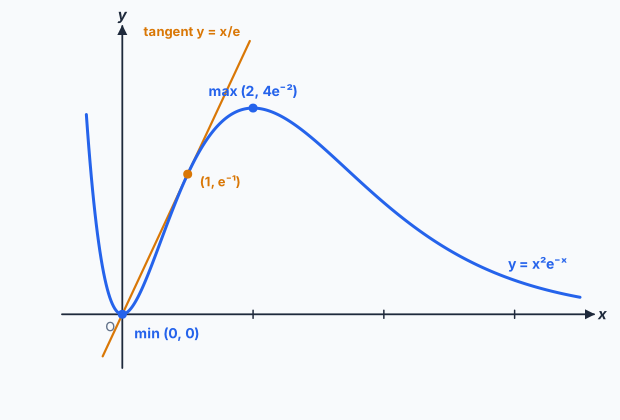
(a) Product rule with \( u = x^{2} \), \( v = e^{-x} \):
\( e^{-x} > 0 \) always, so \( \dfrac{dy}{dx} = 0 \) when \( x = 0 \) or \( x = 2 \). Stationary points \( (0, 0) \) and \( (2, 4e^{-2}) \).
(b) Differentiate \( (2x - x^{2})e^{-x} \) again: \( \dfrac{d^{2}y}{dx^{2}} = (2 - 2x)e^{-x} - (2x - x^{2})e^{-x} = (x^{2} - 4x + 2)e^{-x} \). At \( x = 0 \): \( 2 > 0 \), so \( (0, 0) \) is a minimum. At \( x = 2 \): \( (4 - 8 + 2)e^{-2} = -2e^{-2} < 0 \), so \( (2, 4e^{-2}) \) is a maximum.
(c) At \( x = 1 \): \( y = e^{-1} \) and \( \dfrac{dy}{dx} = 1(1)e^{-1} = e^{-1} \). Tangent: \( y - \tfrac{1}{e} = \tfrac{1}{e}(x - 1) \), which simplifies to \( y = \dfrac{x}{e} \).
✏️Worked example 2 (no calculator)
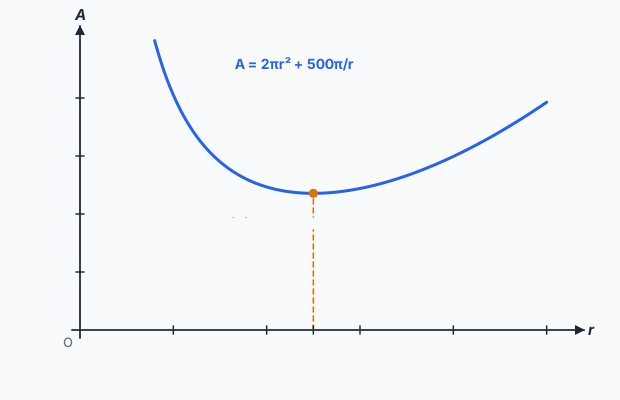
(a) \( \pi r^{2}h = 250\pi \Rightarrow h = \dfrac{250}{r^{2}} \). Then \( A = 2\pi r^{2} + 2\pi rh = 2\pi r^{2} + 2\pi r \cdot \dfrac{250}{r^{2}} = 2\pi r^{2} + \dfrac{500\pi}{r} \).
(b) \( \dfrac{dA}{dr} = 4\pi r - \dfrac{500\pi}{r^{2}} = 0 \Rightarrow r^{3} = 125 \Rightarrow r = 5 \). \( \dfrac{d^{2}A}{dr^{2}} = 4\pi + \dfrac{1000\pi}{r^{3}} = 12\pi > 0 \) at \( r = 5 \), so this is a minimum. Least area \( = 2\pi(25) + \dfrac{500\pi}{5} = 150\pi \) cm².
📝Practise
Written in the style of the current Paper 1 (no calculator) and Paper 2 (calculator) questions.
1. (No calculator.) Differentiate with respect to \(x\): (a) \( 4x^{3} - \dfrac{6}{x^{2}} + 2\sqrt{x} \), (b) \( (3x^{2} + 4)^{5} \), (c) \( x^{2}\sin 3x \). [6]
2. (No calculator.) Given \( y = \dfrac{e^{2x}}{x + 1} \), show that \( \dfrac{dy}{dx} = \dfrac{(2x + 1)e^{2x}}{(x + 1)^{2}} \), and find the \(x\)-coordinate of the stationary point. [4]
3. (No calculator.) Find the equation of the normal to \( y = \ln(3x - 5) \) at the point where \( x = 2 \), and the coordinates of the point where it meets the \(y\)-axis. [5]
4. (No calculator.) Find the coordinates of the stationary points of \( y = x^{3} - 6x^{2} + 9x + 1 \) and determine their nature. [6]
5. (No calculator.) A farmer has 120 m of fencing to enclose a rectangular field against a straight river; no fence is needed along the river. Find the greatest possible area. [5]
6. (No calculator.) \( y = x\ln x \). Use differentiation to find the approximate change in \(y\) as \(x\) increases from \(e\) to \( e + h \), where \(h\) is small. [3]
7. (Calculator.) The volume of a sphere is increasing at a constant rate of 20 cm³ s−1. Find the rate at which the radius is increasing when the radius is 5 cm. [3]
8. (Calculator.) Given \( y = e^{\sin 2x} \), find \( \dfrac{dy}{dx} \), and its value when \( x = 0.3 \). [3]
🔗Go deeper — other people’s work
These are external resources, not mine. If one stops working, tell me and everything above it on this page still stands.
- Desmos — plot a function and its derivative together; the derivative crosses zero at every stationary point
- Cambridge 0606 examiner reports — unjustified “maximum” answers are a regular comment