Permutations and combinations
🎯What you need to be able to do
- Tell whether a problem is about arrangement (order matters) or selection (order does not).
- Use \( n! \), \( {}^{n}P_{r} \) and \( {}^{n}C_{r} \), including \( 0! = 1 \).
- Count arrangements with restrictions: items together, apart, or in fixed positions; numbers with digit conditions.
- Count selections with conditions such as “at least one”, “exactly two” or “not both”.
- Solve algebraic problems involving \( {}^{n}P_{r} \) and \( {}^{n}C_{r} \).
📚The mathematics
Order matters, or it does not
\( {}^{n}P_{r} \) counts ordered arrangements of \(r\) items chosen from \(n\) different ones; \( {}^{n}C_{r} \) counts unordered selections. Each selection of \(r\) items can be arranged in \( r! \) ways, which is why \( {}^{n}P_{r} = r! \times {}^{n}C_{r} \). A team, committee, group or hand is a selection; a queue, number, code, word or seating is an arrangement.
The syllabus leaves out three things: repeated objects (such as the letters of BANANA), arrangements in a circle, and problems that need both a selection and an arrangement. You will only meet distinct objects in a line, or selections.
Arrangements with restrictions
- Fixed positions first. Fill the restricted places, then arrange the rest. A “slot diagram” of boxes makes this visible.
- Together. Glue the items into one block, arrange the blocks, then multiply by the arrangements inside the block.
- Not together (all of them): total minus “together”.
- Numbers. Deal with the digit that has a condition (first digit not 0, last digit even, first digit at least 5) before the others. If two conditions compete for the same digit, split into cases.
Selections with conditions
Split the selection by type and multiply within each case, then add the cases: choosing 2 women from 5 and 2 men from 7 is \( {}^{5}C_{2} \times {}^{7}C_{2} \). “At least one” is usually quickest as total minus none. “Two particular people not both chosen” is total minus the selections that contain both.
✏️Worked example
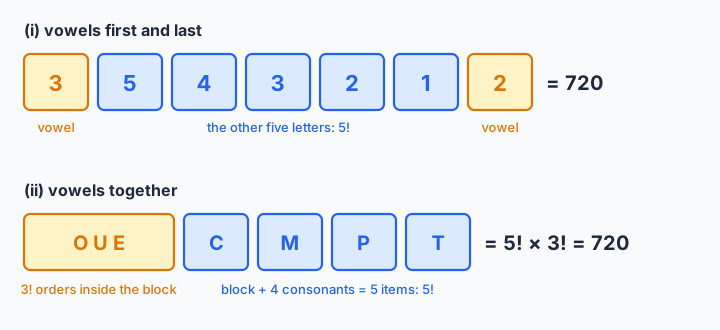
(a)(i) The vowels are O, U, E. Choose the first letter (3 ways) and the last (2 ways), then arrange the other five letters: \( 3 \times 2 \times 5! = 720 \).
(ii) One vowel block plus C, M, P, T is 5 items: \( 5! \) ways. The vowels inside the block: \( 3! \) ways. Total \( 5! \times 3! = 720 \).
(iii) All arrangements minus those with the vowels together: \( 7! - 720 = 5040 - 720 = 4320 \).
(b) Total teams \( {}^{10}C_{5} = 252 \). Remove those with fewer than 2 girls: no girls, \( {}^{6}C_{5} = 6 \); one girl, \( {}^{4}C_{1} \times {}^{6}C_{4} = 4 \times 15 = 60 \). So \( 252 - 6 - 60 = 186 \).
📝Practise
Counting questions appear on both papers; none of these needs a calculator.
1. Evaluate \( {}^{8}P_{3} \) and \( {}^{8}C_{3} \). [2]
2. Find \(n\) given that \( {}^{n}C_{2} = 45 \). [3]
3. Four-digit numbers are formed from the digits 1, 2, 3, 4, 5, 6, 7; no digit is used more than once. Find how many (a) can be formed, (b) are even, (c) are greater than 5000 and even. [6]
4. Three different maths books and three different science books are placed on a shelf. Find the number of arrangements in which (a) the maths books are together, (b) the subjects alternate. [4]
5. A committee of 4 is chosen from 7 men and 5 women. Find the number of committees with (a) exactly 2 women, (b) at least one woman. [4]
6. Five people are chosen from a group of 9, which includes Ana and Budi. Find the number of groups that do not contain both Ana and Budi. [3]
7. Find the value of \(n\) for which \( {}^{n}P_{3} = 6 \times {}^{n}C_{2} \). [3]
🔗Go deeper — other people’s work
These are external resources, not mine. If one stops working, tell me and everything above it on this page still stands.
- Your calculator’s nPr and nCr keys — use them to check Paper 1 answers during revision
- Khan Academy — permutations and combinations, with many short practice sets