Simultaneous equations
🎯What you need to be able to do
- Solve a linear and a non-linear equation simultaneously by substitution.
- Pair each \(x\) with its own \(y\), and present the solutions as coordinate pairs.
- Solve systems where elimination is quicker, for example by dividing one equation by the other.
- Interpret the solutions as the points where a line meets a curve, and use them (lengths, midpoints).
📚The mathematics
Substitution from the linear equation
Make \(x\) or \(y\) the subject of the linear equation, choosing whichever avoids fractions, and substitute into the other one. You get a quadratic in one variable. Solve it, then find the other variable by substituting back into the linear equation.
Why the linear one? Each \(x\) value gives exactly one \(y\) from a straight line. Substituting back into a quadratic can give two \(y\) values for each \(x\), and pairs that are not solutions at all.
Other shapes you will meet
- Products. \( xy = 6 \) and \( 2x + y = 7 \): substitute \( y = 7 - 2x \) into \( xy = 6 \).
- Dividing equations. \( xy^{2} = 12 \) and \( xy = 3 \): neither is linear, but dividing the first by the second gives \( y = 4 \) at once (allowed because \( xy \ne 0 \)).
- Indices. \( 2^{x} \times 4^{y} = 32 \) becomes \( 2^{x + 2y} = 2^{5} \), so \( x + 2y = 5 \): write every term as a power of the same base, then equate the powers.
The number of solutions is the number of intersection points, which the discriminant of the final quadratic predicts (Topic 2): no real roots means the line misses the curve.
✏️Worked example
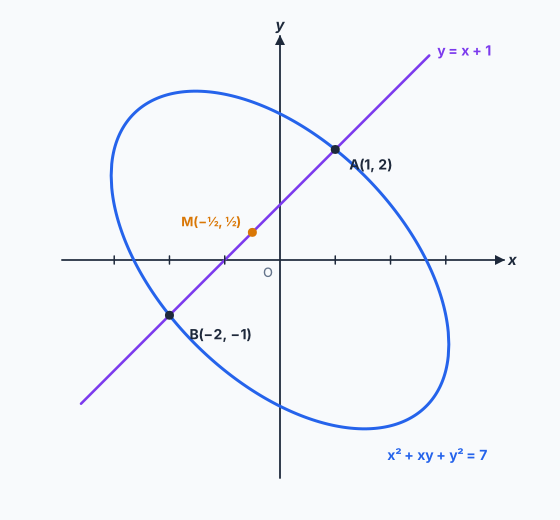
(a) Substitute \( y = x + 1 \):
so \( (x + 2)(x - 1) = 0 \) and \( x = 1 \) or \( x = -2 \). From the line, \( x = 1 \Rightarrow y = 2 \) and \( x = -2 \Rightarrow y = -1 \). So \( A(1, 2) \) and \( B(-2, -1) \).
(b) \( AB = \sqrt{(1 - (-2))^{2} + (2 - (-1))^{2}} = \sqrt{9 + 9} = 3\sqrt{2} \). Midpoint: \( \left(\dfrac{1 + (-2)}{2}, \dfrac{2 + (-1)}{2}\right) = \left(-\tfrac{1}{2}, \tfrac{1}{2}\right) \).
📝Practise
Written in the style of the current Paper 1 (no calculator) and Paper 2 (calculator) questions.
1. (No calculator.) Solve the simultaneous equations \( x + 2y = 5 \) and \( x^{2} + y^{2} = 10 \). [5]
2. (No calculator.) Solve \( xy = 6 \) and \( 2x + y = 7 \). [4]
3. (No calculator.) Solve \( xy^{2} = 12 \) and \( xy = 3 \). [2]
4. (No calculator.) Show that the line \( y = 3 - x \) does not meet the curve \( x^{2} - 3xy + y^{2} + 11 = 0 \). [4]
5. (Calculator.) The line \( y = 2x + 3 \) meets the curve \( y = x^{2} - x - 1 \) at \(P\) and \(Q\). Find the length of \(PQ\). [5]
6. (No calculator.) Solve \( 2^{x} \times 4^{y} = 32 \) and \( \dfrac{3^{x}}{9^{y}} = \dfrac{1}{3} \). [4]
🔗Go deeper — other people’s work
These are external resources, not mine. If one stops working, tell me and everything above it on this page still stands.
- Desmos — type both equations to see the intersection points you should be finding
- Khan Academy — systems of non-linear equations