Calculus II: integration
🎯What you need to be able to do
- Understand integration as the reverse of differentiation, and include the arbitrary constant in indefinite integrals.
- Integrate sums of powers of \(x\), including \( \dfrac{1}{x} \) and \( \dfrac{1}{ax + b} \).
- Integrate \( (ax + b)^{n} \) for any rational \(n\), \( \sin(ax + b) \), \( \cos(ax + b) \), \( \sec^{2}(ax + b) \) and \( e^{ax + b} \).
- Find a curve from its gradient function and a point on it.
- Evaluate definite integrals, including “hence” questions that use a derivative found earlier.
- Find plane areas: under a curve, between a line and a curve, between two curves, and areas made of two parts.
📚The mathematics
Reverse differentiation
If \( \dfrac{d}{dx}F(x) = f(x) \), then \( \displaystyle\int f(x)\,dx = F(x) + c \). The constant matters: every curve \( y = F(x) + c \) has the same gradient function, and the syllabus says indefinite integrals must include it. To find which curve, substitute a known point to find \(c\).
The standard integrals
Every result on the second row, and the two with \( ax + b \) on the first, follow one rule: integrate as if the bracket were \(x\), then divide by \(a\). Check any answer by differentiating it. Angles are in radians. Products and quotients are not integrated directly at this level: expand or divide first, so \( \dfrac{x^{3} - 4}{x^{2}} = x - 4x^{-2} \).
Definite integrals and “hence” questions
\( \displaystyle\int_{a}^{b} f(x)\,dx = F(b) - F(a) \); the constant cancels, so leave it out. On Paper 1 the limits are chosen to give exact values: \( \tan\tfrac{\pi}{3} = \sqrt{3} \), \( \ln e = 1 \), \( e^{0} = 1 \).
A common 0606 structure is “(a) Differentiate \( F(x) \). (b) Hence find \( \int f(x)\,dx \)”. Part (a) gives \( F'(x) = \) something close to \( f(x) \); rearrange so that the integral you want is isolated, and integrate both sides.
Areas
- Under a curve (above the axis): \( \int_{a}^{b} y\,dx \).
- Below the axis the integral is negative. For a region that crosses the axis, integrate each part separately and add the sizes — the “sum of two areas” in the syllabus.
- Between two graphs: \( \int_{a}^{b} (\text{upper} - \text{lower})\,dx \), with \(a\) and \(b\) where they meet. This works whether or not the region is above the axis.
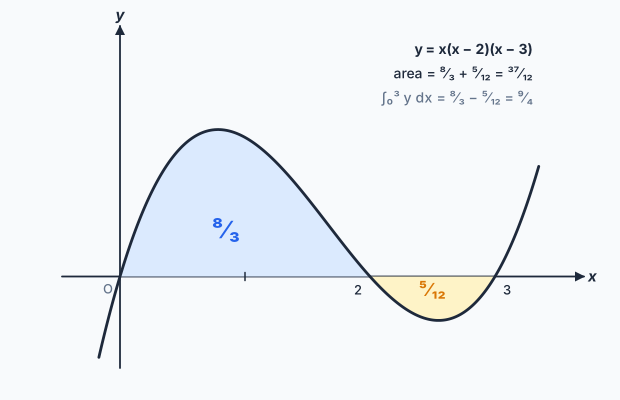
✏️Worked example 1 (no calculator)
(a) \( y = \displaystyle\int \left(6x^{2} - 2x^{-2}\right)dx = 2x^{3} + 2x^{-1} + c \). At \( (1, 5) \): \( 5 = 2 + 2 + c \), so \( c = 1 \) and \( y = 2x^{3} + \dfrac{2}{x} + 1 \).
(b)
(c) Product rule: \( \dfrac{d}{dx}(x\ln x) = \ln x + 1 \). Integrating both sides, \( x\ln x = \int \ln x\,dx + x \), so \( \int \ln x\,dx = x\ln x - x + c \). Then
✏️Worked example 2 (no calculator)
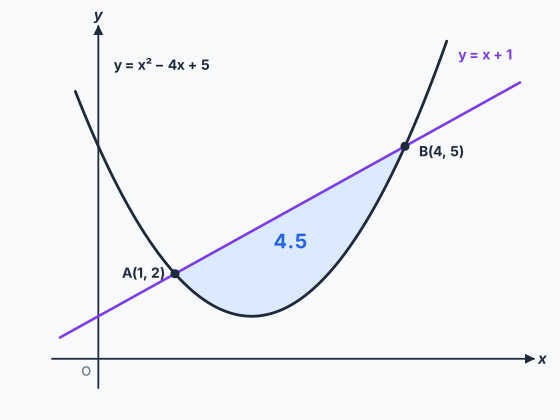
Intersections: \( x^{2} - 4x + 5 = x + 1 \Rightarrow x^{2} - 5x + 4 = 0 \Rightarrow x = 1, 4 \), so \( A(1, 2) \) and \( B(4, 5) \). Between them the line is above the curve (at \( x = 2 \): \( 3 > 1 \)):
📝Practise
Written in the style of the current Paper 1 (no calculator) and Paper 2 (calculator) questions.
1. (No calculator.) Find \( \displaystyle\int \left(3x^{2} - \frac{4}{x^{2}} + 2\sqrt{x}\right)dx \). [3]
2. (No calculator.) Find (a) \( \displaystyle\int (2x - 1)^{5}\,dx \), (b) \( \displaystyle\int \frac{6}{3x + 2}\,dx \), (c) \( \displaystyle\int e^{4x - 1}\,dx \). [5]
3. (No calculator.) Find the exact value of \( \displaystyle\int_{0}^{\pi/4} \sin 2x\,dx \). [2]
4. (No calculator.) Given that \( \displaystyle\int_{1}^{k} (2x - 1)\,dx = 12 \), where \( k > 1 \), find \(k\). [3]
5. (No calculator.) Show that \( \dfrac{d}{dx}\left(xe^{2x}\right) = (1 + 2x)e^{2x} \). Hence find \( \displaystyle\int xe^{2x}\,dx \). [5]
6. (Calculator.) Find the area of the region enclosed by the curve \( y = 6 - x^{2} \) and the line \( y = x \). [5]
7. (Calculator.) Find the total area between the curve \( y = 2\sin x \) and the \(x\)-axis for \( 0 \le x \le \tfrac{3\pi}{2} \). [4]
🔗Go deeper — other people’s work
These are external resources, not mine. If one stops working, tell me and everything above it on this page still stands.
- Desmos — type an integral with limits to check a Paper 1 answer numerically
- Khan Academy — definite integrals and the area between curves