Straight-line graphs
🎯What you need to be able to do
- Find and use the equation of a straight line in any form.
- Use the gradient conditions for parallel and perpendicular lines.
- Find midpoints and lengths, and the equation of a perpendicular bisector.
- Transform relationships such as \( y = Ax^{n} \) and \( y = Ab^{x} \) into straight-line form, and find the constants from the gradient and intercept.
- Go the other way: turn a given straight-line graph (for example \( y^{2} \) against \( x^{3} \)) back into an equation connecting \(x\) and \(y\).
📚The mathematics
The toolkit
Parallel lines have equal gradients. Perpendicular lines have gradients whose product is \(-1\): if one is \( m \), the other is \( -\dfrac{1}{m} \). To get the gradient of a line given as \( 2x - 5y = 7 \), rearrange to \( y = \tfrac{2}{5}x - \tfrac{7}{5} \) first.
The perpendicular bisector of \(AB\) passes through the midpoint of \(AB\) at right angles to it. Every point on it is the same distance from \(A\) as from \(B\) — which is why it turns up in circle questions (the centre of a circle through \(A\) and \(B\) lies on it).
Straight-line form: linearising a relationship
Experimental data often follow \( y = Ax^{n} \) or \( y = Ab^{x} \). Taking logs turns them into straight lines, and then the gradient and intercept give the constants:
The pattern is always \( Y = mX + c \): decide what \(Y\) and \(X\) are, then match. The same works in reverse: “\( e^{2y} \) plotted against \( x^{2} \) gives a straight line with gradient 4 and intercept 3” means \( e^{2y} = 4x^{2} + 3 \).
✏️Worked example 1 (no calculator)
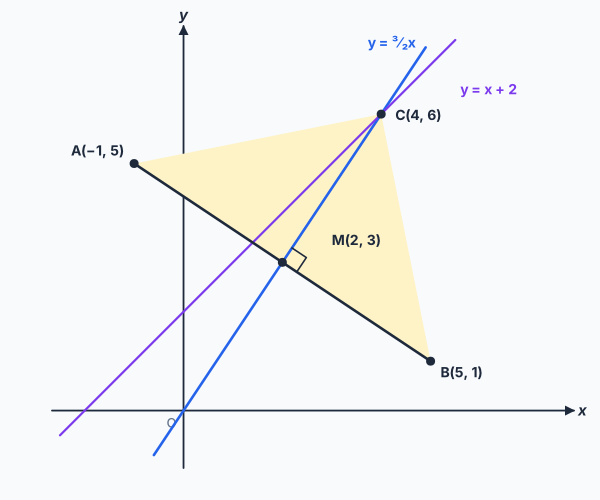
(a) Midpoint \( M = (2, 3) \). Gradient of \(AB\) \( = \dfrac{1 - 5}{5 - (-1)} = -\tfrac{2}{3} \), so the perpendicular gradient is \( \tfrac{3}{2} \). The bisector is \( y - 3 = \tfrac{3}{2}(x - 2) \), which simplifies to \( y = \tfrac{3}{2}x \) (or \( 3x - 2y = 0 \)).
(b) \( \tfrac{3}{2}x = x + 2 \Rightarrow x = 4 \), so \( C(4, 6) \). Because \(CM\) is perpendicular to \(AB\), it is the height of the triangle on base \(AB\):
✏️Worked example 2 (calculator)
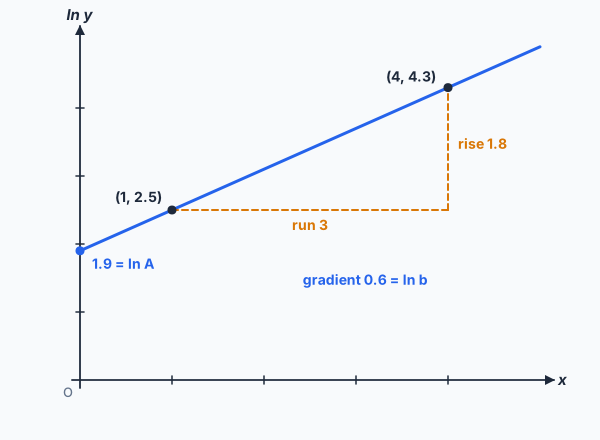
(a) \( \ln y = x\ln b + \ln A \). Gradient \( = \dfrac{4.3 - 2.5}{4 - 1} = 0.6 = \ln b \), so \( b = e^{0.6} = 1.82 \). Intercept: \( 2.5 = 0.6(1) + \ln A \), so \( \ln A = 1.9 \) and \( A = e^{1.9} = 6.69 \).
(b) \( \ln y = 1.9 + 0.6(2.5) = 3.4 \), so \( y = e^{3.4} = 30.0 \).
📝Practise
Written in the style of the current Paper 1 (no calculator) and Paper 2 (calculator) questions.
1. (No calculator.) Find the equation of the line through \( (3, -2) \) that is perpendicular to \( 2x - 5y = 7 \). Give your answer in the form \( ax + by = c \), where \(a\), \(b\) and \(c\) are integers. [3]
2. (No calculator.) The points \( A(2, 7) \) and \( B(k, 1) \) are such that \( AB = 10 \). Find the possible values of \(k\). [3]
3. (Calculator.) The variables satisfy \( y = Ax^{n} \). The graph of \( \lg y \) against \( \lg x \) is a straight line through \( (0.2, 1.1) \) and \( (0.8, 2.9) \). Find \(n\) and \(A\). [4]
4. (No calculator.) When \( y^{2} \) is plotted against \( x^{3} \), a straight line is obtained passing through \( (1, 5) \) and \( (3, 9) \). Find \( y^{2} \) in terms of \(x\). [3]
5. (No calculator.) The graph of \( e^{2y} \) against \( x^{2} \) is a straight line with gradient 4, passing through \( (2, 11) \). Find the exact value of \(y\) when \( x = 1 \). [4]
6. (Calculator.) The point \( P(6, 1) \) and the line \( L: y = 2x - 3 \). (a) Find the coordinates of the foot of the perpendicular from \(P\) to \(L\). (b) Hence find the shortest distance from \(P\) to \(L\). [5]
🔗Go deeper — other people’s work
These are external resources, not mine. If one stops working, tell me and everything above it on this page still stands.
- Desmos — plot \( \ln y \) against \(x\) for a small data set and fit a line, to see linearisation in action
- Cambridge 0606 examiner reports — the intercept-versus-constant confusion in linearisation is a recurring comment