Equations, inequalities and graphs
🎯What you need to be able to do
- Solve modulus equations such as \( |ax + b| = c \), \( |ax + b| = cx + d \), \( |ax + b| = |cx + d| \) and \( |ax^{2} + bx + c| = d \).
- Solve the matching modulus inequalities, graphically or algebraically.
- Spot a substitution that turns an equation into a quadratic (powers, logarithms, exponentials) and solve it.
- Sketch a cubic given as three linear factors, and its modulus, with the axis intercepts labelled.
- Solve cubic inequalities \( f(x) \ge d \) (and similar) from the graph.
📚The mathematics
Modulus equations
\( |X| = c \) (with \( c \ge 0 \)) means \( X = c \) or \( X = -c \). Every modulus equation is two ordinary equations; solve both.
- \( |ax + b| = cx + d \): solve \( ax + b = cx + d \) and \( ax + b = -(cx + d) \), then check each answer in the original. The right-hand side can be negative, and a modulus never is, so one of the two answers may be false.
- \( |ax + b| = |cx + d| \): both sides are non-negative, so squaring is safe: \( (ax + b)^{2} = (cx + d)^{2} \) gives a quadratic. (Or solve \( ax + b = \pm(cx + d) \).)
- \( |ax^{2} + bx + c| = d \): two quadratics, \( = d \) and \( = -d \). Either can have 0, 1 or 2 roots, so there can be up to four solutions. A sketch tells you how many to expect.
Modulus inequalities
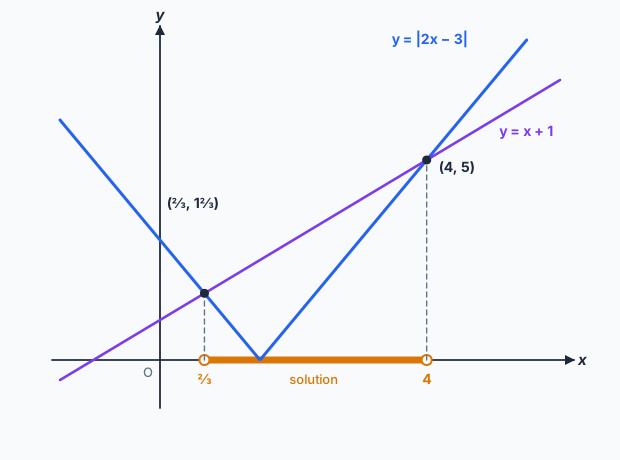
Graphically: sketch both sides, find where they meet (by algebra, not by reading the graph), and read off where one is above the other. Algebraically, two facts do most of the work:
Equations that are quadratics in disguise
If one term’s power is twice another’s, substitute \(u\) for the smaller one:
The syllabus says you are expected to find the substitution yourself. After solving for \(u\), undo it — and reject values it cannot take (\( e^{x} \) and \( 2^{x} \) are always positive).
Cubic graphs and their moduli
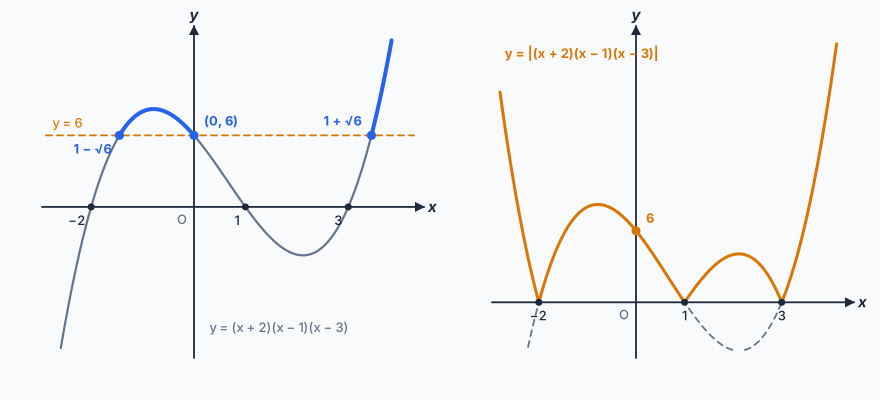
For \( y = k(x - a)(x - b)(x - c) \): it crosses the \(x\)-axis at \(a\), \(b\) and \(c\), the \(y\)-intercept is found by putting \( x = 0 \), and the ends go bottom-left to top-right if \( k > 0 \) (top-left to bottom-right if \( k < 0 \)). For a factor with a coefficient, such as \( 2x + 5 \), the root is \( -\tfrac{5}{2} \), and the leading coefficient is the product of the \(x\)-coefficients.
For \( y = |f(x)| \), reflect the parts below the axis upwards, exactly as in Topic 1. Label all the intercepts: that is what the marks are for.
Cubic inequalities
To solve \( f(x) \ge d \): find where \( f(x) = d \), draw \( y = d \) on the sketch, and read off where the curve is on or above it. Because a cubic can cross a horizontal line three times, the answer is usually two pieces — a bounded interval and a ray. In the figure, \( (x + 2)(x - 1)(x - 3) = 6 \) becomes \( x^{3} - 2x^{2} - 5x = 0 \), so \( x = 0 \) or \( x = 1 \pm \sqrt{6} \).
✏️Worked example
(a) Either \( 2x - 3 = x + 1 \), giving \( x = 4 \), or \( 2x - 3 = -(x + 1) \), giving \( 3x = 2 \) and \( x = \tfrac{2}{3} \). Check both: at \( x = 4 \), \( |5| = 5 \) ✓; at \( x = \tfrac{2}{3} \), \( \left|-\tfrac{5}{3}\right| = \tfrac{5}{3} \) ✓.
(b) From the graph, the V is below the line between the intersections: \( \tfrac{2}{3} < x < 4 \).
(c) Both sides are non-negative, so square:
Divide by 3: \( x^{2} + 4x - 5 \le 0 \), so \( (x + 5)(x - 1) \le 0 \), giving \( -5 \le x \le 1 \).
📝Practise
Written in the style of the current Paper 1 (no calculator) and Paper 2 (calculator) questions.
1. (No calculator.) Solve \( |3x - 2| = 7 \). [2]
2. (No calculator.) Solve \( |x + 4| = |3x - 2| \). [3]
3. (No calculator.) Solve \( |x^{2} - 5x| = 6 \). [4]
4. (No calculator.) Solve \( 3|2x - 1| > 9 \). [3]
5. (No calculator.) Using a suitable substitution, solve \( x^{\frac{2}{3}} - 5x^{\frac{1}{3}} + 4 = 0 \). [4]
6. (Calculator.) Solve \( 2e^{x} + 3e^{-x} = 7 \). [4]
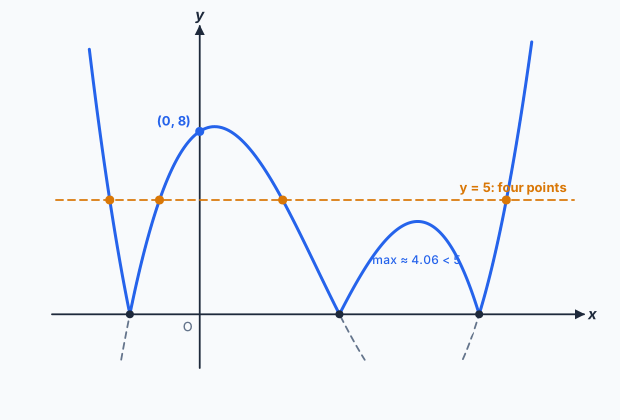
7. (No calculator.) The curve \( y = (x + 1)(x - 2)(x - 4) \) has turning points at approximately \( (0.21, 8.21) \) and \( (3.12, -4.06) \). Sketch \( y = |(x + 1)(x - 2)(x - 4)| \), stating the intercepts with the axes, and hence state the number of solutions of \( |(x + 1)(x - 2)(x - 4)| = 5 \). [4]
🔗Go deeper — other people’s work
These are external resources, not mine. If one stops working, tell me and everything above it on this page still stands.
- Desmos — type
abs(2x-3) < x+1to see the solution set shaded - Cambridge 0606 examiner reports — unchecked false roots in \( |ax + b| = cx + d \) are a regular comment