Vectors in two dimensions
🎯What you need to be able to do
- Read and write vectors in every form: \( \begin{pmatrix} a \\ b \end{pmatrix} \), \( \overrightarrow{AB} \), \( \mathbf{p} \), \( a\mathbf{i} + b\mathbf{j} \).
- Use position vectors, find magnitudes and unit vectors, and add, subtract and scale vectors.
- Solve geometry problems by writing one vector in two ways and equating coefficients.
- Compose and resolve velocities, and use \( \mathbf{r} = \mathbf{r}_{0} + t\mathbf{v} \) for position, including when two objects collide.
📚The mathematics
Notation and the basics
A vector has size and direction. \( \mathbf{i} \) and \( \mathbf{j} \) are unit vectors along the \(x\)- and \(y\)-axes (in context, often east and north), so \( 3\mathbf{i} - 4\mathbf{j} = \begin{pmatrix} 3 \\ -4 \end{pmatrix} \). The syllabus expects correct notation: underline or bold a vector when you write it by hand, and put an arrow over \( \overrightarrow{AB} \).
The position vector of \(A\) is \( \overrightarrow{OA} \), its vector from the origin. The equation \( \overrightarrow{AB} = \mathbf{b} - \mathbf{a} \) is the one to reach for first in almost every question.
Ratio points and parallel vectors
If \(P\) divides \(AB\) with \( AP : PB = m : n \), then \( \overrightarrow{AP} = \dfrac{m}{m + n}\overrightarrow{AB} \), so
Two vectors are parallel when one is a scalar multiple of the other. If \( \mathbf{a} \) and \( \mathbf{b} \) are not parallel and \( \lambda\mathbf{a} + \mu\mathbf{b} = p\mathbf{a} + q\mathbf{b} \), then \( \lambda = p \) and \( \mu = q \) — this is “equating like vectors”, and it is how intersection problems are solved: write the same vector along two different routes, and match the coefficients.
Velocity, position and collisions
Speed is the magnitude of the velocity. To resolve a velocity of speed \(v\) on a bearing \( \theta \) into components: \( v\sin\theta\,\mathbf{i} + v\cos\theta\,\mathbf{j} \) (east and north). To compose velocities, such as a boat’s velocity through the water plus the current, add the vectors.
An object that starts at \( \mathbf{r}_{0} \) and moves with constant velocity \( \mathbf{v} \) is at
after time \(t\). Two objects collide only if they are at the same place at the same time: set the \( \mathbf{i} \) components equal and the \( \mathbf{j} \) components equal, and check that both give the same \(t\). Paths that cross at different times do not collide.
✏️Worked example 1 (no calculator)
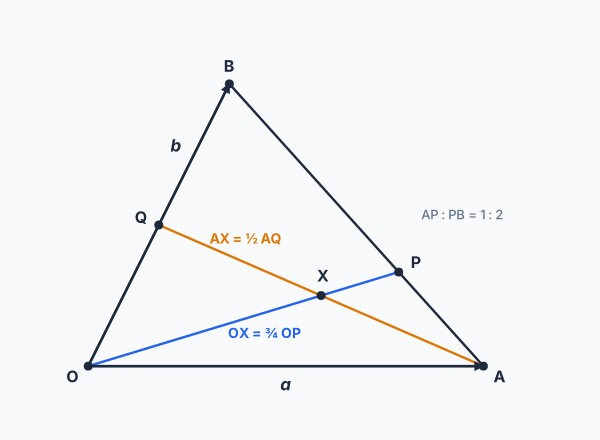
\( \overrightarrow{OP} = \mathbf{a} + \tfrac{1}{3}(\mathbf{b} - \mathbf{a}) = \tfrac{2}{3}\mathbf{a} + \tfrac{1}{3}\mathbf{b} \) and \( \overrightarrow{AQ} = -\mathbf{a} + \tfrac{1}{2}\mathbf{b} \). Two routes to \(X\):
\( \mathbf{a} \) and \( \mathbf{b} \) are not parallel, so equate coefficients: \( \tfrac{2}{3}\lambda = 1 - \mu \) and \( \tfrac{1}{3}\lambda = \tfrac{1}{2}\mu \). The second gives \( \mu = \tfrac{2}{3}\lambda \); substituting, \( \tfrac{4}{3}\lambda = 1 \), so \( \lambda = \tfrac{3}{4} \) and \( \mu = \tfrac{1}{2} \).
✏️Worked example 2 (calculator)
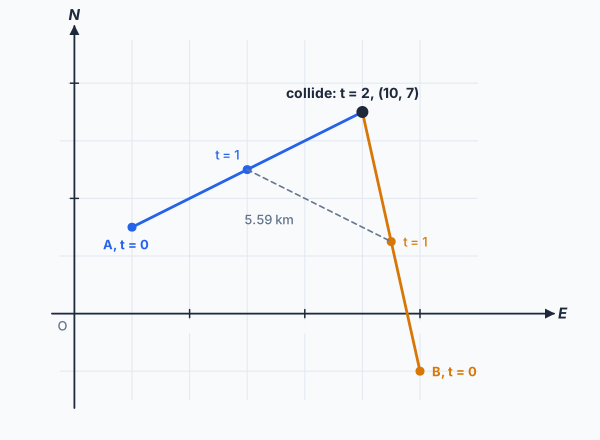
(a) Speed \( = \sqrt{4^{2} + 2^{2}} = \sqrt{20} = 4.47 \) km h−1. Bearing: the angle from north is \( \tan^{-1}\tfrac{4}{2} = 63.4^{\circ} \), so \( 063.4^{\circ} \).
(b) After \(t\) hours, \( \mathbf{r}_{A} = (2 + 4t)\mathbf{i} + (3 + 2t)\mathbf{j} \) and \( \mathbf{r}_{B} = (12 - t)\mathbf{i} + (-2 + 4.5t)\mathbf{j} \). Equal \( \mathbf{i} \) components: \( 2 + 4t = 12 - t \Rightarrow t = 2 \). Equal \( \mathbf{j} \) components: \( 3 + 2t = -2 + 4.5t \Rightarrow t = 2 \). The same time, so they collide at 14:00, at \( 10\mathbf{i} + 7\mathbf{j} \).
(c) At \( t = 1 \): \( \mathbf{r}_{A} = 6\mathbf{i} + 5\mathbf{j} \), \( \mathbf{r}_{B} = 11\mathbf{i} + 2.5\mathbf{j} \). \( \overrightarrow{AB} = 5\mathbf{i} - 2.5\mathbf{j} \), so the distance is \( \sqrt{31.25} = 5.59 \) km.
📝Practise
Written in the style of the current Paper 1 (no calculator) and Paper 2 (calculator) questions.
1. (No calculator.) \( \mathbf{a} = 3\mathbf{i} - 4\mathbf{j} \). Find \( |\mathbf{a}| \) and the unit vector in the direction of \( \mathbf{a} \). [2]
2. (No calculator.) \( \mathbf{p} = \begin{pmatrix} 2 \\ k \end{pmatrix} \) and \( \mathbf{q} = \begin{pmatrix} k \\ 8 \end{pmatrix} \). Find the values of \(k\) for which \( \mathbf{p} \) and \( \mathbf{q} \) are parallel. [3]
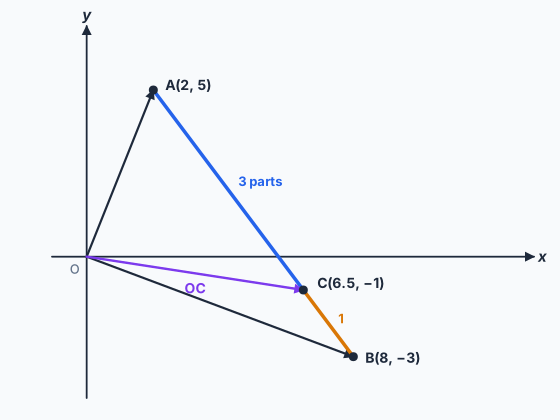
3. (No calculator.) \( \overrightarrow{OA} = 2\mathbf{i} + 5\mathbf{j} \) and \( \overrightarrow{OB} = 8\mathbf{i} - 3\mathbf{j} \). The point \(C\) lies on \(AB\) with \( AC : CB = 3 : 1 \). Find \( \overrightarrow{OC} \). [3]
4. (No calculator.) \( \mathbf{a} \) and \( \mathbf{b} \) are not parallel, and \( (\lambda + 2\mu)\mathbf{a} + (3\lambda - \mu)\mathbf{b} = 5\mathbf{a} + \mathbf{b} \). Find \( \lambda \) and \( \mu \). [3]
5. (Calculator.) A boat travels at 12 km h−1 on a bearing of \( 150^{\circ} \). Write its velocity in the form \( p\mathbf{i} + q\mathbf{j} \), where \( \mathbf{i} \) is east and \( \mathbf{j} \) is north. [2]
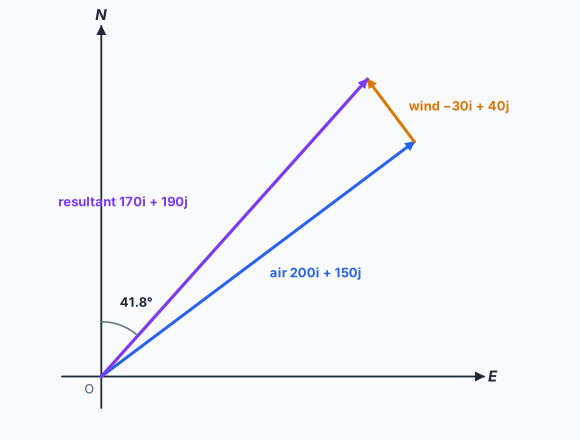
6. (Calculator.) A plane flies with velocity \( (200\mathbf{i} + 150\mathbf{j}) \) km h−1 relative to the air, and the wind has velocity \( (-30\mathbf{i} + 40\mathbf{j}) \) km h−1. Find the plane’s resultant speed and its bearing. [4]
7. (Calculator.) A particle starts at \( \mathbf{i} - 2\mathbf{j} \) and moves with constant velocity \( (3\mathbf{i} + 4\mathbf{j}) \) m s−1. Find its speed, and the time at which it is 13 m from the origin. [5]
🔗Go deeper — other people’s work
These are external resources, not mine. If one stops working, tell me and everything above it on this page still stands.
- GeoGebra — drag the vertices of a triangle and watch a ratio point’s position vector update
- Desmos — plot \( (x_{0} + at,\ y_{0} + bt) \) for two objects with a slider on \(t\) to test a collision