Human impact on the environment
🎯What you need to be able to do
- Describe and explain the growth of the human population.
- Explain the effects of deforestation, including on biodiversity, soil and the carbon and water cycles.
- Explain eutrophication step by step, and the effects of other water and land pollution, including plastics.
- Describe the causes and biological effects of climate change.
- Describe overexploitation and invasive species.
- Evaluate conservation methods and sustainable resource use.
📈Human population growth
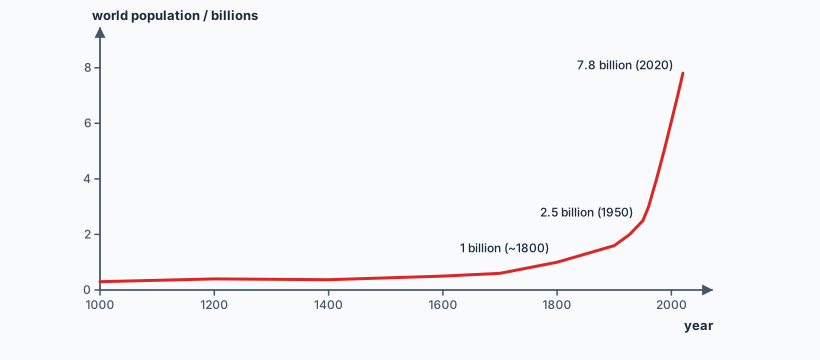
Growth accelerated as death rates fell faster than birth rates: better food supply, clean water and sanitation, vaccines and medicine. Growth is now slowing in many countries as birth rates fall with education, especially of girls, access to family planning, and urbanization. More people and higher consumption per person both increase pressure on the environment.
🌲Deforestation
Forests are cleared for farmland (including oil palm, pulpwood and cattle), timber, mining and settlements. Effects:
- Loss of biodiversity — habitats destroyed; species such as the orangutan and Sumatran tiger are critically endangered;
- More CO2 in the air — fewer trees photosynthesizing, and burning or decaying wood releases stored carbon; draining and burning peatland releases enormous amounts;
- Soil erosion and flooding — without roots to hold soil and leaves to intercept rain, soil washes away, rivers silt up and floods and landslides increase;
- Less rainfall locally, because less water is transpired back into the air.
🌊Water pollution and eutrophication
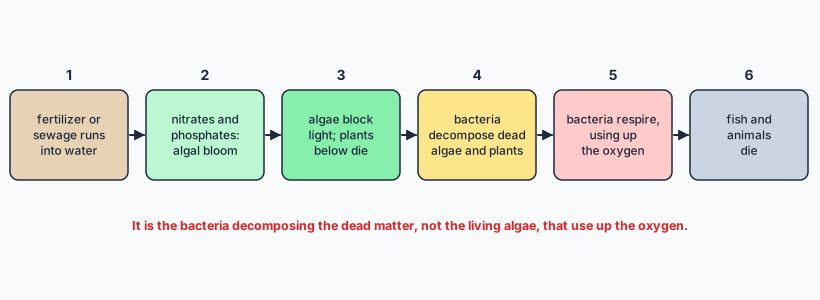
- Fertilizers or untreated sewage wash into rivers and lakes, adding nitrate and phosphate ions.
- Algae grow rapidly: an algal bloom covers the surface.
- The algae block light, so plants below cannot photosynthesize and die.
- Algae also die; decomposer bacteria multiply as they feed on the dead matter.
- The bacteria respire aerobically and use up the dissolved oxygen.
- Fish and other animals die from lack of oxygen.
Other pollutants include pesticides, which can build up along food chains (bioaccumulation) and harm top predators; heavy metals such as mercury from gold mining; and plastics. Plastic waste entangles and is swallowed by turtles, seabirds and fish, and breaks into microplastics that enter food chains.
🌡️Climate change
Burning fossil fuels, deforestation and farming (methane from cattle and rice paddies) increase greenhouse gases, strengthening the greenhouse effect (see MYP Chemistry, topic 13). Biological effects include coral bleaching, shifts in where species can live (some move towards the poles or uphill; others cannot), changes in the timing of flowering and migration, more pests and diseases in new areas, and the loss of coastal habitats such as mangroves as sea levels rise.
🎣Overexploitation and invasive species
Overexploitation is harvesting a resource faster than it can be replaced: overfishing, hunting and the illegal wildlife trade. Destructive methods such as blast (bomb) fishing also destroy the reefs themselves. Invasive species introduced to new places, deliberately or accidentally, can outcompete or eat native species, because they have no natural predators there.
✏️Worked example: interpreting an oxygen profile
At the drain: fertilizer (nitrates, phosphates) enters, but oxygen is still high because the chain of events takes time.
2 km downstream: algae have bloomed and begun to die; decomposing bacteria respiring aerobically have used up much of the oxygen — the lowest value.
5 km downstream: the nutrients are used up or diluted, there is less decomposition, and oxygen dissolves back in from the air as the water flows, so levels recover.
💚Conservation and sustainability
- Protected areas — national parks such as Komodo, Ujung Kulon (last home of the Javan rhino) and marine reserves.
- Captive breeding and seed banks — breeding endangered species (e.g. the Bali starling) for release, and storing seeds of crop varieties and wild plants.
- Reforestation and mangrove restoration; wildlife corridors linking habitats.
- Laws and agreements — CITES controls trade in endangered species; fishing quotas and mesh sizes let young fish escape.
- Reducing pollution — sewage treatment, careful fertilizer use, reducing single-use plastic, and cutting greenhouse-gas emissions.
Sustainable development means meeting the needs of people today without preventing future generations from meeting theirs. Conservation works best when local communities benefit, for example through ecotourism jobs.
🌎Science in context: palm oil
Indonesia is the world’s largest producer of palm oil, found in about half of supermarket products. The industry employs millions and has reduced rural poverty, but its expansion has been a major cause of rainforest and peatland loss. Palm oil produces more oil per hectare than any alternative crop, so a boycott could increase land use elsewhere. Certification schemes, protecting remaining forests and improving yields on existing plantations are proposed solutions. This is one of the richest Criterion D topics there is.
🧠Quick check
1. Why did the human population grow so fast after 1800?
Death rates fell because of better food supply, clean water and sanitation, vaccines and medicine, while birth rates stayed high for a long time.
2. Give three effects of deforestation.
Any three: loss of habitats and biodiversity; more CO2 in the atmosphere; soil erosion; flooding and landslides; reduced local rainfall.
3. In eutrophication, what uses up the oxygen in the water?
Aerobic respiration by decomposer bacteria feeding on dead algae and plants.
4. What is bioaccumulation?
The build-up of a persistent toxin (such as some pesticides or mercury) in organisms, becoming more concentrated at each higher trophic level.
5. Why are invasive species often so damaging?
They have no natural predators or diseases in their new habitat, so their populations grow quickly and outcompete or prey on native species.
6. What is sustainable development?
Meeting the needs of people today without damaging the ability of future generations to meet their needs.
📝Worksheet
Test yourself on the whole topic with a printable worksheet: questions for all four criteria, from recall to a design task, a data-analysis question and a short reflection, with a full mark scheme.
Worksheets are for members — sign in or join. The topic 1 worksheet is a free sample.