Measurement, units and uncertainty
🎯What you need to be able to do
- Name the SI base units and build derived units from them.
- Convert between prefixes (nano to giga) and write numbers in standard form.
- Round to a sensible number of significant figures.
- Distinguish accuracy from precision, and random from systematic error.
- Estimate the uncertainty in a reading and in a mean.
- Draw a graph with correct axes, scales, a line of best fit, and find a gradient.
📏Physical quantities and SI units
A physical quantity is anything that can be measured, and it always has two parts: a number and a unit. “The table is 1.5” means nothing; “the table is 1.5 m long” is a measurement. Scientists worldwide use the Système International (SI), built on seven base units. You need five of them at MYP:
| Quantity | SI base unit | Symbol |
|---|---|---|
| length | metre | m |
| mass | kilogram | kg |
| time | second | s |
| electric current | ampere | A |
| temperature | kelvin | K |
Every other unit is a derived unit, made by multiplying or dividing base units. Speed is distance ÷ time, so its unit is m/s (written m s−1). Some derived units get their own names: the newton (N) is kg m s−2, the joule (J) is a newton-metre, and the watt (W) is a joule per second. Note that the kilogram, not the gram, is the base unit of mass — the only base unit that already carries a prefix.
🔍Prefixes and standard form
Physics deals with numbers from the size of an atom (about 0.000 000 000 1 m) to the distance to a star (about 40 000 000 000 000 000 m). Writing all those zeros invites mistakes, so we use two tools.
Standard form writes a number as \( A \times 10^{n} \), where \( 1 \le A < 10 \) and \( n \) is a whole number. The atom is \( 1 \times 10^{-10} \) m; the star distance is \( 4 \times 10^{16} \) m. A positive power means a big number; a negative power means a number smaller than 1.
Prefixes are shorthand for powers of ten, written in front of a unit:
| Prefix | Symbol | Multiplies by | Example |
|---|---|---|---|
| giga | G | 109 | a 2 GW power station |
| mega | M | 106 | 3 MJ of energy |
| kilo | k | 103 | 5 km |
| centi | c | 10−2 | 30 cm |
| milli | m | 10−3 | 250 mA |
| micro | µ | 10−6 | 10 µm (a cell) |
| nano | n | 10−9 | 500 nm (green light) |
To convert, replace the prefix with its power of ten: 250 mA = 250 × 10−3 A = 0.25 A. Going the other way, divide: 0.004 m in mm is 0.004 ÷ 10−3 = 4 mm. Area and volume units need care: 1 m = 100 cm, but 1 m2 = 100 × 100 = 104 cm2 and 1 m3 = 106 cm3.
🔢Significant figures
The number of significant figures (s.f.) tells the reader how precisely a value is known. Count from the first non-zero digit: 0.0305 has three s.f. (3, 0, 5); 4.20 has three s.f. — the final zero says the value was measured to the nearest hundredth. The rule for answers: give a calculated answer to the same number of s.f. as the least precise value you used, usually two or three. A calculator display of 3.333333 m/s from 10 m in 3.0 s should be written 3.3 m/s.
🎯Accuracy, precision and error
These words have precise meanings in science, and mixing them up costs marks in Criterion C.
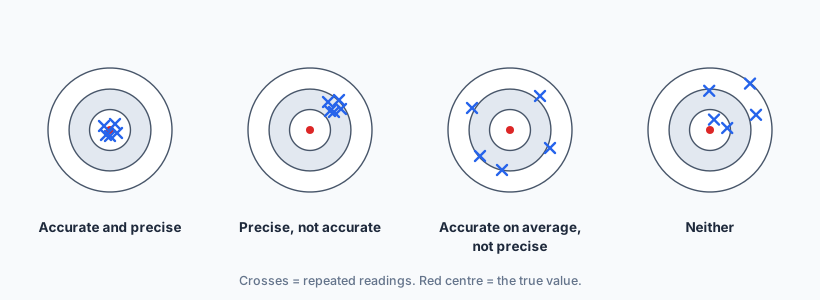
- Accurate — close to the true value.
- Precise — repeated readings are close to each other (little spread).
- Random error — unpredictable scatter, from reaction time, reading a scale that flickers, or small changes in conditions. It makes readings imprecise. You reduce its effect by repeating and taking a mean.
- Systematic error — every reading is shifted the same way, for example a balance that reads 0.2 g with nothing on it (a zero error), or always reading a scale from above (parallax). It makes readings inaccurate. Repeating does not help; you must fix the method or correct the readings.
±Uncertainty
No measurement is exact. The uncertainty is the range within which the true value probably lies, written as \( \pm \). Two quick rules:
- For a single reading on an analogue scale, the uncertainty is usually half the smallest division: a ruler marked in mm gives \( \pm 0.5 \) mm. For a digital meter, use \( \pm 1 \) in the last digit.
- For repeated readings, the uncertainty in the mean is about half the range: \( \pm\tfrac{1}{2}(\text{largest} - \text{smallest}) \).
Any reading that is far from the others is an anomaly (an outlier). Check it, repeat it if you can, and leave it out of the mean — but always say that you did.
✏️Worked example: a mean with its uncertainty
1. Look for anomalies. 2.84 s is about half a second longer than the others, far more than their scatter of a few hundredths. Treat it as anomalous (perhaps the ball snagged) and leave it out.
2. Mean of the rest. \[ \bar{t} = \frac{2.31 + 2.28 + 2.35 + 2.30}{4} = \frac{9.24}{4} = 2.31\ \text{s} \]
3. Uncertainty = half the range. Range = 2.35 − 2.28 = 0.07 s, so the uncertainty is \( \pm 0.035 \approx \pm 0.04 \) s.
Answer: \( t = 2.31 \pm 0.04 \) s.
📈Drawing and reading graphs
A graph is how you turn a table into a relationship. For the top bands in Criterion C, every graph should have:
- the independent variable (the one you changed) on the x-axis and the dependent variable (the one you measured) on the y-axis;
- axis labels with units, for example “time / s”;
- linear scales that use more than half the grid, going up in 1, 2 or 5 steps (never 3 or 7);
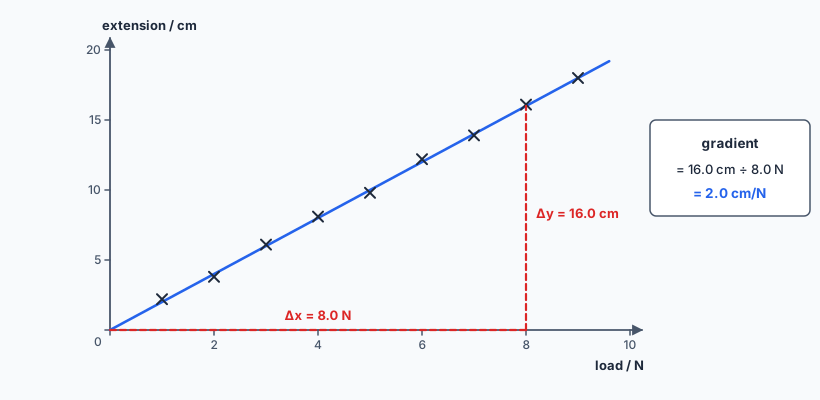
- points plotted as small crosses, and a single smooth line of best fit — straight or curved — with roughly equal numbers of points on each side. Do not join the dots.
If the best-fit line is straight and passes through the origin, the two variables are directly proportional: doubling one doubles the other. The gradient of a straight line is \( \dfrac{\text{change in } y}{\text{change in } x} \); use a large triangle, at least half the length of the line, and include units.
🌎Science in context: why one system of units?
In 1999 NASA lost the Mars Climate Orbiter because one team’s software reported thrust in pound-force seconds while another expected newton-seconds. The spacecraft flew too close to Mars and was destroyed. The SI system exists so that a measurement made in Bali means exactly the same thing in Geneva — a good example for Criterion D of how an agreement between scientists (a model of how to measure) has real economic and safety consequences.
🧠Quick check
1. Write 0.000 45 m in standard form and in micrometres.
\( 4.5 \times 10^{-4} \) m. In micrometres: \( 4.5 \times 10^{-4} \div 10^{-6} = 450\ \mu\text{m} \).
2. How many significant figures are in 0.0200?
Three. Leading zeros do not count; the two zeros after the 2 do, because they show the value was measured to the fourth decimal place.
3. A balance reads 0.3 g when empty. Is this a random or systematic error, and how do you deal with it?
Systematic (a zero error): every reading is 0.3 g too high. Repeating does not remove it. Re-zero (tare) the balance, or subtract 0.3 g from every reading.
4. A student's readings are 5.1, 5.2, 5.1, 5.2 cm but the true value is 6.0 cm. Describe the readings.
Precise (very little spread) but not accurate (far from the true value). This pattern points to a systematic error, such as measuring from the wrong end of the ruler.
5. Convert 3.2 kW to W and 1500 cm3 to m3.
3.2 kW = 3.2 × 103 = 3200 W. 1 m3 = 106 cm3, so 1500 cm3 = 1500 ÷ 106 = \( 1.5 \times 10^{-3} \) m3.
6. Why should you not join the points on a science graph dot to dot?
Each point contains random error. A line of best fit averages out that scatter and shows the underlying relationship; joining the dots draws the errors instead of the trend.
📝Worksheet
Test yourself on the whole topic with a printable worksheet: questions for all four criteria, from recall to a design task, a data-analysis question and a short reflection, with a full mark scheme.