Sound
🎯What you need to be able to do
- Explain how sound is produced by vibrations and travels as a longitudinal wave.
- Explain why sound needs a medium, and compare its speed in solids, liquids and gases.
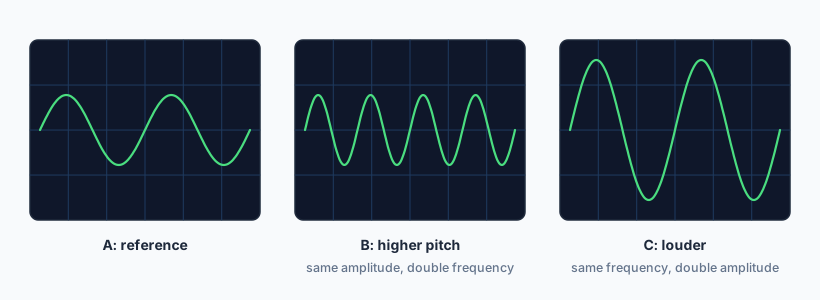
- Relate pitch to frequency and loudness to amplitude, including on oscilloscope traces.
- State the range of human hearing and define ultrasound.
- Use echoes to measure the speed of sound or a distance, with \( d = vt/2 \).
🔊Making and carrying sound
Every sound starts with a vibration: a guitar string, a loudspeaker cone, your vocal cords. The vibrating surface pushes the air particles next to it together (a compression) and then pulls back, leaving a region where they are spread out (a rarefaction). These pass from particle to particle, so a longitudinal wave travels outwards. The particles themselves only oscillate back and forth around fixed positions; it is the energy that travels.
Because sound needs particles to pass on the vibration, it cannot travel through a vacuum. A classic demonstration: an electric bell in a glass jar goes quiet as the air is pumped out, even though you can still see the hammer striking. In space, explosions are silent.
Sound travels faster when the particles are closer together and more strongly linked:
| Medium | Approximate speed of sound |
|---|---|
| air (20 °C) | 340 m/s |
| water | 1500 m/s |
| steel | 5000–6000 m/s |
Light travels at 300 000 km/s — almost a million times faster than sound in air. That is why you see lightning before you hear thunder; counting the seconds between them and dividing by 3 gives the distance in km.
🎵Pitch and loudness
Pitch depends on frequency: a higher frequency gives a higher note. Loudness depends on amplitude: a bigger amplitude carries more energy and sounds louder. A microphone connected to an oscilloscope turns sound into a trace you can see. On the trace, more waves across the screen means a higher frequency, and taller waves mean a larger amplitude. (The trace looks transverse, but it is a graph of the air pressure against time, not a picture of the wave.)
Loudness is measured in decibels (dB). Every 10 dB increase means ten times the sound intensity. Long exposure above about 85 dB (heavy traffic, a loud concert) can permanently damage the hair cells in the inner ear.
👂Human hearing and ultrasound
Young humans hear frequencies from about 20 Hz to 20 000 Hz (20 kHz); the upper limit falls with age. Sound above 20 kHz is ultrasound. Bats and dolphins use it to echolocate. Humans use it for:
- medical scanning — pulses reflect from boundaries between tissues to build an image of a fetus or an organ, without the ionizing radiation of X-rays;
- sonar — ships measure the depth of the sea floor or find shoals of fish from the time taken for echoes to return;
- cleaning and testing — vibrating dirt off jewellery, and finding hidden cracks in metal.
📣Echoes
An echo is a reflected sound. The sound travels to the reflecting surface and back, so the distance to the surface is half the total distance travelled:
✏️Worked example: sonar depth
1. Total distance travelled. \( vt = 1500 \times 0.24 = 360 \) m.
2. Halve it for the one-way depth: \( d = 360 \div 2 = 180 \) m.
Measuring the speed of sound
Stand a measured distance (say 100 m) from a large wall and clap. Adjust your clapping rate until each clap coincides with the echo of the previous one, then time 20 claps. In the time between claps the sound has travelled 200 m. Timing many claps reduces the effect of reaction time. Alternatively, two microphones a measured distance apart connected to a fast timer record the time directly.
🌎Science in context: noise pollution
Noise is now recognised as a health hazard: long-term exposure to traffic noise is linked to sleep loss, stress and heart disease. Cities respond with noise barriers (which reflect and absorb sound), quieter road surfaces, and limits on night flights. A Criterion D question might ask you to weigh the economic benefit of a new airport near Denpasar against the noise it brings to nearby villages.
🧠Quick check
1. Why is there no sound on the Moon's surface?
There is no atmosphere, so there are no particles to carry the vibrations; sound cannot travel through a vacuum.
2. Why does sound travel faster in steel than in air?
The particles in a solid are much closer together and strongly bonded, so vibrations are passed on far more quickly.
3. A trace on an oscilloscope gets taller but keeps the same spacing. What has changed about the sound?
The amplitude has increased, so the sound is louder. The frequency, and so the pitch, is unchanged.
4. A bat emits a 50 kHz call. Can a human hear it? Explain.
No. 50 kHz is above the upper limit of human hearing (about 20 kHz), so it is ultrasound.
5. A student shouts towards a cliff 170 m away and hears the echo 1.0 s later. Find the speed of sound.
The sound travels 2 × 170 = 340 m in 1.0 s, so \( v = 340 \) m/s.
6. You hear thunder 6 s after a lightning flash. Roughly how far away was it?
\( d = 340 \times 6 \approx 2000 \) m, about 2 km. (Light arrives almost instantly.)
📝Worksheet
Test yourself on the whole topic with a printable worksheet: questions for all four criteria, from recall to a design task, a data-analysis question and a short reflection, with a full mark scheme.
Worksheets are for members — sign in or join. The topic 1 worksheet is a free sample.