Stars, galaxies and the Big Bang
🎯What you need to be able to do
- Explain how stars form and why nuclear fusion makes them shine.
- Describe the life cycles of a Sun-like star and of a massive star.
- Describe the scale of the universe and use the light-year.
- Explain red-shift and how it shows the universe is expanding.
- Describe the Big Bang theory and the evidence for it, including the cosmic microwave background.
⭐How a star works
A star begins in a nebula, a vast cloud of hydrogen gas and dust. Gravity pulls part of the cloud together; as it collapses it heats up and becomes a protostar. When the core reaches about 10 million °C, hydrogen nuclei begin to fuse into helium, releasing enormous amounts of energy. The star is born.
For most of its life a star is a main-sequence star, stable because two effects balance: gravity pulling inwards, and the outward pressure of the hot gas heated by fusion. The Sun has been in this stage for about 4.6 billion years and has roughly 5 billion to go.
🔄The life cycle of stars
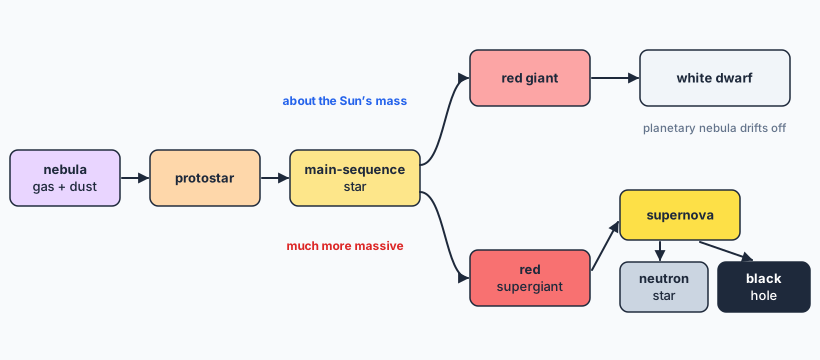
- Sun-like stars: when hydrogen in the core runs out, the star swells into a red giant, fusing helium into carbon. Its outer layers drift away as a planetary nebula and the hot core is left as a small, dense white dwarf, which slowly cools.
- Massive stars (more than about eight times the Sun’s mass) become red supergiants, fusing heavier and heavier elements up to iron. Then the core collapses and the star explodes as a supernova, briefly outshining a whole galaxy. The remnant is a neutron star or, for the most massive, a black hole, whose gravity is so strong that not even light escapes.
Elements heavier than iron are made in supernovae and in collisions of neutron stars, then scattered into space where they become part of new stars and planets. The iron in your blood and the calcium in your bones were made inside stars that died before the Sun was born.
🌌The scale of the universe
The Sun is one of 100–400 billion stars in the Milky Way, a spiral galaxy about 100 000 light-years across. A light-year is a distance: how far light travels in one year,
The nearest star after the Sun, Proxima Centauri, is 4.2 light-years away, so we see it as it was 4.2 years ago. Looking at a galaxy millions of light-years away means looking millions of years into the past.
✏️Worked example: how old is sunlight?
Sunlight. \( t = \dfrac{d}{v} = \dfrac{1.5 \times 10^{11}}{3.0 \times 10^{8}} = 500 \) s ≈ 8.3 minutes.
Proxima Centauri. \( 4.2 \times 9.5 \times 10^{15} = 4.0 \times 10^{16} \) m.
🔴Red-shift and the expanding universe
Each element absorbs light at particular wavelengths, giving dark lines in a star’s spectrum — a fingerprint. In the light from distant galaxies these lines are shifted towards the red (longer-wavelength) end. This red-shift means the galaxies are moving away from us, stretching the light as it travels.
In 1929 Edwin Hubble found that the further away a galaxy is, the greater its red-shift, so the faster it is receding. The simplest explanation is that space itself is expanding, carrying galaxies apart, like dots on a balloon being blown up: every dot moves away from every other, and distant dots separate fastest.

💥The Big Bang
If galaxies are moving apart now, they were closer together in the past. Running the expansion backwards leads to the Big Bang theory: about 13.8 billion years ago the universe was extremely hot and dense and has been expanding and cooling ever since. The main evidence:
- Red-shift of distant galaxies, increasing with distance.
- The cosmic microwave background (CMB): a faint glow of microwaves reaching us from every direction, discovered by accident in 1965. It is the heat left over from the early universe, stretched by expansion into microwaves.
- The observed proportions of hydrogen and helium in the universe match the amounts predicted to form in the first few minutes.
A scientific theory is accepted because it explains the evidence and makes predictions that are later confirmed; the CMB was predicted before it was found. Open questions remain — what dark matter and dark energy are, and what happened “before” — which is why cosmology is still an active field.
🌎Science in context: dark skies
Light pollution now hides the Milky Way from most of the world’s population. Some places protect dark skies as a resource for astronomy and tourism; Indonesia sited its national observatory at Timau, in East Nusa Tenggara, partly because the skies there are still dark. Weighing the benefits of outdoor lighting (safety, business) against the loss of the night sky is a good Criterion D exercise.
🧠Quick check
1. What process releases energy in the core of a main-sequence star?
Nuclear fusion of hydrogen nuclei into helium.
2. Why is a main-sequence star stable?
The inward pull of gravity is balanced by the outward pressure of the hot gas heated by fusion.
3. What will the Sun become at the end of its life?
A red giant, then a white dwarf. It is not massive enough to become a supernova.
4. What does red-shift tell us about a galaxy?
It is moving away from us; a larger red-shift means it is moving away faster (and is further away).
5. Give two pieces of evidence for the Big Bang.
Any two: red-shift increasing with distance; the cosmic microwave background; the observed abundances of hydrogen and helium.
6. A galaxy is 2 million light-years away. What are we seeing when we look at it?
Light that left it 2 million years ago, so we see the galaxy as it was then, not as it is now.
📝Worksheet
Test yourself on the whole topic with a printable worksheet: questions for all four criteria, from recall to a design task, a data-analysis question and a short reflection, with a full mark scheme.
Worksheets are for members — sign in or join. The topic 1 worksheet is a free sample.