Gravity and the solar system
🎯What you need to be able to do
- Describe gravity as an attractive force between all masses, depending on mass and distance.
- Define gravitational field strength and compare \( g \) on different bodies.
- Describe the solar system: Sun, planets, dwarf planets, moons, asteroids and comets.
- Explain orbits in terms of gravity providing a centripetal force.
- Compare geostationary and low polar orbits and their uses.
- Explain day and night, seasons, the phases of the Moon, eclipses and tides.
🍎Gravity
Gravity is an attractive force between any two objects with mass. Newton realised it was the same force that makes an apple fall and keeps the Moon in orbit. The force is larger when the masses are larger and gets weaker quickly as they move apart: doubling the distance between the centres reduces the force to a quarter (an inverse-square law). Between everyday objects it is far too small to notice; it only becomes large when at least one of the masses is a planet or a star.
The gravitational field strength \( g \) is the force per kilogram at a place, in N/kg. It is the \( g \) in \( W = mg \):
| Body | \( g \) at the surface / N/kg | Weight of a 50 kg person / N |
|---|---|---|
| Earth | 9.8 | 490 |
| Moon | 1.6 | 80 |
| Mars | 3.7 | 185 |
| Jupiter | 24.8 | 1240 |
☀️The solar system
The Sun is a star containing over 99.8% of the solar system’s mass. Around it orbit eight planets: the four small, rocky inner planets (Mercury, Venus, Earth, Mars), then the asteroid belt, then the four giant outer planets (Jupiter and Saturn, the gas giants; Uranus and Neptune, the ice giants). Beyond Neptune are dwarf planets such as Pluto. Moons orbit planets. Comets are lumps of ice and dust on long, stretched (elliptical) orbits; near the Sun their ice vaporizes into a glowing tail that always points away from the Sun.
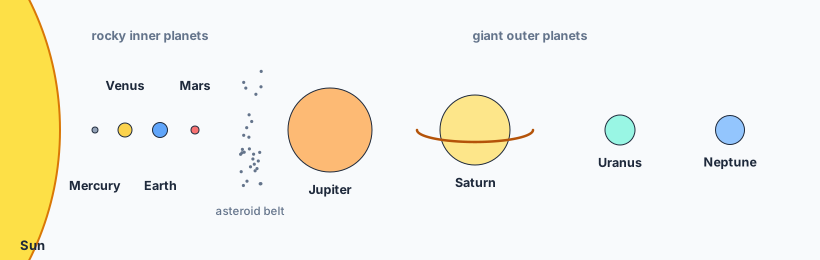
The further a planet is from the Sun, the weaker the Sun’s pull, the slower it moves, and the longer its year: Mercury orbits in 88 days, Earth in 365, Neptune in 165 years.
🛰️Orbits and satellites
A satellite is anything that orbits a larger body; the Moon is a natural one. In an orbit, gravity is the only force, and it always points towards the centre of the planet. That force does not speed the satellite up; it keeps changing its direction, bending its path into a circle. Newton’s picture: fire a cannonball horizontally from a mountain fast enough, and the ground curves away beneath it as fast as it falls, so it falls around the Earth for ever. An orbiting astronaut is not weightless because there is no gravity (at 400 km, \( g \) is still about 8.7 N/kg); she floats because she and the station are falling together.
| Orbit | Height and period | Uses |
|---|---|---|
| Geostationary | about 36 000 km above the equator; one orbit per 24 h, so it stays above the same spot | TV broadcasting, communications, weather images of a whole hemisphere |
| Low polar | a few hundred km; about 90 min per orbit, passing over the poles while the Earth turns beneath | mapping, detailed weather, spying, monitoring forests and crops |
✏️Worked example: the speed of the ISS
1. Distance per orbit = circumference = \( 2\pi r = 2\pi \times 6780 = 42\,600 \) km.
2. Time = 93 × 60 = 5580 s.
3. Speed \( v = \dfrac{42\,600\ \text{km}}{5580\ \text{s}} = 7.6 \) km/s, about 27 000 km/h.
🌓The Earth, Sun and Moon
- Day and night — the Earth spins on its axis once every 24 hours.
- Seasons — the Earth’s axis is tilted by 23.5°. When a hemisphere leans towards the Sun, sunlight hits it more directly and days are longer: summer. Near the equator, as in Indonesia, the Sun is always high, so seasons are wet and dry rather than hot and cold.
- Phases of the Moon — half of the Moon is always lit by the Sun; as it orbits the Earth (every 27.3 days, about 29.5 days from new moon to new moon) we see different fractions of the lit half.
- Eclipses — a solar eclipse is the Moon passing between the Sun and the Earth; a lunar eclipse is the Earth’s shadow falling on the Moon.
- Tides — the Moon’s gravity pulls the oceans into two bulges, one facing the Moon and one on the opposite side, giving two high tides a day.
🌎Science in context: space junk
Tens of thousands of pieces of debris larger than a few centimetres orbit the Earth at speeds of several km/s, and a collision can shatter a working satellite into more debris. Indonesia depends on satellites to link its islands by phone and internet, so the problem is not abstract. Who should pay to clean up orbit, and should countries that launched the debris be responsible? That is a Criterion D question with no easy answer.
🧠Quick check
1. What happens to the gravitational force between two objects if the distance between them doubles?
It falls to a quarter of its original value (inverse-square law).
2. A robot has a mass of 120 kg. What is its weight on Mars (g = 3.7 N/kg)?
\( W = 120 \times 3.7 = 444 \) N. Its mass is still 120 kg.
3. What force keeps the Moon in orbit, and in which direction does it act?
The Earth’s gravitational pull on the Moon, acting towards the centre of the Earth.
4. Why are TV satellites put in geostationary orbit?
They orbit once every 24 hours above the equator, so they stay above the same point on Earth and dishes can point at them without moving.
5. Why does Neptune take longer to orbit the Sun than Earth does?
It is much further away, so its orbit is far longer and the Sun’s weaker pull means it moves more slowly.
6. What causes the seasons?
The tilt of the Earth’s axis. As the Earth orbits, each hemisphere in turn leans towards the Sun, getting more direct sunlight and longer days.
📝Worksheet
Test yourself on the whole topic with a printable worksheet: questions for all four criteria, from recall to a design task, a data-analysis question and a short reflection, with a full mark scheme.
Worksheets are for members — sign in or join. The topic 1 worksheet is a free sample.