Energy resources
🎯What you need to be able to do
- Distinguish renewable from non-renewable energy resources.
- Describe how a thermal power station generates electricity.
- Explain how hydroelectric, wind, solar, geothermal, tidal and biofuel resources work.
- Compare resources on reliability, cost, efficiency and environmental impact.
- Calculate the fuel needed from the power output and efficiency of a power station.
♻️Renewable and non-renewable
A non-renewable resource is used up faster than it can be replaced: the fossil fuels (coal, oil and natural gas, formed over millions of years from buried organisms) and nuclear fuel (uranium). A renewable resource is replaced naturally as fast as we use it: sunlight, wind, flowing water, waves, tides, geothermal heat and biofuels from plants.
Almost all of these trace back to the Sun. Fossil fuels and biofuels store energy that plants captured by photosynthesis; wind and waves are driven by the Sun heating the Earth unevenly; rain that fills dams was lifted by evaporation. The exceptions are nuclear, geothermal (heat from radioactive decay inside the Earth) and tidal (the Moon’s gravity).
🏭How a thermal power station works
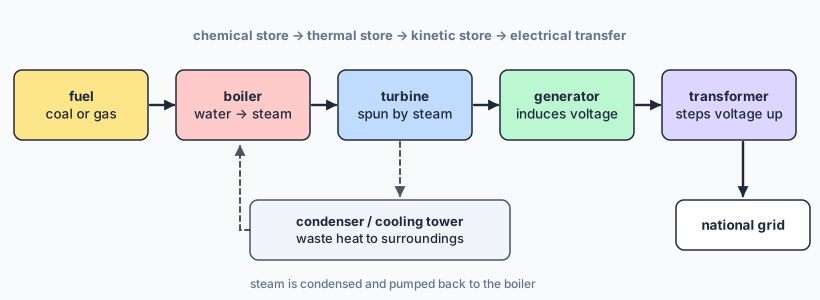
- Fuel is burned (or, in a nuclear station, uranium nuclei split) to heat water in a boiler.
- The water becomes high-pressure steam, which spins a turbine.
- The turbine turns a generator, which induces a voltage by electromagnetic induction (Topic 15).
- A transformer steps the voltage up for the national grid.
- The steam is condensed back to water in cooling towers or by sea water. This step wastes over half the input energy as heat, so a coal station is only about 35% efficient.
🌬️The other resources
| Resource | How it works | For | Against |
|---|---|---|---|
| Coal, oil, gas | burned to make steam (gas can also drive a turbine directly) | reliable, on demand; existing infrastructure | CO2 (climate change), SO2 (acid rain), particulates; will run out |
| Nuclear | fission of uranium heats water | no CO2 in operation; huge output from little fuel; reliable | radioactive waste for thousands of years; accident risk; expensive to build and decommission |
| Hydroelectric | water from a dam falls through turbines | no fuel cost; fast response to demand; can store energy | floods valleys and villages; disrupts rivers and fish |
| Wind | wind turns the blades of a turbine | no fuel, no emissions in use | intermittent; visual and noise impact; needs many turbines |
| Solar photovoltaic | solar cells convert light directly to electricity | no moving parts; works on rooftops and in remote islands | nothing at night; output falls with cloud; around 20% efficient |
| Geothermal | hot rock heats water to steam underground | reliable, runs day and night | only in volcanic regions; can release gases |
| Tidal and wave | moving sea water turns turbines | tides are predictable | few suitable sites; harms estuary habitats; costly |
| Biofuel | plant material or biogas is burned | roughly carbon-neutral if replanted | uses land that could grow food; can drive deforestation |
Indonesia is a good case study because it has nearly all of them: large coal reserves, some of the world’s biggest geothermal potential along its volcanic arc, hydroelectric rivers in Sumatra and Sulawesi, strong sunshine, and palm-oil biodiesel — with the deforestation debate that comes with it.
✏️Worked example: how much coal?
1. Input power. Efficiency = output ÷ input, so \[ P_{\text{in}} = \frac{600}{0.35} = 1714\ \text{MW} \]
2. Coal per second. 1714 MW = 1714 MJ every second: \( 1714 \div 24 = 71.4 \) kg/s.
3. Coal per day. \( 71.4 \times 86\,400 = 6.2 \times 10^{6} \) kg — about 6200 tonnes, or roughly a hundred railway wagons, every day.
🌎Science in context: the energy trilemma
Energy planners talk about a “trilemma”: electricity should be secure (always available), affordable and sustainable, and no single resource achieves all three. Solar is sustainable but not available at night without storage; coal is cheap and reliable but drives climate change. In a Criterion D response, name the trade-off explicitly and reach a judgement for a specific place — a remote island, a big city — rather than for “the world”.
🧠Quick check
1. Name two renewable resources that do not depend on the Sun.
Geothermal (heat from inside the Earth) and tidal (driven by the Moon’s gravity).
2. Why is a thermal power station only about 35% efficient?
Most of the energy is lost as heat when the steam is condensed back to water (and some in the boiler flue gases and by friction). That waste heat cannot be turned into electricity.
3. Give one advantage of hydroelectricity over wind power.
It can be switched on within minutes whenever demand rises, and the dam stores energy; wind only generates when the wind blows.
4. Why can biofuels be described as "carbon neutral", and why is that claim questioned?
The CO2 released on burning was absorbed from the air by the plants as they grew. But fertiliser, transport and processing emit extra CO2, and clearing forest to plant crops releases a great deal.
5. A 2.0 MW wind turbine produces on average 30% of its maximum. How much energy does it deliver in a day?
Average power = 0.6 MW; energy = 0.6 × 106 × 86 400 = \( 5.2 \times 10^{10} \) J.
6. Suggest why solar panels suit remote Indonesian islands.
Strong sunshine all year; no fuel has to be shipped in; small systems can be installed without connecting to a national grid.
📝Worksheet
Test yourself on the whole topic with a printable worksheet: questions for all four criteria, from recall to a design task, a data-analysis question and a short reflection, with a full mark scheme.
Worksheets are for members — sign in or join. The topic 1 worksheet is a free sample.