Forces and Newton’s laws
🎯What you need to be able to do
- Name common forces and draw free-body diagrams with labelled arrows.
- Find the resultant of forces along a line.
- Distinguish mass from weight and use \( W = mg \).
- State and apply Newton’s three laws, including \( F = ma \).
- Explain friction, drag and terminal velocity.
- Use momentum \( p = mv \) and its conservation in simple collisions.
💪What forces do
A force is measured in newtons (N) and is a vector — it has a size and a direction. A force can change an object’s speed, its direction of motion, or its shape. Forces come in two families:
- Contact forces act when objects touch: friction, air resistance (drag), tension in a rope or spring, the normal (reaction) force from a surface, upthrust in a fluid.
- Non-contact forces act at a distance, through a field: gravitational (weight), magnetic and electrostatic forces.
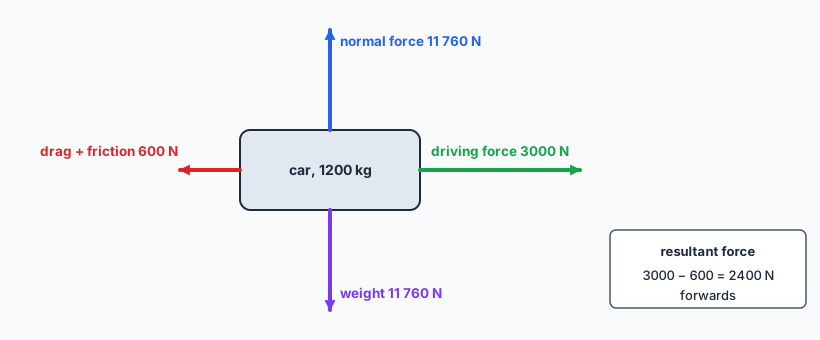
A free-body diagram shows one object as a box or dot with every force on it drawn as an arrow starting on the object. The length of each arrow shows the size of the force.
➕Resultant force
When several forces act along one line, add those in one direction and subtract those in the other. The single force with the same effect is the resultant force. If the forces cancel, the resultant is zero and the forces are balanced.
⚖️Mass and weight
Mass is the amount of matter in an object, measured in kg. It is the same everywhere. Weight is the gravitational force on that mass, measured in N, and it depends on where you are.
A 60 kg astronaut weighs \( 60 \times 9.8 = 588 \) N on Earth but only \( 60 \times 1.6 = 96 \) N on the Moon. Her mass is 60 kg in both places. A newtonmeter measures weight; a balance compares masses.
📜Newton’s three laws
First law. An object stays at rest, or keeps moving at a constant velocity, unless a resultant force acts on it. A hockey puck on ice glides a long way because friction is tiny. A moving object does not “need” a force to keep going; it needs a force to change. The tendency to keep doing what you are doing is called inertia, and it is larger for larger masses.
Second law. A resultant force produces an acceleration in its direction. The acceleration is proportional to the force and inversely proportional to the mass:
Third law. When object A pushes on object B, B pushes back on A with a force that is equal in size and opposite in direction. The two forces act on different objects and are the same type of force. When you jump, you push the Earth down and the Earth pushes you up; the Earth also accelerates, but its mass is so huge that its acceleration is immeasurably small.
✏️Worked example: resultant force and acceleration
1. Resultant force. \( F = 3000 - 600 = 2400 \) N forwards.
2. Rearrange \( F = ma \). \[ a = \frac{F}{m} = \frac{2400}{1200} = 2.0\ \text{m/s}^2 \]
3. As it speeds up, drag increases. With the same driving force the resultant force falls, so the acceleration falls. When drag reaches 3000 N the resultant is zero and the car travels at its top speed.
🪂Friction, drag and terminal velocity
Friction acts between surfaces and always opposes motion (or the tendency to move). It is useful for grip in tyres, shoes and brakes, and wasteful in machines, where it heats moving parts. Lubricants reduce it. Drag (air or water resistance) is friction in a fluid; it increases with speed and with frontal area, which is why racing cyclists crouch and cars are streamlined.
A falling object speeds up until drag equals its weight. Then the resultant force is zero and, by the first law, it moves at a constant terminal velocity.
🎱Momentum
Momentum is mass multiplied by velocity, \( p = mv \), measured in kg m/s. It is a vector. In a collision or explosion where no outside force acts, total momentum is conserved: the total before equals the total after. If a 2 kg trolley at 3 m/s hits a stationary 1 kg trolley and they stick together, the momentum before is 6 kg m/s, so afterwards \( 3v = 6 \) and they move off at 2 m/s.
Force is also the rate of change of momentum. Car crumple zones, airbags and bike helmets all work by making the collision last longer, so the same change of momentum happens with a smaller force.
🌎Science in context: seat belts and helmets
In a crash the car stops almost instantly, but by Newton’s first law an unbelted passenger keeps moving at the car’s old speed until something stops them — usually the windscreen. A seat belt stretches slightly, spreading the stop over a longer time and so reducing the force. Motorbike helmets in Indonesia must meet the SNI standard for the same reason: the foam liner crushes to lengthen the time of impact. When you evaluate a safety law for Criterion D, the physics sets out the benefit; the discussion of cost, comfort and enforcement is what earns the higher bands.
🧠Quick check
1. What is the weight of a 5.0 kg bag on Earth (g = 9.8 N/kg)?
\( W = mg = 5.0 \times 9.8 = 49 \) N.
2. A 0.50 kg ball is kicked with a resultant force of 150 N. Find its acceleration.
\( a = F/m = 150 \div 0.50 = 300 \) m/s2.
3. A book rests on a table. Are its weight and the normal force a Newton's third law pair?
No. Both act on the book, and they are different types of force (gravitational and contact). The third-law partner of the book’s weight is the book’s gravitational pull on the Earth.
4. A boat moves at constant velocity. The engine gives 800 N. What is the water resistance?
800 N backwards. Constant velocity means zero resultant force (first law), so the forces balance.
5. Why does an astronaut's mass stay the same on the Moon while her weight changes?
Mass is the amount of matter, which does not change. Weight is \( mg \), and \( g \) on the Moon (1.6 N/kg) is about one-sixth of Earth’s.
6. A 60 kg skater at rest pushes a 40 kg skater, who moves off at 3 m/s. How fast does the first skater move?
Total momentum before = 0, so after: \( 60v = 40 \times 3 = 120 \), giving \( v = 2 \) m/s in the opposite direction.
📝Worksheet
Test yourself on the whole topic with a printable worksheet: questions for all four criteria, from recall to a design task, a data-analysis question and a short reflection, with a full mark scheme.
Worksheets are for members — sign in or join. The topic 1 worksheet is a free sample.