States of matter and density
🎯What you need to be able to do
- Describe the arrangement and motion of particles in solids, liquids and gases.
- Name the changes of state and explain them with the particle (kinetic) model.
- Explain the differences between evaporation and boiling, and why evaporation cools.
- Define density and use \( \rho = m/V \).
- Describe how to measure the density of regular and irregular objects and of liquids.
- Use density to predict whether something floats.
⚫The particle model
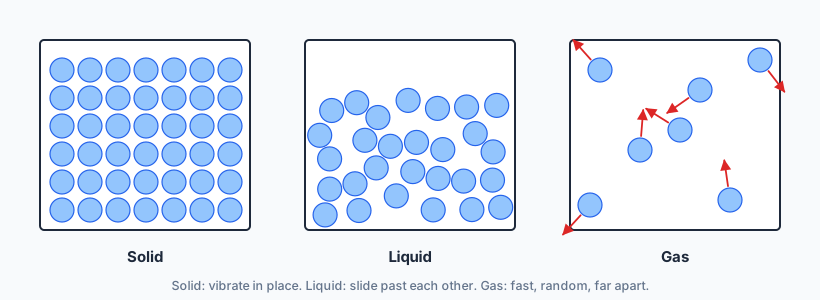
| Solid | Liquid | Gas | |
|---|---|---|---|
| Arrangement | regular, closely packed | random, close together | random, far apart |
| Motion | vibrate about fixed positions | move around each other | move quickly in all directions |
| Forces between particles | strong | weaker | almost none |
| Shape and volume | fixed shape, fixed volume | takes the container’s shape, fixed volume | fills the container |
| Compressible? | no | barely | easily |
The kinetic theory adds one more idea: the particles are always moving, and the temperature of a substance is a measure of the average kinetic energy of its particles. Heating a substance makes its particles move faster. Evidence that particles move comes from Brownian motion: smoke specks under a microscope jiggle randomly because invisible air molecules keep hitting them unevenly, and from diffusion, the spreading of a smell across a room.
🔄Changes of state
Melting (solid → liquid), boiling or evaporation (liquid → gas), condensation (gas → liquid) and freezing or solidifying (liquid → solid). Some substances go straight from solid to gas — sublimation, like dry ice — and the reverse is deposition, like frost forming on a cold night.
A change of state is a physical change: no new substance is made, mass is conserved, and it can be reversed. During melting and boiling the energy supplied breaks the forces between particles rather than making them move faster, so the temperature stays constant until the change is complete. The details, including heating curves, are in Topic 8.
💧Evaporation, boiling and condensation
Evaporation happens only at the surface of a liquid, at any temperature. The fastest-moving particles near the surface have enough energy to escape. Because the most energetic particles leave, the average kinetic energy of those left behind drops — so evaporation cools the liquid. That is why sweating cools you, and why a clay water pot (a kendi) keeps water cool.
Evaporation is faster when the liquid is warmer, has a larger surface area, or has air moving over it (wind carries the vapour away), and when the air is less humid. Boiling happens throughout the liquid, with bubbles, and only at the boiling point. Condensation is the reverse: vapour particles lose energy on a cold surface and join the liquid — the droplets on a cold glass, or clouds forming as moist air rises and cools. Evaporation from the sea and condensation into clouds drive the water cycle that brings rain.
⚖️Density
Density is mass per unit volume. It tells you how tightly packed the matter in a material is.
Water has a density of 1.0 g/cm3. An object floats in a liquid if its average density is less than the liquid’s. A steel ship floats because its hollow hull encloses a lot of air, so its average density is less than that of water. Gases have densities around a thousand times smaller than liquids, because their particles are so far apart.
Measuring density
- Regular solid: measure its mass on a balance; measure length, width and height with a ruler and multiply for the volume.
- Irregular solid: find its volume by displacement — lower it into a measuring cylinder of water (or a eureka can) and read how much the level rises.
- Liquid: weigh an empty measuring cylinder, add a measured volume of liquid, weigh again, and subtract.
✏️Worked example: is the ring pure gold?
1. Volume by displacement. \( V = 21.2 - 20.0 = 1.2 \) cm3.
2. Density. \( \rho = \dfrac{19.3}{1.2} = 16.1 \) g/cm3.
3. Compare. 16.1 is well below 19.3, so the ring is not pure gold — it is probably mixed with a less dense metal such as silver or copper.
🌎Science in context: why ice floats
Almost every substance is denser as a solid than as a liquid. Water is the famous exception: its molecules lock into an open hexagonal pattern when they freeze, so ice (0.92 g/cm3) floats. Lakes freeze from the top down, and the ice layer insulates the water beneath, allowing fish to survive the winter. Floating sea ice also reflects sunlight; as it melts, darker ocean absorbs more heat — one of the feedback loops that speeds up climate change.
🧠Quick check
1. Why can a gas be compressed but a liquid cannot (easily)?
Gas particles are far apart with empty space between them, so they can be pushed closer. Liquid particles are already touching.
2. Give two differences between evaporation and boiling.
Evaporation happens only at the surface and at any temperature; boiling happens throughout the liquid, with bubbles, and only at the boiling point.
3. Explain why wet clothes dry faster on a windy day.
Wind carries away the water vapour near the surface, so fewer vapour particles return to the cloth and the net rate of evaporation increases.
4. A block measures 2.0 cm × 3.0 cm × 5.0 cm and has a mass of 81 g. Find its density. Will it float in water?
\( V = 30 \) cm3; \( \rho = 81 \div 30 = 2.7 \) g/cm3 (aluminium). It is denser than water, so it sinks.
5. What is the mass of 2.5 m3 of air (density 1.2 kg/m3)?
\( m = \rho V = 1.2 \times 2.5 = 3.0 \) kg.
6. Why does the temperature of ice stay at 0 °C while it melts, even though it is being heated?
The energy supplied is used to break the forces between the particles (to change state), not to increase their kinetic energy, so the temperature does not rise until all the ice has melted.
📝Worksheet
Test yourself on the whole topic with a printable worksheet: questions for all four criteria, from recall to a design task, a data-analysis question and a short reflection, with a full mark scheme.
Worksheets are for members — sign in or join. The topic 1 worksheet is a free sample.