Thermal physics and heat transfer
🎯What you need to be able to do
- Distinguish temperature from internal (thermal) energy; convert between °C and K.
- Use \( E = mc\Delta T \) for specific heat capacity.
- Interpret a heating curve and use \( E = mL \) for latent heat.
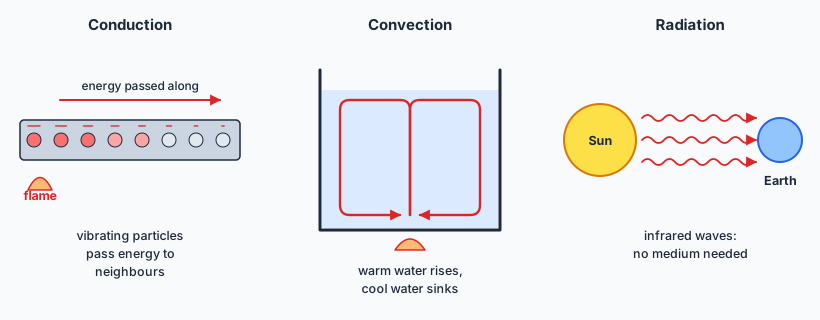
- Explain conduction, convection and radiation using particles and waves.
- Explain how insulation reduces energy transfer, with real examples.
🌡️Temperature and internal energy
Temperature measures the average kinetic energy of the particles in a substance. Internal (thermal) energy is the total energy of all its particles. A bath of warm water has a lower temperature than a cup of boiling tea, but far more internal energy, because it has many more particles.
Energy flows by heating from a hotter object to a colder one until they reach the same temperature (thermal equilibrium). The Celsius scale sets 0 °C and 100 °C at the melting and boiling points of water. The Kelvin scale starts at absolute zero, the temperature at which particles have the least possible energy: 0 K = −273 °C. To convert, \( T(\text{K}) = \theta(^{\circ}\text{C}) + 273 \). A change of 1 K equals a change of 1 °C.
♨️Specific heat capacity
The specific heat capacity \( c \) of a material is the energy needed to raise the temperature of 1 kg of it by 1 °C. Water’s is unusually high, 4200 J/(kg °C); dry sand’s is about 800 J/(kg °C). In the sun, both absorb similar energy, but the sand’s temperature rises about five times as much — hence hot sand and a cool sea, and the sea breezes that follow.
📈Heating curves and latent heat
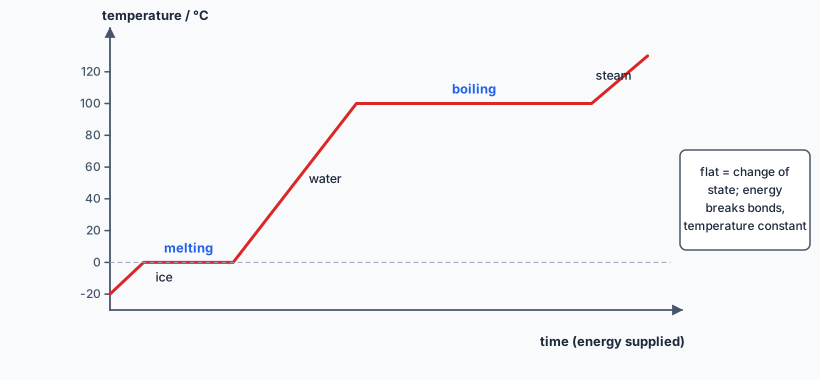
On the flat sections of a heating curve, energy is still being supplied but the temperature does not change. This energy — the latent heat — is used to overcome the forces between particles. The specific latent heat \( L \) is the energy needed to change the state of 1 kg without changing its temperature: for water, 334 000 J/kg to melt (fusion) and 2 260 000 J/kg to boil (vaporization).
✏️Worked example: boiling a kettle dry
(a) \( E = mc\Delta T = 0.50 \times 4200 \times (100 - 25) = 157\,500 \) J ≈ 158 kJ.
(b) \( E = mL = 0.50 \times 2.26 \times 10^6 = 1.13 \times 10^6 \) J = 1130 kJ.
🔥Conduction, convection and radiation
Conduction is the transfer of energy through a material without the material itself moving. Particles at the hot end vibrate more strongly and pass energy to their neighbours. Metals are excellent conductors because they also have free (delocalized) electrons that carry energy quickly through the metal. Non-metals and gases are poor conductors — insulators. The metal spoon feels colder than a wooden one because it conducts energy away from your hand faster, not because it is at a lower temperature.
Convection happens only in fluids (liquids and gases). A heated region of fluid expands, becomes less dense and rises; cooler, denser fluid sinks to take its place, setting up a convection current. This is how a heater warms a room, how sea breezes form, and how the Earth’s mantle and atmosphere circulate.
Radiation is energy carried by electromagnetic waves, mainly infrared. It needs no medium, so it is how the Sun’s energy crosses empty space. All objects emit infrared; hotter objects emit more. Dark, matt surfaces are the best absorbers and emitters; light, shiny surfaces are poor absorbers and good reflectors.
Reducing energy transfer
A vacuum flask combines all three ideas: a vacuum between two walls stops conduction and convection; silvered surfaces reduce radiation; a plastic stopper cuts conduction and convection at the top. Houses use cavity-wall foam, loft insulation and double glazing, all of which trap still air (a poor conductor) in small pockets so it cannot form convection currents.
🌎Science in context: keeping buildings cool in the tropics
In Bali most of the energy a building uses goes into air conditioning. Traditional architecture — high thatched roofs, wide eaves for shade, open walls for cross-ventilation — uses convection and shading instead. White “cool roofs” reflect sunlight and can lower indoor temperatures by several degrees. A good MYP inquiry question here is how far passive design can replace air conditioning in a hot, humid climate.
🧠Quick check
1. Convert 27 °C to kelvin, and 400 K to °C.
27 + 273 = 300 K; 400 − 273 = 127 °C.
2. How much energy raises 2.0 kg of aluminium (c = 900 J/(kg °C)) by 15 °C?
\( E = 2.0 \times 900 \times 15 = 27\,000 \) J.
3. How much energy melts 0.20 kg of ice at 0 °C? (Lf = 334 000 J/kg)
\( E = mL = 0.20 \times 334\,000 = 66\,800 \) J.
4. Why is a radiator usually placed low down in a room?
Air heated by the radiator becomes less dense and rises; cool air sinks to replace it, setting up a convection current that circulates warm air through the whole room.
5. Why are metals good conductors of heat?
They have free (delocalized) electrons that move through the metal and carry energy quickly, in addition to vibrations passed between neighbouring ions.
6. Why are solar water heaters painted matt black?
Matt black surfaces are the best absorbers of infrared and visible radiation, so they absorb as much of the Sun’s energy as possible.
📝Worksheet
Test yourself on the whole topic with a printable worksheet: questions for all four criteria, from recall to a design task, a data-analysis question and a short reflection, with a full mark scheme.
Worksheets are for members — sign in or join. The topic 1 worksheet is a free sample.