Atomic structure and isotopes
🎯What you need to be able to do
- Describe the structure of an atom and the relative charge and mass of protons, neutrons and electrons.
- Use nuclide notation \( ^{A}_{Z}\text{X} \) to find the numbers of each particle.
- Define isotopes and give examples.
- Describe how models of the atom developed, including the alpha-scattering experiment.
- Explain how atoms become ions, and why the size of an atom is so different from its nucleus.
⚛️Inside the atom
An atom has a tiny, dense, positively charged nucleus made of protons and neutrons (together called nucleons), surrounded by electrons arranged in shells (energy levels).
| Particle | Relative mass | Relative charge | Where |
|---|---|---|---|
| proton | 1 | +1 | nucleus |
| neutron | 1 | 0 | nucleus |
| electron | about 1/1840 | −1 | shells around the nucleus |
An atom is neutral because it has the same number of electrons as protons. It is about \( 10^{-10} \) m across, while its nucleus is about \( 10^{-15} \) m — a hundred thousand times smaller. If the atom were a football stadium, the nucleus would be a pea on the centre spot.
🔢Nuclide notation
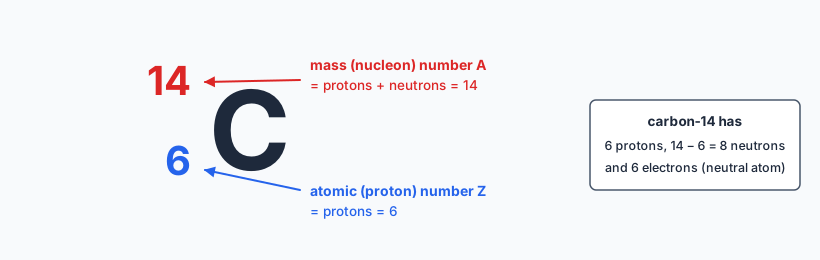
- Atomic (proton) number \( Z \) — the number of protons. It defines the element: every carbon atom has 6.
- Mass (nucleon) number \( A \) — the number of protons plus neutrons.
- Neutrons = \( A - Z \).
👥Isotopes
Isotopes are atoms of the same element (same number of protons) with different numbers of neutrons, and so different mass numbers. Carbon-12 has 6 neutrons and carbon-14 has 8; both are carbon and react identically in chemistry, because chemistry depends on the electrons. Some isotopes have unstable nuclei and are radioactive (see Topic 19).
✏️Worked example: counting particles
U-235: 92 protons, 235 − 92 = 143 neutrons, 92 electrons.
U-238: 92 protons, 238 − 92 = 146 neutrons, 92 electrons.
Same element because both have 92 protons. They are isotopes: they differ only in the number of neutrons.
⚡Ions
If an atom loses or gains electrons it becomes an ion. Losing electrons makes a positive ion; gaining them makes a negative ion. The nucleus is unchanged. A sodium atom (11 protons, 11 electrons) that loses one electron becomes Na+ with 11 protons and 10 electrons.
📜How the model of the atom developed
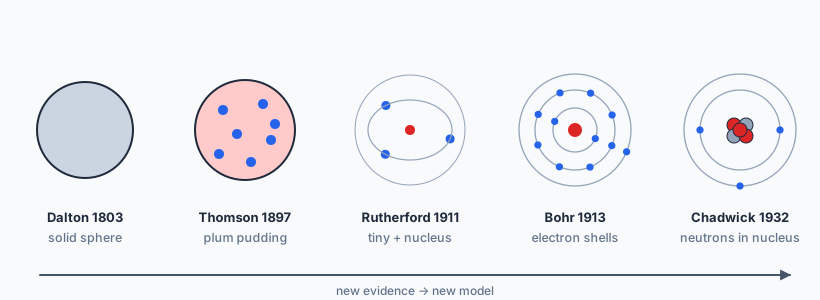
- Dalton (1803): atoms are tiny, indivisible solid spheres; each element has its own kind.
- Thomson (1897) discovered the electron, so atoms could not be indivisible. His “plum pudding” model: a ball of positive charge with electrons scattered through it.
- Rutherford, Geiger and Marsden (1909–1911) fired alpha particles at thin gold foil. Most went straight through, so the atom is mostly empty space. A few were deflected, and about 1 in 8000 bounced almost straight back — only possible if the positive charge and mass were concentrated in a tiny nucleus. The plum-pudding model could not explain this.
- Bohr (1913): electrons orbit in fixed shells at particular energies, explaining the line spectra of elements.
- Chadwick (1932) discovered the neutron, accounting for the extra mass in the nucleus.
🌎Science in context: models are tools
No model of the atom is “the truth”; each is a tool that explains some evidence. Chemists still use Bohr’s shells to explain bonding, even though quantum mechanics describes electrons as clouds of probability. Recognising a model’s limitations — and how scientists test and replace models — is exactly what Criterion D rewards.
🧠Quick check
1. How many protons, neutrons and electrons are in \( ^{27}_{13}\text{Al} \)?
13 protons, 27 − 13 = 14 neutrons, 13 electrons.
2. What is an isotope?
An atom of the same element (same number of protons) with a different number of neutrons.
3. Why is an atom electrically neutral?
It has equal numbers of protons (+1 each) and electrons (−1 each), so the charges cancel.
4. What did the fact that most alpha particles passed straight through the gold foil show?
That the atom is mostly empty space.
5. Why did a few alpha particles bounce back?
They came close to a tiny, dense, positively charged nucleus and were strongly repelled by it.
6. An oxygen atom (8 protons) gains two electrons. What is the ion and how many electrons does it have?
O2−, with 10 electrons.
📝Worksheet
Test yourself on the whole topic with a printable worksheet: questions for all four criteria, from recall to a design task, a data-analysis question and a short reflection, with a full mark scheme.
Worksheets are for members — sign in or join. The topic 1 worksheet is a free sample.