Static electricity and electric fields
🎯What you need to be able to do
- Explain charging by friction in terms of electron transfer.
- State the rules of attraction and repulsion between charges.
- Distinguish conductors from insulators.
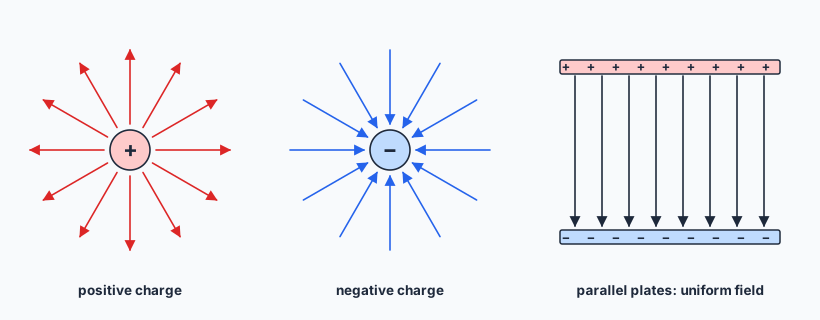
- Describe and draw electric field patterns around charges.
- Explain uses of static (printers, spraying, dust precipitators) and its dangers (fuel, lightning).
- Explain why earthing removes charge.
⚡Charge and the atom
Atoms contain positive protons in the nucleus and negative electrons around it. A neutral atom has equal numbers of each. Protons are locked in the nucleus, but electrons — especially the outer ones — can be moved. Charge is measured in coulombs (C).
When two insulating materials are rubbed together, electrons are transferred from one surface to the other. The material that gains electrons becomes negatively charged; the one that loses them becomes positively charged by the same amount. Positive charges do not move — a positive object is one that is missing electrons. Rubbing a polythene rod with a cloth moves electrons onto the rod (negative); rubbing an acetate rod moves electrons off it (positive).
🧲Forces between charges
Like charges repel; unlike charges attract. The force is stronger when the charges are larger and when they are closer together. A charged object can also attract a neutral one: a negative balloon near a wall pushes the wall’s electrons slightly away, leaving the nearby surface slightly positive, and the balloon is attracted to it. This is induced charge, and it is why a charged comb picks up small bits of paper.
🔌Conductors and insulators
In a conductor (metals, graphite, the human body to some extent) electrons move freely, so charge flows away and spreads out. In an insulator (plastic, rubber, glass, dry air, wool) electrons cannot move easily, so charge stays where it was put. That is why you can charge a plastic rod by rubbing it but not a metal rod held in your hand: the metal’s charge flows straight through you to the ground.
Earthing connects an object to the ground with a conductor. Electrons flow to or from the Earth until the object is neutral, so no charge can build up.
🔮Electric fields
An electric field is the region around a charge where another charge feels a force. We draw it with field lines, which show the direction of the force on a small positive test charge: they point away from positive charges and towards negative charges. Where the lines are closer together the field is stronger.
✏️Worked example: explaining a shock
1. Charging. Friction between the shoes and the carpet transferred electrons, so the student became charged (say negatively).
2. Charge stays. The rubber soles are insulators, so the charge could not flow to the ground and built up on the student’s body.
3. Discharge. The metal handle is a conductor connected to the building and the Earth. As the hand approached it, the field became strong enough to ionize the air in the small gap, and electrons jumped across as a spark, flowing through the handle to earth. That brief current is the shock.
🖨️Uses of static electricity
- Photocopiers and laser printers: light discharges parts of a charged drum; toner powder sticks only to the charged areas and is pressed onto paper.
- Electrostatic spraying: paint or crop spray droplets are charged so they repel each other into a fine mist and are attracted to the (earthed or oppositely charged) object, covering even the back of it with less waste.
- Electrostatic precipitators: in factory chimneys, smoke particles are charged and then collected on plates of opposite charge, cleaning the exhaust.
⛈️Dangers
A spark near flammable gases or dust can cause an explosion. When fuel flows quickly through a pipe into an aircraft or tanker, friction can charge it, so the vehicle is earthed with a cable first. Lightning is static on a huge scale: collisions between ice particles in a storm cloud separate charge until the field is strong enough to break down the air. Tall buildings carry lightning conductors — thick copper strips from a point on the roof to the ground — so the discharge flows safely to earth instead of through the building.
🌎Science in context: lightning safety
Indonesia has some of the highest lightning rates in the world, and lightning kills farmers and fishers caught in the open every rainy season. Advice follows from the physics: avoid being the tallest object, stay out of water, shelter in buildings or metal-roofed cars (which conduct the charge around you). A Criterion D task might ask you to evaluate a campaign that teaches this advice in rural communities.
🧠Quick check
1. A polythene rod becomes negatively charged when rubbed with a cloth. What charge does the cloth get, and why?
Positive, of equal size. Electrons moved from the cloth to the rod, so the cloth is left with fewer electrons than protons.
2. Two charged balloons repel each other. What can you say about their charges?
They have the same sign (both positive or both negative), because like charges repel.
3. Why can't a metal rod held in the hand be charged by rubbing?
Metal is a conductor, so any charge flows through the rod and your body to earth instead of staying on the rod.
4. In which direction do electric field lines point near a negative charge?
Towards the negative charge (the direction a positive test charge would be pulled).
5. Why is an aircraft earthed before it is refuelled?
Fuel flowing through the hose can become charged by friction. Earthing lets the charge flow away safely, preventing a spark that could ignite the fuel vapour.
6. Explain why electrostatic crop spraying wastes less pesticide.
The charged droplets repel each other into an even mist and are attracted to the plants, even wrapping round to the undersides of leaves, so less drifts away onto the ground or into the air.
📝Worksheet
Test yourself on the whole topic with a printable worksheet: questions for all four criteria, from recall to a design task, a data-analysis question and a short reflection, with a full mark scheme.
Worksheets are for members — sign in or join. The topic 1 worksheet is a free sample.