Pressure
🎯What you need to be able to do
- Define pressure and use \( p = F/A \) with units of pascals.
- Explain everyday examples of large and small pressure.
- Use \( p = \rho g h \) for pressure in a liquid and explain why it increases with depth.
- Explain how hydraulic machines multiply force.
- Describe atmospheric pressure and explain gas pressure using particles.
- Use \( p_1V_1 = p_2V_2 \) for a gas at constant temperature.
📌Pressure on a surface
To increase pressure, concentrate the force on a small area: knife edges, needles, nails and the studs on football boots. To reduce pressure, spread it over a large area: snowshoes, wide tyres on tractors, the broad feet of camels and the wide base of a building’s foundations.
A 600 N student standing on two feet (total area 0.04 m2) exerts \( 600 \div 0.04 = 15\,000 \) Pa. In a stiletto heel of area 0.0001 m2, the same weight on one heel gives 6 000 000 Pa — enough to dent a wooden floor.
🌊Pressure in liquids
A liquid presses on everything it touches, in all directions. The deeper you go, the more liquid there is above you, so the pressure increases with depth. It also depends on how dense the liquid is.
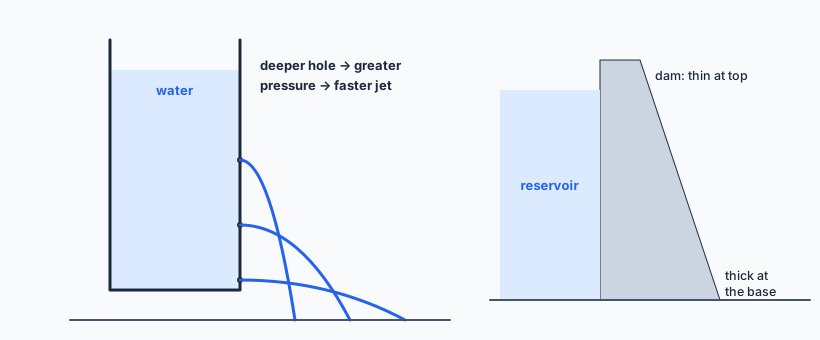
The pressure depends only on depth and density — not on the shape of the container or the total amount of water. That is why a dam holding back a narrow but deep reservoir must be as strong at the base as one holding back a wide lake of the same depth. Divers feel about 1 extra atmosphere of pressure for every 10 m of sea water.
🚗Hydraulics: multiplying force
Liquids are almost incompressible, and a pressure applied to an enclosed liquid is transmitted equally throughout it. A hydraulic system uses this with two pistons of different area. A small force on the small piston creates a pressure; the same pressure acts on the large piston and produces a large force.
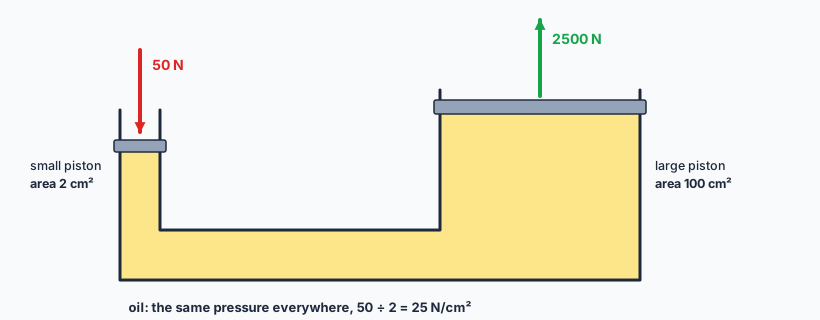
✏️Worked example: a hydraulic jack
1. Convert the area to m2. 1 cm2 = 10−4 m2, so 2.0 cm2 = \( 2.0 \times 10^{-4} \) m2.
2. Pressure. \( p = \dfrac{50}{2.0 \times 10^{-4}} = 250\,000 \) Pa (250 kPa).
3. Force on the large piston. Its area is \( 100 \times 10^{-4} = 0.010 \) m2, so \( F = pA = 250\,000 \times 0.010 = 2500 \) N.
☁️Atmospheric pressure and gas pressure
We live at the bottom of an ocean of air. The weight of the air above pushes on every surface with an atmospheric pressure of about 101 000 Pa (101 kPa) at sea level. It falls as you climb, because there is less air above you; at the top of Mount Rinjani (3726 m) it is roughly two-thirds of the sea-level value. A barometer measures it.
In a gas, pressure comes from particles hitting the container walls. Each collision exerts a tiny force; billions of collisions per second add up to a steady pressure. The pressure increases if:
- the gas is heated in a fixed volume — particles move faster, hit the walls more often and harder;
- the gas is squashed into a smaller volume at the same temperature — the particles hit the walls more often.
For a fixed mass of gas at constant temperature, pressure and volume are inversely proportional (Boyle’s law):
Halve the volume of a syringe of air and its pressure doubles.
🌎Science in context: tyres, altitude and medicine
Aircraft cabins are pressurized to the equivalent of about 2000 m altitude; the drop in pressure as the plane climbs is why ears “pop” and sealed snack bags swell. Blood pressure is measured in mmHg, a unit left over from mercury barometers, and a high reading is a warning sign of heart disease. In an MYP inquiry about pressure you might weigh these applications — and the risks, such as divers surfacing too fast — against each other.
🧠Quick check
1. A box of weight 240 N rests on a base of area 0.60 m2. Find the pressure it exerts.
\( p = 240 \div 0.60 = 400 \) Pa.
2. Why does a sharp knife cut better than a blunt one?
The sharp edge has a much smaller area, so the same force produces a much greater pressure on the food.
3. Find the pressure due to the water 5.0 m below the surface of a pool (ρ = 1000 kg/m3, g = 9.8 N/kg).
\( p = \rho g h = 1000 \times 9.8 \times 5.0 = 49\,000 \) Pa (plus atmospheric pressure on top of that if you want the total).
4. Explain in terms of particles why a car tyre's pressure rises after a long drive.
The tyre warms up, so the air particles move faster. They hit the tyre walls more often and with more force, so the pressure increases.
5. 200 cm3 of air at 100 kPa is compressed to 50 cm3 at constant temperature. Find the new pressure.
\( p_2 = p_1V_1/V_2 = 100 \times 200 \div 50 = 400 \) kPa.
6. Why must hydraulic brake fluid contain no air bubbles?
Air is compressible. Pressing the pedal would squash the bubbles instead of transmitting the pressure to the brakes, so the brakes would feel “spongy” and work poorly.
📝Worksheet
Test yourself on the whole topic with a printable worksheet: questions for all four criteria, from recall to a design task, a data-analysis question and a short reflection, with a full mark scheme.
Worksheets are for members — sign in or join. The topic 1 worksheet is a free sample.