Wave properties and behaviour
🎯What you need to be able to do
- Distinguish transverse and longitudinal waves, with examples.
- Define amplitude, wavelength, frequency and period, and label them on diagrams.
- Use the wave equation \( v = f\lambda \) and \( T = 1/f \).
- Describe and draw reflection, refraction and diffraction.
- Apply the law of reflection and explain refraction as a change of speed.
- Explain total internal reflection and its use in optical fibres.
🌊Transverse and longitudinal waves
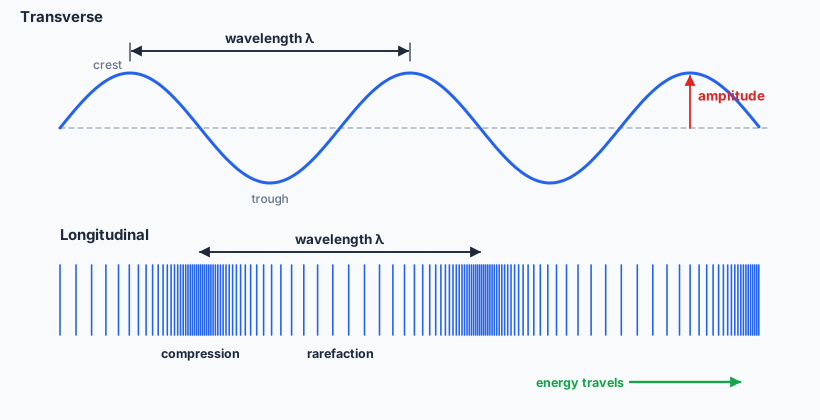
In a transverse wave the particles (or fields) oscillate at right angles to the direction the wave travels. Examples: water ripples, waves on a rope, and all electromagnetic waves, including light. In a longitudinal wave the oscillations are parallel to the direction of travel, forming compressions (particles squeezed together) and rarefactions (particles spread out). Examples: sound, and the P-waves of an earthquake. A slinky spring can show both: shake it side to side for transverse, push and pull along its length for longitudinal.
📏Describing a wave
- Amplitude \( A \) — the maximum displacement from the rest position. A bigger amplitude carries more energy (a louder sound, a brighter light).
- Wavelength \( \lambda \) — the distance between two neighbouring identical points, such as crest to crest or compression to compression (m).
- Frequency \( f \) — the number of waves passing a point per second, in hertz (Hz).
- Period \( T \) — the time for one complete wave, \( T = 1/f \).
- Wave speed \( v \) — how fast the energy travels (m/s).
If a wave passes into a new medium its speed and wavelength change, but its frequency stays the same — the source sets the frequency.
✏️Worked example: waves at the beach
Frequency. \( f = 12 \div 60\ \text{s} = 0.20 \) Hz.
Period. \( T = 1/f = 1/0.20 = 5.0 \) s — a wave every five seconds.
Speed. \( v = f\lambda = 0.20 \times 25 = 5.0 \) m/s.
🪞Reflection
When a wave hits a barrier it bounces back. The law of reflection: the angle of incidence equals the angle of reflection, both measured from the normal — a line drawn at 90° to the surface. A plane mirror forms an image that is upright, the same size, laterally inverted (left and right swapped) and as far behind the mirror as the object is in front. Echoes are reflected sound.
💧Refraction
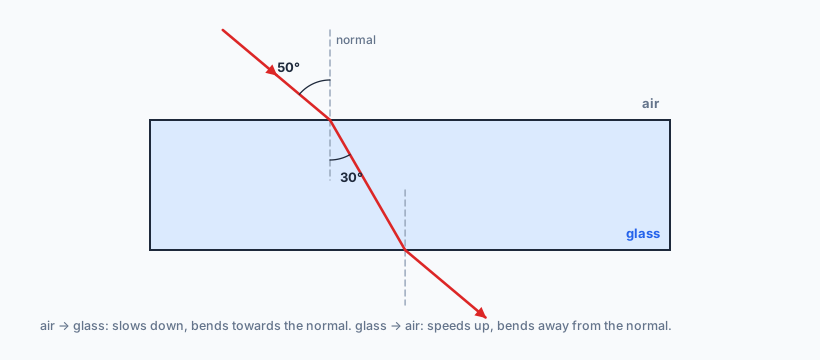
Refraction is the change in direction of a wave when it crosses a boundary at an angle and its speed changes. Light slows down when it goes from air into glass or water, and bends towards the normal; when it speeds up again on leaving, it bends away from the normal. A wave hitting the boundary along the normal changes speed but not direction. Refraction makes a pool look shallower than it is and a straw look bent. Water waves refract too, slowing as they reach shallow water — which is why waves line up parallel to the beach.
Total internal reflection
When light travels from a slower medium into a faster one (glass → air), it bends away from the normal. At a particular angle of incidence, the critical angle (about 42° for glass), the refracted ray skims along the surface. At larger angles, no light escapes: it is all reflected back inside. This total internal reflection traps light inside optical fibres, which carry internet data under the oceans and let doctors see inside the body with endoscopes.
🌬️Diffraction
Diffraction is the spreading of a wave as it passes through a gap or around an obstacle. It is greatest when the gap is about the same size as the wavelength. Sound (wavelength around a metre) diffracts through doorways, so you can hear people around a corner; light (wavelength under a millionth of a metre) diffracts only through tiny gaps, which is why you cannot see around the same corner. Long-wavelength radio waves diffract around hills, so they reach valleys that shorter-wavelength signals cannot.
🌎Science in context: tsunami warnings
A tsunami in the deep ocean travels at over 700 km/h with a small amplitude; as it reaches shallow water it slows down, its wavelength shortens and its amplitude grows dramatically. Indonesia’s tsunami warning system uses seismometers and ocean buoys to detect the waves early. The physics of wave speed decides how many minutes of warning a coastal village gets — and how evacuation routes should be planned.
🧠Quick check
1. Is sound transverse or longitudinal? Describe how the air particles move.
Longitudinal. The particles oscillate backwards and forwards along the direction the sound travels, forming compressions and rarefactions.
2. A radio station broadcasts at 100 MHz. Radio waves travel at 3.0 × 10⁸ m/s. Find the wavelength.
\( \lambda = v/f = 3.0 \times 10^8 \div 1.0 \times 10^8 = 3.0 \) m.
3. A wave has a period of 0.025 s. What is its frequency?
\( f = 1/T = 1/0.025 = 40 \) Hz.
4. Light enters water from air along the normal. What happens to its speed and direction?
It slows down but does not change direction, because it meets the boundary at 0° to the normal.
5. Why can you hear, but not see, someone talking in the next room through an open door?
Sound wavelengths are similar in size to the doorway, so sound diffracts strongly around it; light’s wavelength is far smaller than the gap, so it hardly diffracts.
6. What two conditions are needed for total internal reflection?
Light must travel from a denser (slower) medium towards a less dense (faster) one, and the angle of incidence must be greater than the critical angle.
📝Worksheet
Test yourself on the whole topic with a printable worksheet: questions for all four criteria, from recall to a design task, a data-analysis question and a short reflection, with a full mark scheme.
Worksheets are for members — sign in or join. The topic 1 worksheet is a free sample.