The electromagnetic spectrum
🎯What you need to be able to do
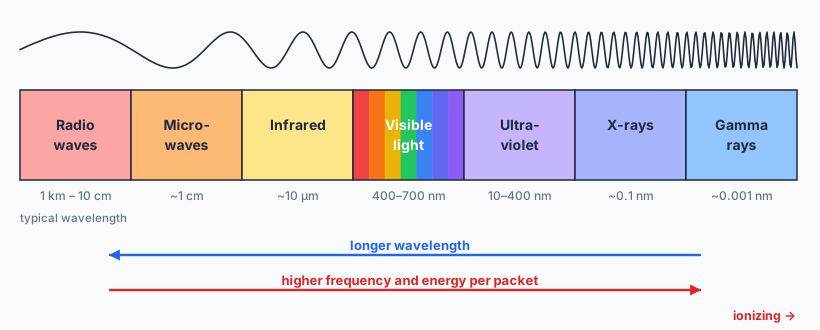
- List the regions of the EM spectrum in order of wavelength and frequency.
- State the properties all EM waves share, including their speed in a vacuum.
- Describe at least one use and one danger of each region.
- Explain why high-frequency EM waves are ionizing and more hazardous.
- Explain white light, dispersion by a prism, and the colour of objects.
🌈One family of waves
All electromagnetic (EM) waves:
- are transverse — oscillating electric and magnetic fields at right angles to the direction of travel;
- can travel through a vacuum (no medium needed);
- travel at the same speed in a vacuum, the speed of light \( c = 3.0 \times 10^8 \) m/s;
- transfer energy, and can be reflected, refracted and diffracted;
- obey \( c = f\lambda \), so a shorter wavelength means a higher frequency.
📡Uses and dangers
| Region | Uses | Dangers |
|---|---|---|
| Radio waves | radio and TV broadcasting, communication with ships and aircraft | very low risk at normal intensities |
| Microwaves | mobile phones, Wi-Fi, satellite links, microwave ovens, radar | heating of body tissue at high intensity |
| Infrared | remote controls, thermal imaging cameras, toasters and grills, fibre-optic data | skin burns |
| Visible light | seeing, photography, lasers, optical fibres in medicine | very bright light (lasers, looking at the Sun) damages the retina |
| Ultraviolet | sterilizing water and surgical tools, security marking, making vitamin D in skin | sunburn, skin cancer, cataracts |
| X-rays | medical images of bones, airport baggage scanners | ionizing: cell damage and cancer |
| Gamma rays | killing cancer cells (radiotherapy), sterilizing food and medical equipment | ionizing: cell damage, mutations, cancer |
⚠️Why the high-frequency end is dangerous
EM radiation comes in packets of energy, and the energy of each packet is proportional to the frequency. Ultraviolet, X-rays and gamma rays carry enough energy per packet to knock electrons out of atoms — they are ionizing. Ionization inside a cell can break DNA and cause mutations that lead to cancer. Lower-frequency radiation (radio, microwaves, infrared, visible) is non-ionizing; at high intensity it can heat tissue, but it cannot break chemical bonds in DNA however long you are exposed. That is why X-ray staff stand behind lead screens and wear badges that record their dose, while nobody wears a badge to use Wi-Fi.
✏️Worked example: from frequency to wavelength
(a) \( \lambda = \dfrac{c}{f} = \dfrac{3.0 \times 10^8}{2.4 \times 10^9} = 0.125 \) m = 12.5 cm.
(b) The frequencies are similar, but the power is not: an oven delivers about 800 W concentrated inside a metal box, while a router emits well under 1 W spread out in all directions. The intensity reaching your body is millions of times smaller.
🎨Light and colour
White light is a mixture of all the colours of the visible spectrum, from red (longest wavelength, about 700 nm) to violet (shortest, about 400 nm). A glass prism separates them — dispersion — because each colour is refracted by a slightly different amount: violet slows down most and bends most. Raindrops do the same to make a rainbow.
An object’s colour is the colour of light it reflects; it absorbs the rest. A red shirt reflects red and absorbs the other colours. Under blue light, it has no red to reflect and looks black. A white object reflects all colours; a black object absorbs them all (and so heats up most in the Sun). Filters work by transmitting only their own colour.
🌎Science in context: UV index and skin cancer
Near the equator the Sun is high in the sky all year and the UV index in Bali often reaches 11+ (“extreme”). UV-B causes sunburn; both UV-A and UV-B raise skin-cancer risk. Sunscreen absorbs or reflects UV; its SPF rating describes how well it blocks UV-B. A good Criterion D discussion might weigh sun protection against the need for UV to make vitamin D, and consider who can afford protection.
🧠Quick check
1. Put in order of increasing frequency: X-rays, infrared, radio, ultraviolet.
Radio, infrared, ultraviolet, X-rays.
2. State three properties shared by all EM waves.
Any three: transverse; travel through a vacuum; same speed in a vacuum (3.0 × 10⁸ m/s); transfer energy; can be reflected, refracted and diffracted.
3. Why are X-rays more dangerous than radio waves?
X-rays have a much higher frequency and energy, so they are ionizing: they can damage DNA and cause cancer. Radio waves are non-ionizing.
4. Visible red light has a wavelength of 7.0 × 10⁻⁷ m. Find its frequency.
\( f = c/\lambda = 3.0 \times 10^8 \div 7.0 \times 10^{-7} = 4.3 \times 10^{14} \) Hz.
5. What colour does a green leaf appear under red light? Why?
Black (very dark). The leaf reflects only green light; red light is absorbed, and there is no green light to reflect.
6. Which EM region is used by thermal imaging cameras, and why does it work in the dark?
Infrared. All warm objects emit infrared themselves, so the camera detects the radiation they give out rather than reflected visible light.
📝Worksheet
Test yourself on the whole topic with a printable worksheet: questions for all four criteria, from recall to a design task, a data-analysis question and a short reflection, with a full mark scheme.
Worksheets are for members — sign in or join. The topic 1 worksheet is a free sample.