Electric circuits
🎯What you need to be able to do
- Draw and read circuit diagrams using standard symbols.
- Define current, voltage (potential difference) and resistance, with units, and how to measure them.
- Use \( Q = It \) and \( V = IR \).
- Describe the I–V graphs of a resistor, a filament lamp and a diode.
- Apply the rules for current, voltage and resistance in series and parallel circuits.
- Calculate electrical power and energy, \( P = VI \), and explain fuses and earthing.
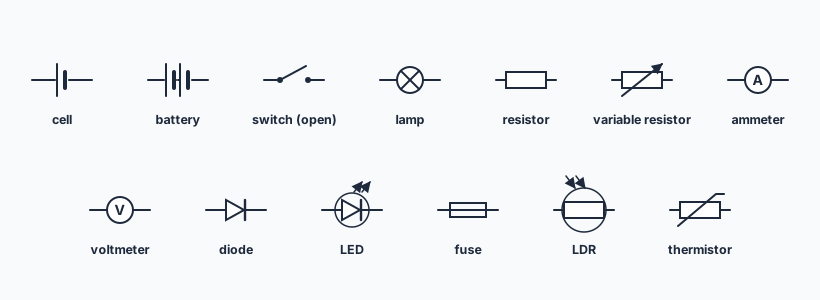
🔌Circuit symbols
⚡Current, voltage and resistance
Current \( I \) is the rate of flow of charge, measured in amperes (A) with an ammeter connected in series. In metal wires the moving charges are electrons, but by convention the current arrow points from + to −.
Voltage (potential difference, p.d.) \( V \) is the energy transferred per unit charge between two points, in volts (V): 1 V = 1 J/C. It is measured with a voltmeter connected in parallel across a component. A 9 V battery gives each coulomb of charge 9 J of energy.
Resistance \( R \) is how much a component opposes the current, in ohms (Ω). Longer and thinner wires have more resistance; so do most metals when hot.
📈Current–voltage graphs
- Fixed resistor (at constant temperature) — a straight line through the origin: current is directly proportional to voltage. This is Ohm’s law, and such a component is ohmic.
- Filament lamp — a curve that flattens: as the filament heats up its resistance increases.
- Diode — current flows in one direction only, and only above about 0.6 V.
Two sensors are special resistors: a light-dependent resistor (LDR) has lower resistance in bright light (used in automatic street lights), and a thermistor has lower resistance when hot (used in thermostats).
🔗Series and parallel
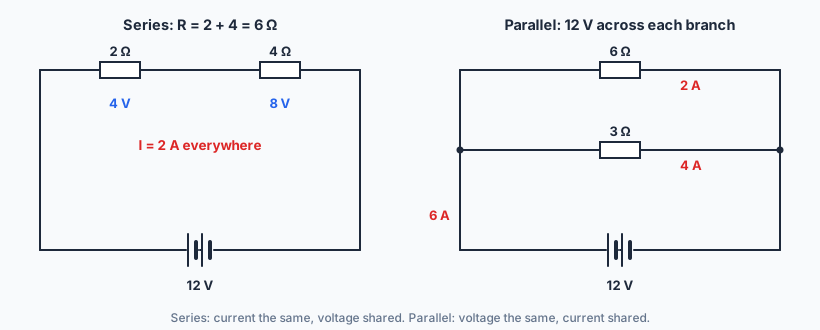
| Series | Parallel | |
|---|---|---|
| Current | the same everywhere | splits between branches; total = sum of branch currents |
| Voltage | shared: supply = sum of component voltages | each branch gets the full supply voltage |
| Total resistance | \( R = R_1 + R_2 \) (increases) | less than the smallest branch; \( \frac{1}{R} = \frac{1}{R_1} + \frac{1}{R_2} \) |
| If one lamp breaks | all go out | the others stay on |
House wiring is parallel: every appliance gets the full mains voltage and can be switched on and off on its own.
✏️Worked example: a series circuit
1. Total resistance. \( R = 2 + 4 = 6\ \Omega \).
2. Current. \( I = V/R = 12 \div 6 = 2.0 \) A (the same through both).
3. Voltages. \( V_1 = IR_1 = 2 \times 2 = 4 \) V and \( V_2 = 2 \times 4 = 8 \) V.
4. Power. \( P = VI = 8 \times 2.0 = 16 \) W.
💡Power, energy and cost
Electricity companies measure energy in kilowatt-hours (kWh): the energy used by a 1 kW appliance in one hour, equal to 3.6 MJ. Cost = energy in kWh × price per kWh. A 2 kW air conditioner running for 5 hours uses 10 kWh.
⚠️Electrical safety
Mains electricity (220 V in Indonesia) can kill. A fuse is a thin wire in the live wire that melts if the current gets too large, breaking the circuit before the cable overheats; choose a rating just above the normal current. A circuit breaker does the same job with a switch that can be reset. The earth wire connects a metal case to the ground, so if a fault makes the case live, a large current flows to earth and blows the fuse instead of flowing through a person. Double-insulated appliances with plastic cases do not need an earth.
🌎Science in context: the cost of cooling
A household’s bill is easy to estimate with \( E = Pt \): a 1 kW air conditioner run eight hours a night uses 8 kWh, around 240 kWh a month. Understanding this helps families choose efficient appliances and timers — and helps a Criterion D answer turn a vague claim (“AC uses lots of electricity”) into evidence.
🧠Quick check
1. A current of 0.5 A flows for 2 minutes. How much charge passes?
\( Q = It = 0.5 \times 120 = 60 \) C.
2. What is the resistance of a lamp that takes 0.25 A from a 6.0 V supply?
\( R = V/I = 6.0 \div 0.25 = 24\ \Omega \).
3. How must an ammeter and a voltmeter be connected?
Ammeter in series (so the current passes through it); voltmeter in parallel across the component.
4. Why does a filament lamp's I–V graph curve?
As the current rises the filament gets hotter, and the resistance of the metal increases, so current rises less and less for each extra volt.
5. A 6 Ω and a 3 Ω resistor are in parallel across 12 V. Find each branch current and the total.
12 ÷ 6 = 2 A and 12 ÷ 3 = 4 A; total = 6 A. (Total resistance = 12 ÷ 6 = 2 Ω, less than either branch.)
6. A 2000 W kettle runs on 220 V. Should it have a 5 A or a 13 A fuse?
\( I = P/V = 2000 \div 220 = 9.1 \) A. A 5 A fuse would blow in normal use; use 13 A, the next rating above.
📝Worksheet
Test yourself on the whole topic with a printable worksheet: questions for all four criteria, from recall to a design task, a data-analysis question and a short reflection, with a full mark scheme.
Worksheets are for members — sign in or join. The topic 1 worksheet is a free sample.