Magnetism and electromagnetism
🎯What you need to be able to do
- Describe the forces between magnetic poles and identify magnetic materials.
- Draw field lines around a bar magnet and describe the Earth’s field.
- Distinguish permanent and induced magnets.
- Describe the field around a wire and a coil, and how to make a stronger electromagnet.
- Explain the motor effect, use Fleming’s left-hand rule, and describe how a DC motor works.
🧲Magnets and magnetic fields
Every magnet has a north pole and a south pole. Like poles repel; unlike poles attract. Only a few materials are magnetic: iron, steel, nickel and cobalt. Copper, aluminium, plastic and wood are not.
A magnetic field is the region around a magnet where a magnetic material or another magnet feels a force. Field lines go from north to south outside the magnet and show the direction a small compass needle would point. They are closest together, and the field strongest, at the poles.
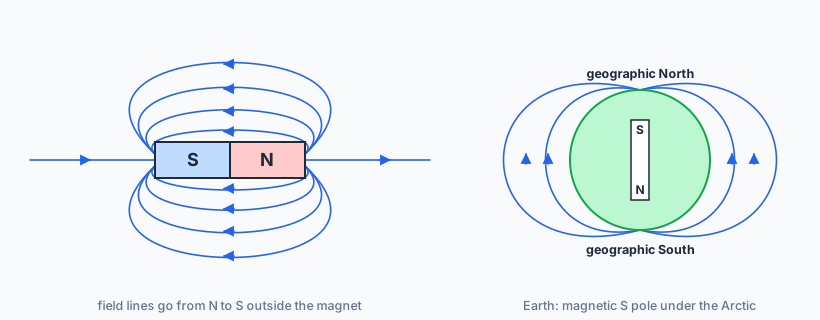
A permanent magnet (such as steel or neodymium) keeps its magnetism. An induced magnet is a magnetic material that becomes a magnet only while it is in a field — a paper clip next to a magnet, which then attracts other clips. Iron is magnetically soft: easy to magnetize and quick to lose it. Steel is hard: it stays magnetized.
The Earth’s magnetic field
Molten iron moving in the Earth’s outer core generates a field that behaves like a giant bar magnet. A compass’s north pole points to the geographic North, which means the magnetic pole there is actually a magnetic south pole. The field protects the atmosphere from the solar wind and lets birds, turtles and people navigate.
🔌Electromagnetism
In 1820 Hans Christian Ørsted noticed a compass needle move when a current flowed nearby. A current creates a magnetic field. Around a straight wire, the field lines are concentric circles; their direction follows the right-hand grip rule (thumb along the current, fingers curl the way the field goes). Winding the wire into a coil (a solenoid) makes the fields add up into a field shaped like a bar magnet’s.
An electromagnet is a solenoid with a soft-iron core. It can be switched on and off. To make it stronger:
- increase the current;
- increase the number of turns on the coil;
- use a soft-iron core.
Electromagnets are used in scrapyard cranes, relays, electric bells, door locks and MRI scanners.
⚙️The motor effect
A wire carrying a current in a magnetic field feels a force, because its own field interacts with the magnet’s. The force is biggest when the wire is at right angles to the field, and zero when parallel. It increases with the current and with the strength of the field. Reverse either the current or the field and the force reverses.
Fleming’s left-hand rule gives the direction. Hold the thumb, first finger and second finger of your left hand at right angles: First finger = Field (N to S), seCond finger = Current (+ to −), thuMb = Motion (force).
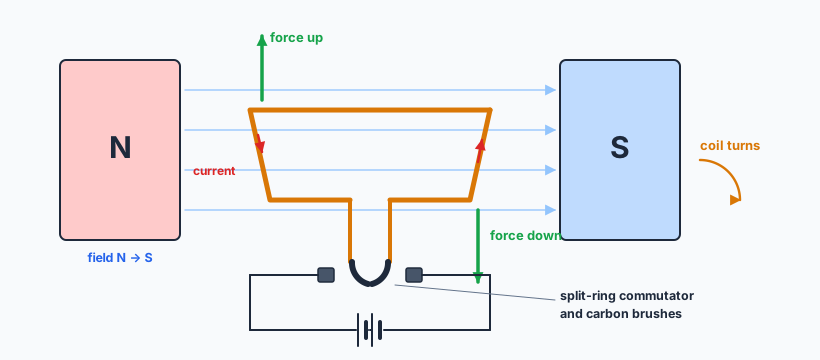
The DC motor
A coil of wire sits between the poles of a magnet. Current flows in opposite directions along the two sides of the coil, so one side is pushed up and the other down: the coil turns. A split-ring commutator reverses the current in the coil every half turn, so the forces keep turning it the same way. The motor turns faster with a larger current, a stronger magnet or more turns on the coil.
✏️Worked example: predicting the force
1. Field: N to S, so downwards. Point your first finger down.
2. Current: left to right. Point your second finger to the right.
3. Thumb: with the first finger down and the second finger right, your left thumb points away from you, into the page. The wire is pushed into the gap between the poles, away from the observer.
🌎Science in context: magnetic navigation
Sea turtles that hatch on Indonesian beaches cross whole oceans and return decades later to nest on the same coast, apparently by sensing the strength and angle of the Earth’s magnetic field. Research published in 2008 even suggested that grazing cattle tend to line up north–south. Artificial lighting and coastal development can disorient hatchlings, which links electromagnetism to conservation in a Criterion D discussion.
🧠Quick check
1. Which of these are magnetic: copper, nickel, steel, aluminium?
Nickel and steel.
2. Why is the core of an electromagnet made of soft iron rather than steel?
Soft iron magnetizes strongly and loses its magnetism as soon as the current is switched off; steel would stay magnetized.
3. Give three ways to make an electromagnet stronger.
Increase the current; add more turns to the coil; use a soft-iron core.
4. What is the shape of the magnetic field around a straight current-carrying wire?
Concentric circles centred on the wire, in a plane at right angles to it.
5. What is the job of the split-ring commutator in a DC motor?
It reverses the direction of the current in the coil every half turn, so the forces keep turning the coil in the same direction.
6. Give two ways to reverse the direction a motor spins.
Reverse the current (swap the battery connections) or reverse the magnetic field (swap the magnet’s poles).
📝Worksheet
Test yourself on the whole topic with a printable worksheet: questions for all four criteria, from recall to a design task, a data-analysis question and a short reflection, with a full mark scheme.
Worksheets are for members — sign in or join. The topic 1 worksheet is a free sample.