Electromagnetic induction and the grid
🎯What you need to be able to do
- Describe how a voltage is induced when a conductor and a magnetic field move relative to each other.
- State the factors that affect the size and direction of the induced voltage.
- Describe how an AC generator works, and compare AC with DC.
- Describe a transformer and use \( V_p/V_s = N_p/N_s \) and \( V_pI_p = V_sI_s \).
- Explain why the national grid transmits electricity at very high voltage.
🧲Inducing a voltage
When a wire moves through a magnetic field, or a magnetic field changes around a coil, a voltage (e.m.f.) is induced across it. If the wire is part of a complete circuit, a current flows. The key word is change: a magnet sitting still inside a coil induces nothing; pushing it in or pulling it out does.
The induced voltage is larger when:
- the magnet or coil moves faster;
- the magnetic field is stronger;
- the coil has more turns (or a larger area).
The direction reverses if the motion reverses (pushing in versus pulling out) or the pole is reversed. The induced current always creates a field that opposes the change that made it — otherwise you would get energy for nothing. That is why it takes effort to turn a generator that is supplying a current.
⚙️Generators: AC and DC
A generator is a motor in reverse: a coil is turned in a magnetic field (by steam, wind or water), and a voltage is induced. In an alternator (AC generator) each side of the coil moves up through the field, then down through it, so the voltage reverses every half turn. Slip rings and brushes connect the coil to the circuit.
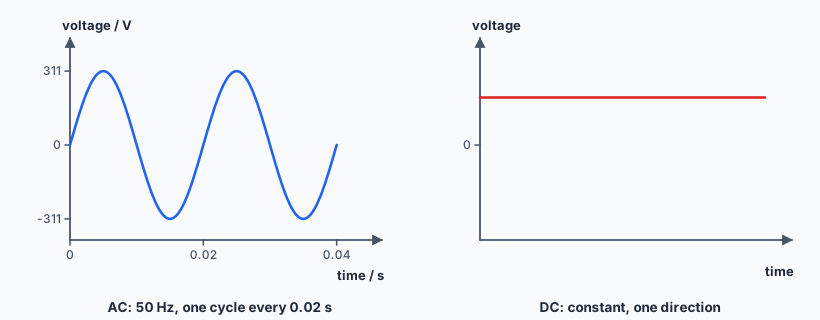
Alternating current (AC) repeatedly changes direction; mains electricity is AC at 50 Hz. Direct current (DC) flows one way only; cells, batteries and solar panels produce DC. Phones and laptops run on DC, so their chargers contain a transformer and a rectifier to convert mains AC into low-voltage DC.
🔌Transformers
A transformer changes the size of an alternating voltage. Two coils — the primary and the secondary — are wound on the same soft-iron core. The alternating current in the primary makes a changing magnetic field in the core, which induces an alternating voltage in the secondary. It only works with AC: a steady DC would give no change and so no induced voltage.
A step-up transformer has more turns on the secondary and increases the voltage; a step-down transformer has fewer and reduces it. If the voltage goes up, the current goes down in the same ratio, because power in = power out.
✏️Worked example: a phone charger
1. Turns. \( N_s = N_p \times \dfrac{V_s}{V_p} = 2000 \times \dfrac{5.5}{220} = 50 \) turns.
2. Current. \( I_p = \dfrac{V_s I_s}{V_p} = \dfrac{5.5 \times 2.0}{220} = 0.050 \) A.
🏗️The national grid
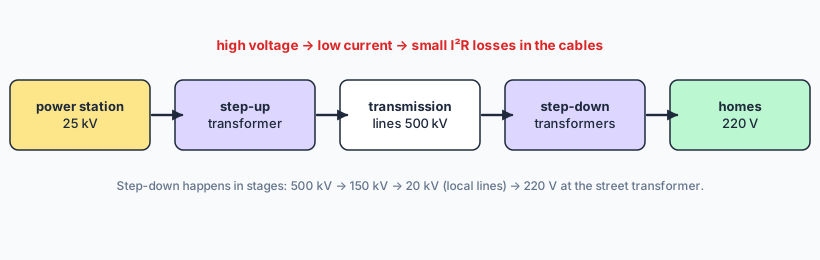
The cables that carry electricity across the country have resistance, so they heat up and waste energy. The power wasted is \( P = I^2R \): it depends on the square of the current. A step-up transformer at the power station raises the voltage to hundreds of kilovolts, which lowers the current by the same factor, and the losses fall by the square of that factor. Near homes, step-down transformers bring the voltage back to a safe 220 V.
🌎Science in context: electricity for islands
Indonesia has over 17 000 islands, so one national grid is impossible. Java and Bali share a high-voltage network, but many smaller islands rely on diesel generators or local solar micro-grids. Undersea cables are expensive; high-voltage DC links are being considered because they lose less energy over long sea crossings. Choosing between these options is a real Criterion D problem of cost, reliability and fairness.
🧠Quick check
1. A magnet is held still inside a coil. Is a voltage induced? Why?
No. A voltage is induced only when the magnetic field through the coil is changing; a stationary magnet gives no change.
2. State three ways to increase the voltage from a bicycle dynamo.
Pedal faster (rotate faster), use a stronger magnet, use more turns on the coil.
3. What is the difference between AC and DC?
AC repeatedly reverses direction; DC flows in one direction only.
4. Why won't a transformer work with a battery?
A battery gives steady DC, so the magnetic field in the core does not change and no voltage is induced in the secondary.
5. A transformer has 500 primary turns and 10 000 secondary turns. The input is 25 kV. What is the output voltage?
\( V_s = 25 \times 10\,000 \div 500 = 500 \) kV (step-up).
6. If the transmission current is halved, by what factor do the cable heating losses fall?
By a factor of 4, because \( P = I^2R \).
📝Worksheet
Test yourself on the whole topic with a printable worksheet: questions for all four criteria, from recall to a design task, a data-analysis question and a short reflection, with a full mark scheme.
Worksheets are for members — sign in or join. The topic 1 worksheet is a free sample.