Radioactivity and nuclear energy
🎯What you need to be able to do
- Describe alpha, beta and gamma radiation: nature, charge, penetration and ionizing power.
- Write balanced nuclear equations for alpha and beta decay.
- Explain that decay is random, define activity and half-life, and use half-life in calculations.
- Describe sources of background radiation and the uses and dangers of radiation.
- Distinguish contamination from irradiation.
- Describe nuclear fission and fusion.
☢️Three kinds of radiation
An unstable nucleus becomes more stable by emitting radiation. This radioactive decay is random: you cannot predict when a particular nucleus will decay, and it is unaffected by temperature or chemistry.
| Alpha (α) | Beta (β) | Gamma (γ) | |
|---|---|---|---|
| What it is | 2 protons + 2 neutrons (a helium nucleus) | a fast electron from the nucleus | a high-energy EM wave |
| Charge | +2 | −1 | 0 |
| Stopped by | a sheet of paper or a few cm of air | a few mm of aluminium | several cm of lead or metres of concrete (reduced, not fully stopped) |
| Ionizing power | strongest | moderate | weakest |
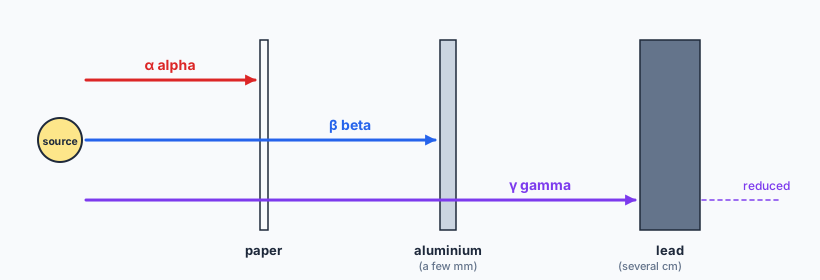
Alpha and beta are deflected by electric and magnetic fields (in opposite directions, because their charges are opposite); gamma is not.
⚖️Nuclear equations
In a nuclear equation both the mass numbers (top) and the atomic numbers (bottom) must balance.
Gamma emission changes neither number; the nucleus just loses energy.
⏳Half-life
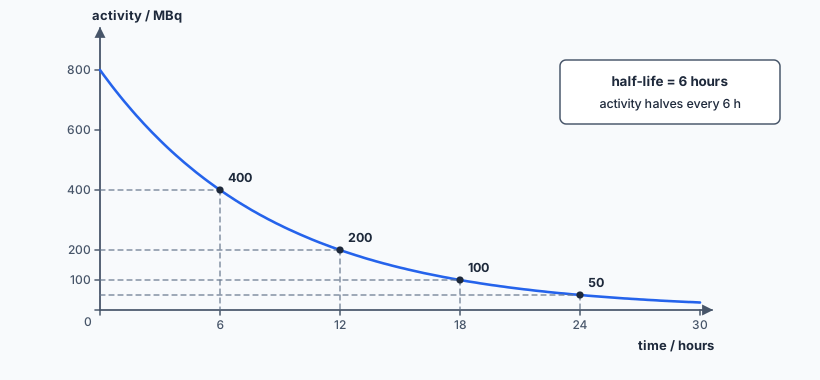
The activity of a source is the number of decays per second, measured in becquerels (Bq) with a Geiger–Müller tube and counter. Because decay is random, a large sample behaves predictably: the half-life is the time taken for the number of unstable nuclei — or the activity — to halve. It is constant for a given isotope, from fractions of a second to billions of years.
✏️Worked example: a medical tracer
1. Number of half-lives. 24 ÷ 6 = 4.
2. Halve four times. 800 → 400 → 200 → 100 → 50 MBq.
3. Fraction. \( \left(\tfrac12\right)^4 = \tfrac{1}{16} \) of the original activity.
🌍Background radiation, uses and dangers
Background radiation is around us all the time: radon gas from rocks, cosmic rays, food and our own bodies (natural), plus medical X-rays and scans (artificial). Always measure background and subtract it from your readings.
Uses depend on the type of radiation and the half-life:
- Smoke detectors — alpha from americium ionizes the air; smoke absorbs it, the current falls and the alarm sounds.
- Thickness control — beta passing through paper or plastic sheet; a change in count adjusts the rollers.
- Sterilizing food and medical equipment, and radiotherapy for cancer — gamma kills cells.
- Tracers — short-half-life gamma emitters show blood flow or leaks in pipes.
- Carbon dating — carbon-14 (half-life 5730 years) dates once-living material.
Dangers: ionizing radiation damages cells and DNA, causing burns, radiation sickness and cancer. Outside the body gamma and beta are most dangerous (they penetrate); inside the body alpha is the most dangerous (it is strongly ionizing and all its energy is deposited in nearby cells). Irradiation is exposure to radiation from outside; the object does not become radioactive. Contamination is when radioactive material gets onto or into something, which keeps being exposed until it is removed. Safety: keep your distance, minimize time, use shielding, handle sources with tongs.
⚡Fission and fusion
- Fission — a large nucleus such as uranium-235 absorbs a neutron and splits into two smaller nuclei plus two or three neutrons, releasing energy. Those neutrons can split more nuclei: a chain reaction. In a nuclear reactor, control rods absorb spare neutrons to keep it steady; the energy heats water for a steam turbine.
- Fusion — small nuclei such as hydrogen join to form a larger one, releasing even more energy per kilogram. It powers the Sun, but needs temperatures of millions of degrees, so fusion power stations are still experimental.
🌎Science in context: nuclear power for Indonesia?
Indonesia has debated building nuclear power stations for decades. Supporters point to reliable, low-carbon electricity; opponents point to earthquake and tsunami risk, the cost, and waste that stays radioactive for thousands of years. The 2011 Fukushima disaster in Japan — another country on the Pacific Ring of Fire — is central to this debate and is an excellent Criterion D case study.
🧠Quick check
1. Which radiation is stopped by paper, and which needs thick lead to reduce it?
Alpha is stopped by paper; gamma needs thick lead (and is only reduced, not completely stopped).
2. Complete: \( ^{238}_{92}\text{U} \rightarrow {}^{?}_{?}\text{Th} + {}^{4}_{2}\alpha \).
\( ^{234}_{90}\text{Th} \): 238 − 4 = 234 and 92 − 2 = 90.
3. A sample has an activity of 1200 Bq and a half-life of 2 days. What is its activity after 8 days?
8 ÷ 2 = 4 half-lives: 1200 → 600 → 300 → 150 → 75 Bq.
4. Why is an alpha source inside the body more dangerous than one outside it?
Outside, alpha is stopped by the dead outer layer of skin. Inside, it deposits all its energy in nearby living cells, and it is the most strongly ionizing, so it causes the most damage.
5. What is the difference between contamination and irradiation?
Irradiation is exposure to radiation from an outside source; contamination is radioactive material getting onto or into an object, which keeps emitting until it is removed.
6. What is the difference between nuclear fission and fusion?
Fission splits a large nucleus into smaller ones; fusion joins small nuclei into a larger one. Both release energy.
📝Worksheet
Test yourself on the whole topic with a printable worksheet: questions for all four criteria, from recall to a design task, a data-analysis question and a short reflection, with a full mark scheme.
Worksheets are for members — sign in or join. The topic 1 worksheet is a free sample.