Work, energy and power
🎯What you need to be able to do
- Name energy stores and the ways energy is transferred between them.
- Calculate work done, \( W = Fd \).
- Calculate kinetic energy \( E_k = \tfrac12 mv^2 \) and gravitational potential energy \( E_p = mgh \).
- Apply conservation of energy, including falling and swinging objects.
- Calculate power, \( P = E/t \), and efficiency, and draw Sankey diagrams.
🔋Energy stores and transfers
Energy is measured in joules (J). It is useful to think of energy sitting in stores:
- kinetic — in anything moving;
- gravitational potential — in anything raised above the ground;
- elastic potential — in a stretched or squashed spring or rubber band;
- chemical — in fuels, food and batteries;
- thermal (internal) — in anything warm;
- nuclear — in the nuclei of atoms.
Energy moves from one store to another by four transfer pathways: mechanically (a force moving through a distance), electrically (a current), by heating, and by radiation (light, sound and other waves). A battery-powered fan transfers energy from the battery’s chemical store, electrically to the motor, and mechanically to the kinetic store of the blades and the air — with some heating of the motor on the way.
🔧Work done
When a force moves an object, it does work on it and energy is transferred. The work done equals the energy transferred.
Holding a heavy bag still does no work on the bag, however tiring it feels: it does not move. Friction does work too, transferring energy to the thermal store of the surfaces — which is why rubbing your hands warms them.
⚡Kinetic and gravitational potential energy
Because speed is squared, doubling the speed of a car quadruples its kinetic energy — and the energy the brakes must remove. The change in gravitational potential energy depends only on the change in height \( h \), not on the route taken.
♻️Conservation of energy
The principle of conservation of energy: energy cannot be created or destroyed, only transferred from one store to another. The total is always the same. In a falling object with no air resistance, every joule of gravitational potential energy lost becomes a joule of kinetic energy: \( mgh = \tfrac12 mv^2 \). Real systems also transfer some energy to thermal stores, by friction or air resistance. That energy is not destroyed; it is dissipated — spread out into the surroundings, where it is no longer useful.
✏️Worked example: a falling coconut
(a) \( E_p = mgh = 1.5 \times 9.8 \times 12 = 176.4 \approx 176 \) J.
(b) All of it becomes kinetic energy: \( \tfrac12 mv^2 = 176.4 \), so \[ v = \sqrt{\frac{2 \times 176.4}{1.5}} = \sqrt{235.2} = 15.3\ \text{m/s} \]
⏳Power
Power is the rate of transferring energy, or of doing work.
Two students climb the same stairs; they do the same work if they weigh the same, but the one who runs up develops more power.
📊Efficiency and Sankey diagrams
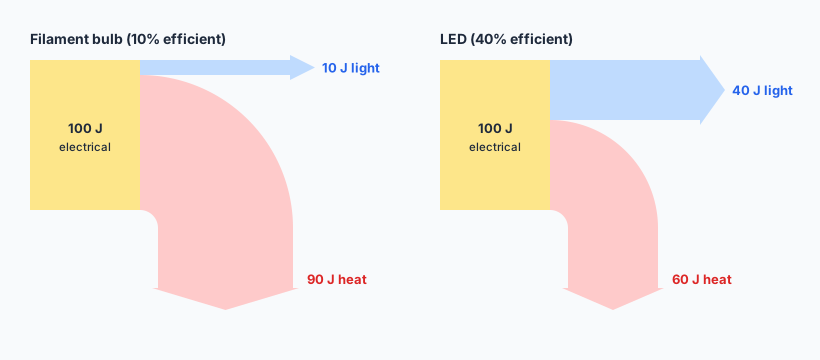
A Sankey diagram shows energy transfers as arrows whose widths are proportional to the amount of energy. The useful output goes straight on; wasted energy bends away.
🌎Science in context: efficient lighting
Switching from filament bulbs to LEDs is one of the cheapest ways to cut electricity use: for the same light, the LED draws about a quarter of the power. Many countries, including Indonesia through its energy-efficiency labelling, now push consumers towards efficient appliances. A Criterion D discussion could weigh the lower running cost and emissions against a higher purchase price and the disposal of electronic waste.
🧠Quick check
1. A worker pushes a crate 8.0 m with a force of 150 N. How much work is done?
\( W = Fd = 150 \times 8.0 = 1200 \) J.
2. Find the kinetic energy of a 70 kg runner moving at 6.0 m/s.
\( E_k = \tfrac12 \times 70 \times 6.0^2 = 1260 \) J.
3. A 50 kg student climbs 4.0 m of stairs in 5.0 s. Find the power she develops. (g = 9.8 N/kg)
\( E = mgh = 50 \times 9.8 \times 4.0 = 1960 \) J; \( P = 1960 \div 5.0 = 392 \) W.
4. A motor takes in 500 J and gives 350 J of useful kinetic energy. What is its efficiency, and where does the rest go?
350 ÷ 500 × 100% = 70%. The other 150 J is dissipated, mainly heating the motor and the surroundings (and some as sound).
5. A pendulum swings lower and lower until it stops. Has energy been destroyed?
No. Air resistance and friction at the pivot transfer energy to the thermal store of the pendulum and air. The total energy is conserved; it has been dissipated.
6. If a car's speed goes from 10 m/s to 20 m/s, by what factor does its kinetic energy change?
It quadruples, because \( E_k \propto v^2 \) and \( 2^2 = 4 \).
📝Worksheet
Test yourself on the whole topic with a printable worksheet: questions for all four criteria, from recall to a design task, a data-analysis question and a short reflection, with a full mark scheme.
Worksheets are for members — sign in or join. The topic 1 worksheet is a free sample.