Mass, weight and density
🎯What you need to be able to do
- State what mass and weight are; define gravitational field strength and use \( g = \dfrac{W}{m} \); compare masses with a balance.
- Describe weight as the effect of a gravitational field on a mass EXTENDED.
- Define density and use \( \rho = \dfrac{m}{V} \); describe how to measure the density of a liquid, a regular solid and an irregular solid.
- Decide whether an object floats from density data; whether one liquid floats on another EXTENDED.
📚The physics
Mass and weight
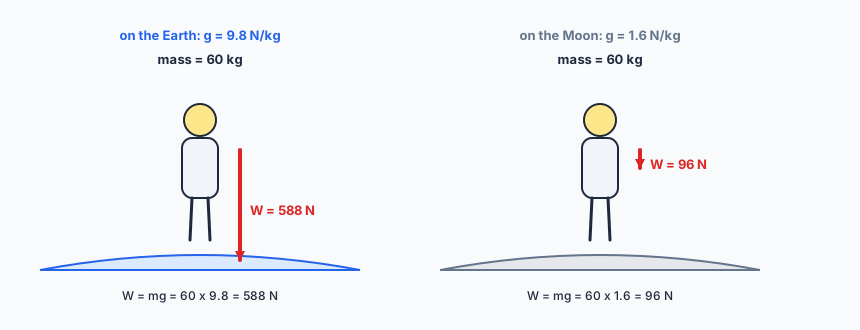
Mass is a measure of the quantity of matter in an object at rest relative to the observer; it is measured in kilograms and does not depend on where the object is. Weight is a gravitational force on an object that has mass, measured in newtons.
Gravitational field strength is force per unit mass:
On the Earth \( g = 9.8 \) N/kg, which is equivalent to the acceleration of free fall, 9.8 m/s2. Weights (and so masses) can be compared using a balance. EXTENDED Weight is the effect of a gravitational field on a mass: move the mass to a weaker field and its weight falls, while its mass stays the same.
Density
Density is mass per unit volume:
Units are g/cm3 or kg/m3; 1 g/cm3 = 1000 kg/m3 (water is 1.0 g/cm3).
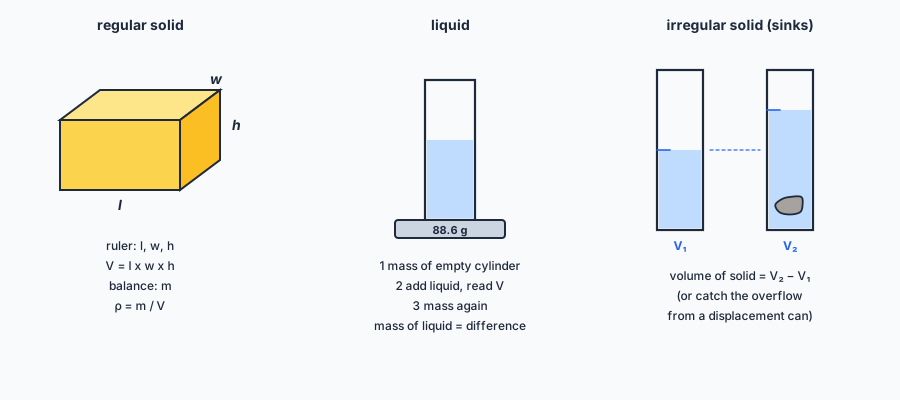
- Regular solid: measure the sides with a ruler (a calliper for small ones), \( V = l \times w \times h \); mass on a balance.
- Liquid: find the mass of an empty measuring cylinder, pour in liquid, read the volume, find the mass again; subtract.
- Irregular solid that sinks: volume by displacement — the rise in water level in a measuring cylinder, or the volume of water that overflows from a full displacement can into a measuring cylinder.
Floating and sinking
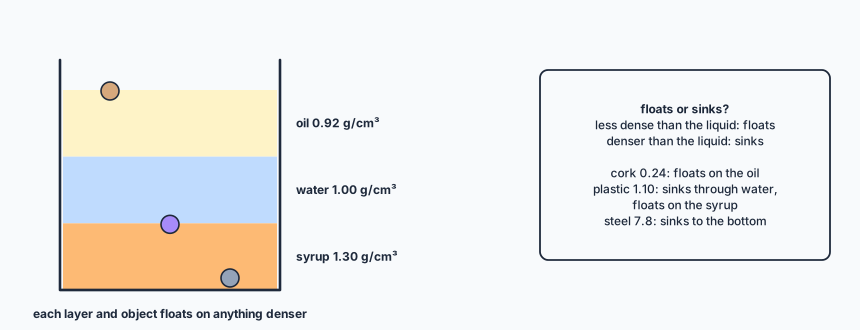
An object floats in a liquid if its density is less than the liquid’s and sinks if it is greater. EXTENDED Liquids that do not mix form layers: the less dense liquid floats on the denser one.
✏️Worked example
(a) Volume = 100 − 40 = 60 cm3. \( \rho = \dfrac{156}{60} = 2.6 \) g/cm3 = 2600 kg/m3.
(b) Yes: 2.6 g/cm3 is less than 2.9 g/cm3.
(c) Lower it gently on a thread (so no water splashes out and the cylinder does not crack); make sure it is fully submerged; read the meniscus at eye level.
📝Practise
In the style of the multiple-choice, theory and practical papers. EXTENDED marks Supplement content.
1. (Multiple choice.) Which is a unit of weight? A: gram. B: kilogram. C: newton. D: joule.
2. (Theory.) A rover has a mass of 900 kg. On Mars, g = 3.7 N/kg. Calculate its weight on Mars, and state its mass there. [2]
3. (Theory.) A scientist has a small piece of rock, a displacement can, a measuring cylinder, a beaker of water and a balance. Describe how to find the volume of the rock. [3] (Modelled on 0625/32 June 2026 Q3.)
4. (Theory.) The rock in question 3 has a mass of 84 g and a volume of 35 cm3. Calculate its density. [2]
5. (Multiple choice.) Densities: petrol 0.70, water 1.00, glycerol 1.26 (g/cm3). Which object floats on glycerol but sinks in water and in petrol? A: 18 g, 20 cm3. B: 30 g, 25 cm3. C: 40 g, 25 cm3. D: 12 g, 20 cm3. (Modelled on 0625/12 June 2026 Q5.)
6. (Practical.) Describe how to measure the density of cooking oil. [4]
7. (Theory.) EXTENDED Paraffin (0.80 g/cm3) and salt water (1.03 g/cm3) do not mix. Which liquid forms the top layer? Explain. [1]
8. (Theory.) Convert 7.8 g/cm3 into kg/m3. [1]
🔗Go deeper — other people’s work
These are external resources, not mine. If one stops working, tell me and everything above it on this page still stands.
- PhET “Density” — blocks of different materials in water
- BBC Bitesize — density and how to measure it