Kinetic particle model and gases
🎯What you need to be able to do
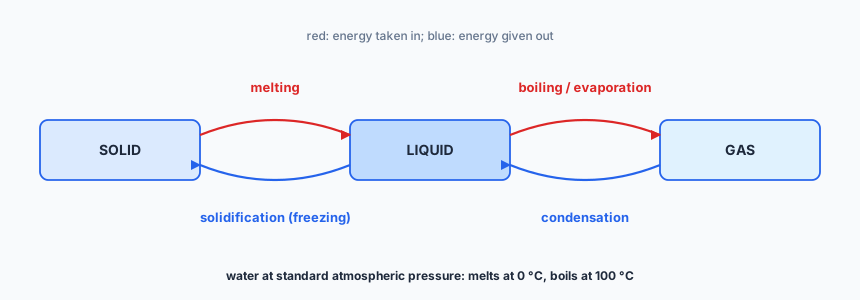
- Know the properties of solids, liquids and gases and the names of the changes of state.
- Describe and draw the particle structure of each state; link particle motion to temperature and absolute zero.
- Describe Brownian motion as evidence for the kinetic particle model.
- Explain gas pressure, and its changes with temperature and volume, in terms of particles; use force per unit area EXTENDED.
- Convert between kelvin and degrees Celsius; use \( pV = \) constant EXTENDED.
📚The physics
States of matter
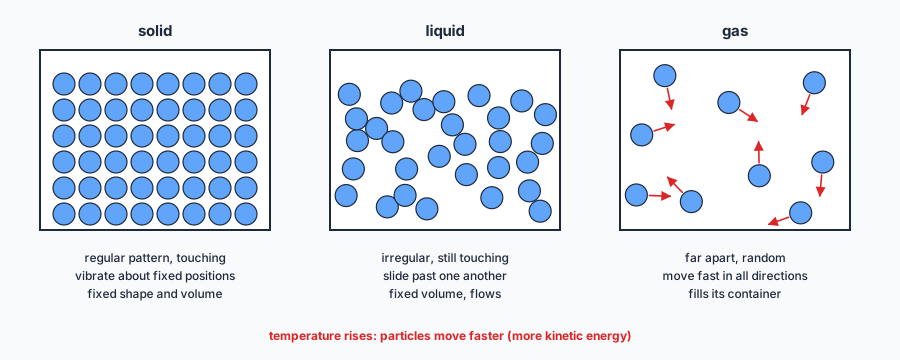
EXTENDED The forces and distances between particles (atoms, molecules, ions, electrons) and the motion of the particles decide the properties. In a solid, strong forces hold particles close in fixed positions; in a liquid, the forces still hold them close but they can move past each other; in a gas, the forces are very weak and the particles are far apart.
Temperature and particles
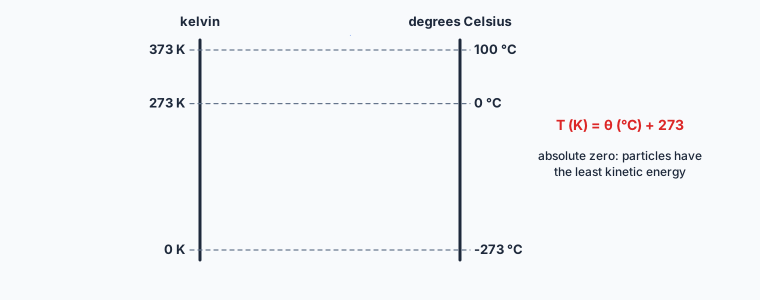
The higher the temperature, the faster the particles move (the more kinetic energy they have). There is a lowest possible temperature, absolute zero, −273 °C, where the particles have the least kinetic energy.
Brownian motion
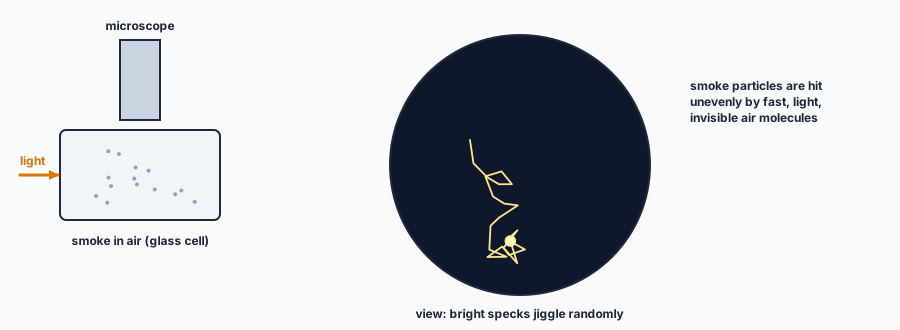
The random motion of microscopic particles in a suspension is evidence for the kinetic particle model. The visible particles (smoke, pollen) are hit at random by the particles of the gas or liquid, which are far too small to see. EXTENDED The air molecules are light and fast-moving; the smoke particle is far more massive, so each collision moves it only slightly, and the uneven number of hits on different sides makes it jiggle.
Gas pressure
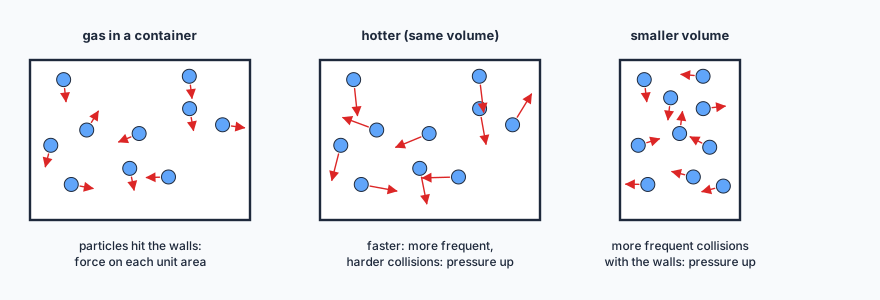
- Gas particles move randomly and collide with the walls of the container, exerting a force. EXTENDED Each collision changes a particle’s momentum, so exerts a force; pressure is the total force of the collisions per unit area.
- Temperature up, volume constant: particles move faster, hit the walls more often and harder, so pressure increases.
- Volume down, temperature constant: the same particles in a smaller space hit the walls more often, so pressure increases.
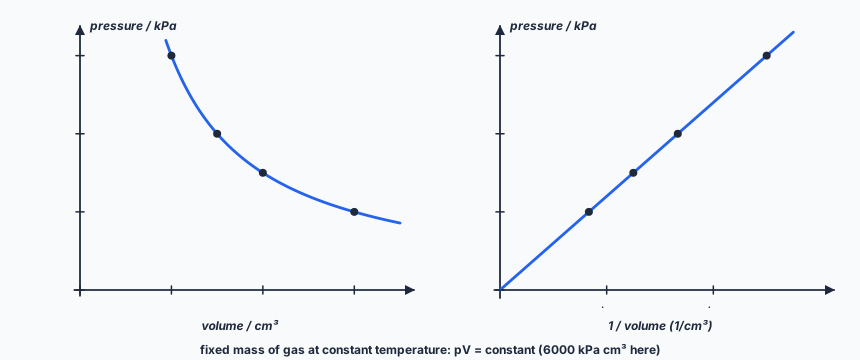
EXTENDED For a fixed mass of gas at constant temperature: \( p_1V_1 = p_2V_2 \). A graph of p against V is a curve; p against 1/V is a straight line through the origin.
✏️Worked example
(a) The same number of particles are in a smaller volume, so they hit the walls (the plunger) more frequently; the force per unit area increases.
(b) \( p_2 = \dfrac{p_1V_1}{V_2} = \dfrac{100 \times 60}{24} = \) 250 kPa.
(c) 22 + 273 = 295 K.
📝Practise
In the style of the multiple-choice and theory papers. EXTENDED marks Supplement content.
1. (Theory.) Molten metal is poured into a mould and cools until it is solid. Name this change of state, and describe the arrangement, separation and motion of the particles in the solid. [4] (Modelled on 0625/32 June 2026 Q4.)
2. (Theory.) State the name for the lowest possible temperature and its value in °C. [2]
3. (Theory.) EXTENDED A weather balloon is filled with hydrogen. Explain, in terms of particles, how the gas exerts a pressure on the inside of the balloon, and convert the air temperature at its highest point, 218 K, into °C. [4] (Modelled on 0625/42 June 2026 Q2(b).)
4. (Multiple choice.) Tyre pressure is lower on a cold night than on a warm afternoon, with no leak. Why? A: The air particles are smaller. B: The air particles move more slowly and hit the walls less often. C: There are fewer air particles. D: The air particles stick to the rubber.
5. (Theory.) Describe what is seen when smoke in air is observed through a microscope, and explain it. [3]
6. (Theory.) EXTENDED A gas at 120 kPa occupies 2.0 m3. At constant temperature it expands to 3.0 m3. Calculate the new pressure. [2]
7. (Multiple choice.) Which equation converts a temperature θ in °C into T in kelvin? A: T = θ − 273. B: T = θ + 273. C: T = 273 − θ. D: T = 273θ.
🔗Go deeper — other people’s work
These are external resources, not mine. If one stops working, tell me and everything above it on this page still stands.
- PhET “States of Matter” and “Gas Properties” — particles, temperature and pressure
- Royal Society of Chemistry — Brownian motion demonstrations