Radioactivity and half-life
🎯What you need to be able to do
- Know what background radiation is and its main sources; measure count rate; correct for background EXTENDED.
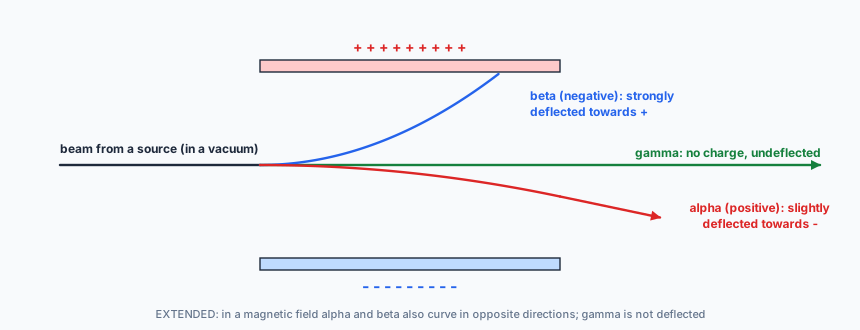
- Describe emission as spontaneous and random; identify alpha, beta and gamma by nature, ionising effect and penetration; describe their deflection EXTENDED.
- Describe radioactive decay; use decay equations and explain why some nuclei are unstable EXTENDED.
- Define half-life and use it in calculations; find half-life from data with background; choose isotopes for uses EXTENDED.
- State the effects of ionising radiation on living things and describe safe handling; explain precautions EXTENDED.
📚The physics
Detecting radiation
Background radiation is the ionising radiation always present around us. Significant sources are radon gas in the air, rocks and buildings, food and drink, and cosmic rays. Ionising radiation is measured with a detector (such as a Geiger–Müller tube) connected to a counter; the count rate is given in counts/s or counts/minute. EXTENDED Measure the background count with no source present and subtract it from every reading to get the corrected count rate.
Alpha, beta and gamma
Radioactive emission is spontaneous (nothing triggers it) and random in direction and timing.
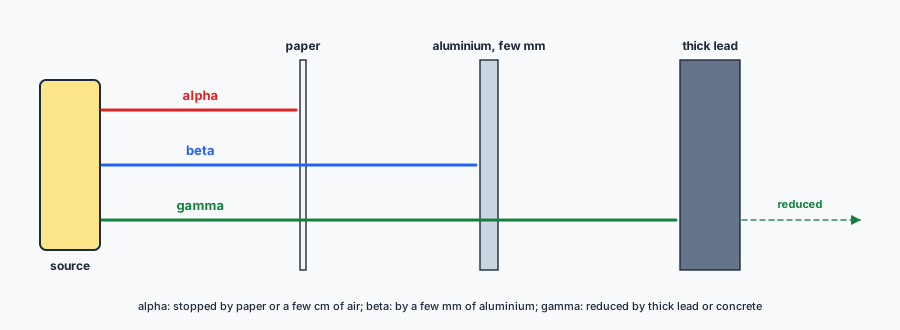
EXTENDED Alpha particles are the most ionising because they are heavily charged (+2) and move relatively slowly with a large kinetic energy, so they interact with many atoms in a short distance. Gamma rays have no charge, so they rarely ionise.
Radioactive decay
Radioactive decay is a change in an unstable nucleus that emits alpha or beta particles and/or gamma radiation; it is spontaneous and random. In alpha or beta decay the nucleus becomes a different element. EXTENDED Isotopes may be radioactive because they have too many neutrons or are too heavy; decay makes the nucleus more stable. In beta decay a neutron changes into a proton and an electron: neutron → proton + electron.
EXTENDED Alpha decay: A falls by 4 and Z by 2. Beta decay: A unchanged, Z rises by 1. Gamma emission: no change in A or Z (the nucleus loses energy).
Half-life
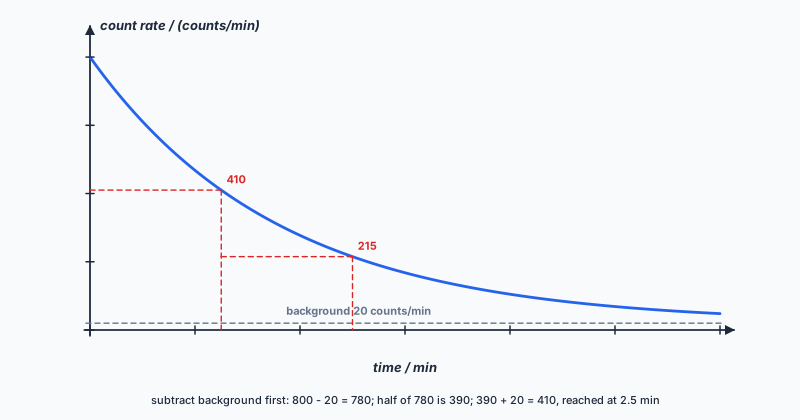
The half-life of an isotope is the time taken for half the nuclei of that isotope in any sample to decay (so the count rate halves).
Uses EXTENDED
- Smoke alarms: an alpha source with a long half-life (americium-241, 432 years) ionises air between plates; smoke absorbs the alpha particles, the current falls and the alarm sounds.
- Irradiating food and sterilising equipment: gamma rays kill bacteria, penetrating the packaging.
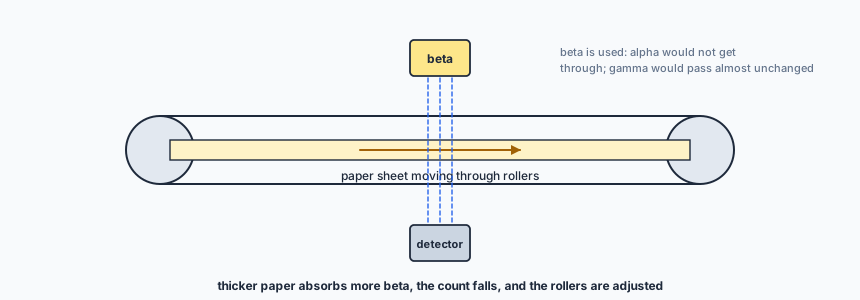
- Measuring and controlling thickness: the radiation chosen must be partly absorbed by the material (beta for paper, gamma for steel sheet).
- Diagnosis and treatment of cancer: gamma emitters; tracers need a short half-life so the patient is not exposed for long.
Safety
Ionising radiation can cause cell death, mutations and cancer. Sources are moved and used with tongs, kept pointing away from people, and stored in lead-lined boxes. EXTENDED Precautions work by reducing exposure time, increasing the distance between the source and living tissue, and using shielding to absorb the radiation.
✏️Worked example
(a) Corrected initial rate = 800 − 20 = 780; half is 390, so the reading is 390 + 20 = 410, reached at 2.5 min. (Check: 215 − 20 = 195 = 780/4 at 5.0 min.)
(b) 10 min is 4 half-lives: 780 × (½)4 = 49 counts/min (48.75).
(c) 24 / 8 = 3 half-lives: (½)3 = 1/8.
📝Practise
In the style of the multiple-choice and theory papers. EXTENDED marks Supplement content.
1. (Theory.) Complete a table for alpha, beta and gamma: the nature of each emission and its charge. [3] (Modelled on 0625/32 June 2026 Q9(a).)
2. (Theory.) EXTENDED A sample contains 24 μg of strontium-90 (half-life 29 years). Sketch the mass–time graph for 90 years, and state the mass after 58 years. [3] (Modelled on 0625/42 June 2026 Q9(a)(ii).)
3. (Multiple choice.) EXTENDED A source has a half-life of 6.0 hours. With the source present a detector reads 330 counts/min; the background is 30 counts/min. What is the count rate due to the source after 6.0 hours? A: 135. B: 150. C: 165. D: 180 counts/min.
4. (Theory.) EXTENDED Polonium-210 (Z = 84) emits an alpha particle. Write the decay equation, the product being lead (Pb). [2]
5. (Theory.) State two sources that make a significant contribution to background radiation. [2]
6. (Multiple choice.) A hospital worker wears a lead apron near a radioactive source. How does it protect her? A: it increases her distance from the source. B: it reduces her exposure time. C: it absorbs some of the radiation. D: it reflects the radiation.
7. (Theory.) EXTENDED Explain why an alpha source with a long half-life is used in a smoke alarm. [3]
8. (Theory.) EXTENDED Describe what happens in a nucleus during beta decay. [2]
🔗Go deeper — other people’s work
These are external resources, not mine. If one stops working, tell me and everything above it on this page still stands.
- PhET “Alpha Decay”, “Beta Decay” and “Radioactive Dating Game”
- UK Health Security Agency — radon and background radiation