Induction, generators and transformers
🎯What you need to be able to do
- Know that moving a conductor across a field, or changing the field linking it, induces an e.m.f.; describe an experiment and the factors affecting its size.
- Know that the induced e.m.f. opposes the change causing it; use the relative directions of force, field and induced current EXTENDED.
- Describe a simple a.c. generator with slip rings and brushes, and interpret its e.m.f.–time graph EXTENDED.
- Describe transformers; use \( \dfrac{V_p}{V_s} = \dfrac{N_p}{N_s} \); describe high-voltage transmission and its advantages.
- Explain how a transformer works; use \( I_pV_p = I_sV_s \) and \( P = I^2R \) EXTENDED.
📚The physics
Electromagnetic induction
An e.m.f. is induced in a conductor when it moves across a magnetic field, or when the magnetic field linking it changes. If the conductor is part of a complete circuit, a current flows.
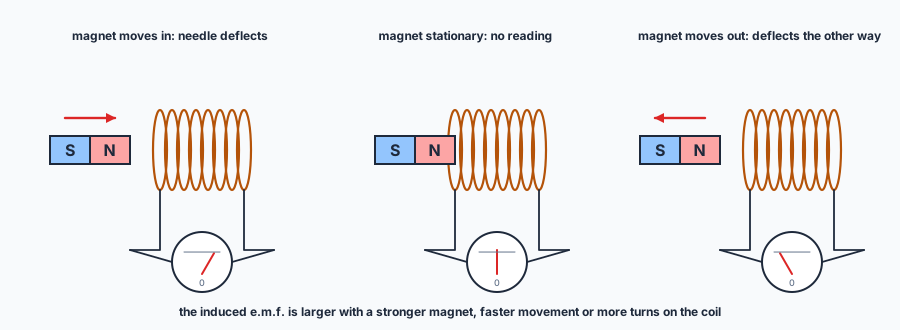
The size of the induced e.m.f. increases with a stronger magnet, faster movement (a faster change) and more turns on the coil. EXTENDED The direction of the induced e.m.f. opposes the change causing it: pushing an N pole into a coil induces a current that makes an N pole at that end, repelling the magnet. For a wire moving across a field, the force (motion), field and induced current are at right angles to each other (Fleming’s right-hand rule).
The a.c. generator EXTENDED
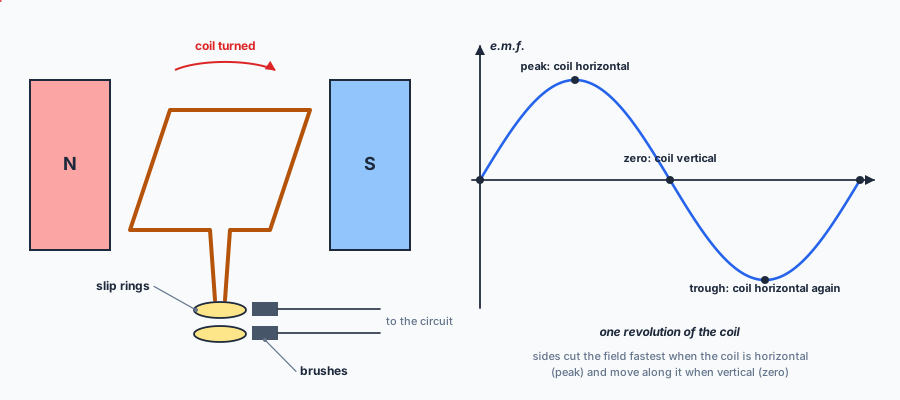
EXTENDED A coil rotating in a magnetic field (or a magnet rotating inside a coil) has an e.m.f. induced in it that reverses every half turn: alternating current. Slip rings and brushes connect the turning coil to the external circuit without twisting the wires. The e.m.f. is greatest when the plane of the coil is parallel to the field (its sides cut the field lines fastest) and zero when the coil is at right angles to the field.
Transformers
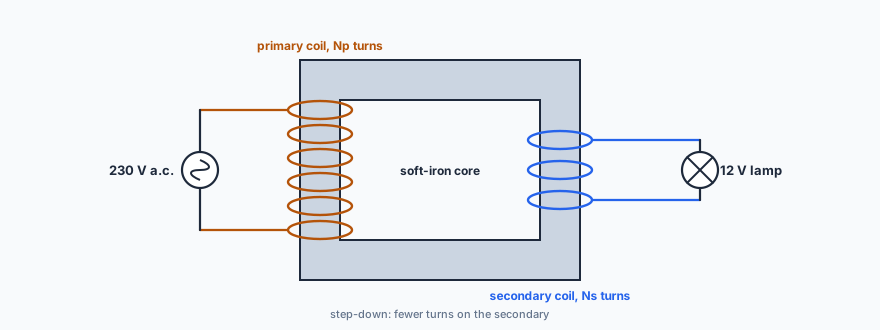
A step-up transformer has more turns on the secondary coil and increases the voltage; a step-down transformer has fewer. EXTENDED The alternating current in the primary coil produces a changing magnetic field in the soft-iron core; this changing field passes through the secondary coil and induces an alternating e.m.f. in it. For a 100% efficient transformer, power in = power out:
High-voltage transmission
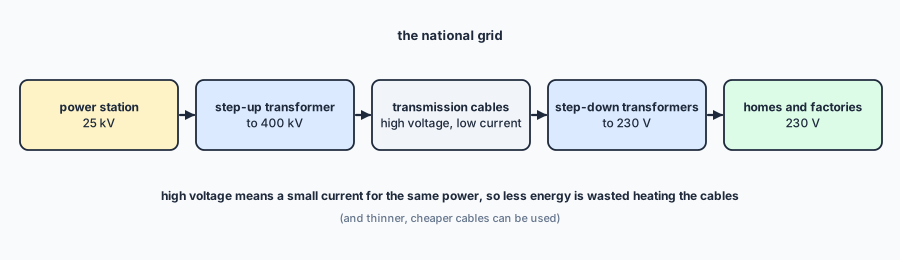
Transmitting at a high voltage means a lower current for the same power, so less energy is wasted heating the cables, and thinner, lighter, cheaper cables and pylons can be used. EXTENDED The power wasted in the cables is \( P = I^2R \): halving the current quarters the loss.
✏️Worked example
(a) I = P/V = 1.0 × 10⁶ / 1.0 × 104 = 100 A; P = I2R = 1002 × 5.0 = 50 000 W (5% of the power).
(b) I = 1.0 × 10⁶ / 4.0 × 105 = 2.5 A; P = 2.52 × 5.0 = 31 W.
(c) \( N_p = N_s \times \dfrac{V_p}{V_s} = 550 \times \dfrac{400}{11} = \) 20 000 turns.
📝Practise
In the style of the multiple-choice and theory papers. EXTENDED marks Supplement content.
1. (Multiple choice.) EXTENDED A 100% efficient transformer has 3000 turns on its primary and 600 on its secondary. The primary is supplied with 0.80 A at 230 V. What is the secondary current? A: 0.16 A. B: 0.80 A. C: 4.0 A. D: 46 A. (Modelled on 0625/22 June 2026 Q33.)
2. (Theory.) A magnet is held still inside a coil connected to a meter. State and explain the reading. [2]
3. (Theory.) State three ways to increase the e.m.f. induced when a magnet is pushed into a coil. [3]
4. (Theory.) A transformer changes 230 V to 6.0 V. The primary has 1150 turns. Calculate the number of secondary turns. [2]
5. (Theory.) EXTENDED Explain how a transformer produces an output voltage. [3]
6. (Theory.) EXTENDED Explain why a transformer does not work with a steady d.c. supply. [2]
7. (Theory.) EXTENDED Sketch the e.m.f.–time graph for a simple a.c. generator, and describe the effect of turning the coil twice as fast. [3]
8. (Multiple choice.) A transformer gets warm when it is used. Which energy store increases? A: chemical. B: gravitational. C: internal (thermal) store of the surroundings. D: nuclear.
🔗Go deeper — other people’s work
These are external resources, not mine. If one stops working, tell me and everything above it on this page still stands.
- PhET “Faraday’s Electromagnetic Lab” — induction, generators and transformers
- BBC Bitesize — the national grid and transformers