Thin lenses and dispersion
🎯What you need to be able to do
- Describe the action of thin converging and diverging lenses on a parallel beam; define focal length, principal axis and principal focus.
- Draw ray diagrams for a real image, and describe images as enlarged/same size/diminished, upright/inverted, real/virtual.
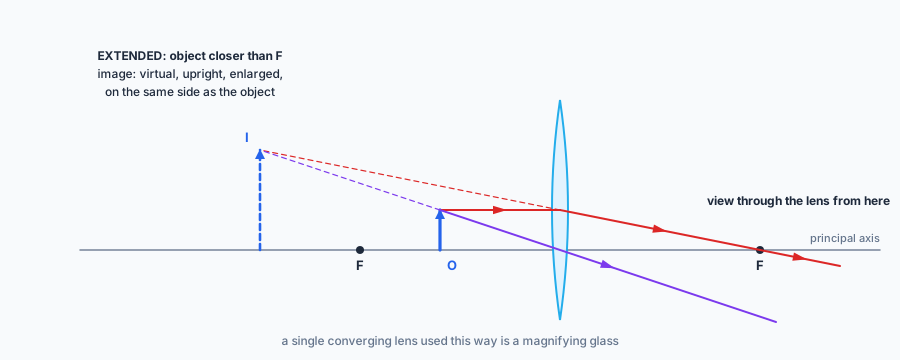
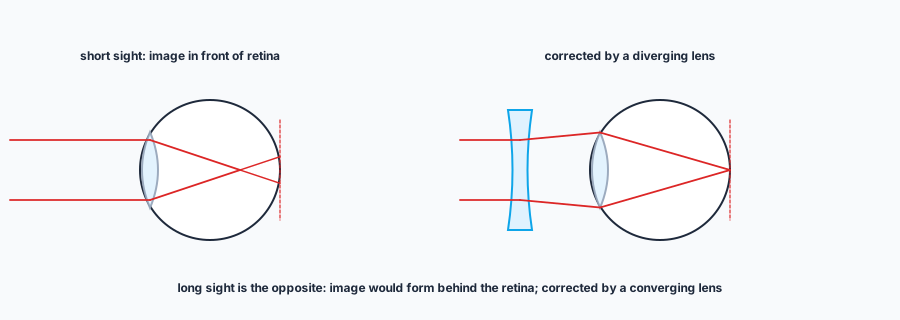
- Draw ray diagrams for a virtual image; describe a magnifying glass and the correction of short and long sight EXTENDED.
- Describe dispersion by a prism and the seven colours in order; recall that light of one frequency is monochromatic EXTENDED.
📚The physics
Lenses and a parallel beam
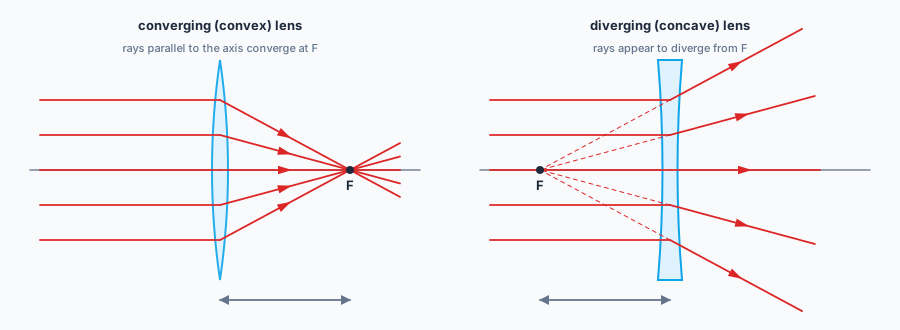
Ray diagrams
Draw any two of these rays from the top of the object; where they meet is the top of the image:
- parallel to the principal axis, then through F on the far side;
- straight through the centre of the lens, undeviated;
- through F on the object side, then parallel to the principal axis.
A real image is formed where rays actually meet and can be projected on a screen. A virtual image is formed where diverging rays appear to come from when extended backwards; it cannot be projected. Describe any image as enlarged, same size or diminished; upright or inverted; real or virtual.
Correcting sight EXTENDED
Dispersion
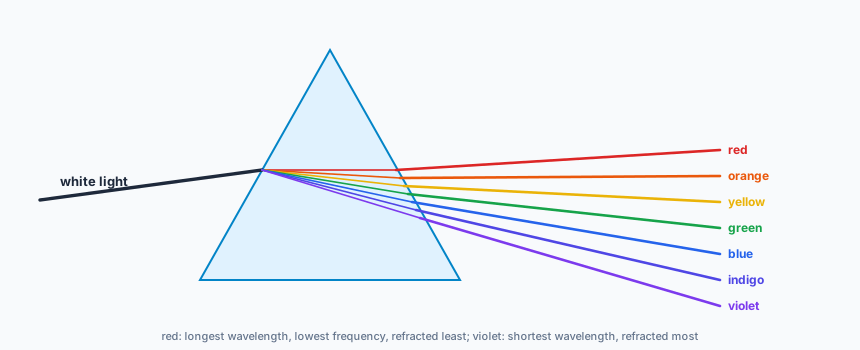
White light is a mixture of colours. A prism refracts each colour by a different amount, so they separate: this is dispersion. The seven colours, in order of increasing frequency (decreasing wavelength), are red, orange, yellow, green, blue, indigo, violet. EXTENDED Light of a single frequency is monochromatic.
✏️Worked example
(a) … where rays parallel to the principal axis converge (meet) after passing through the lens.
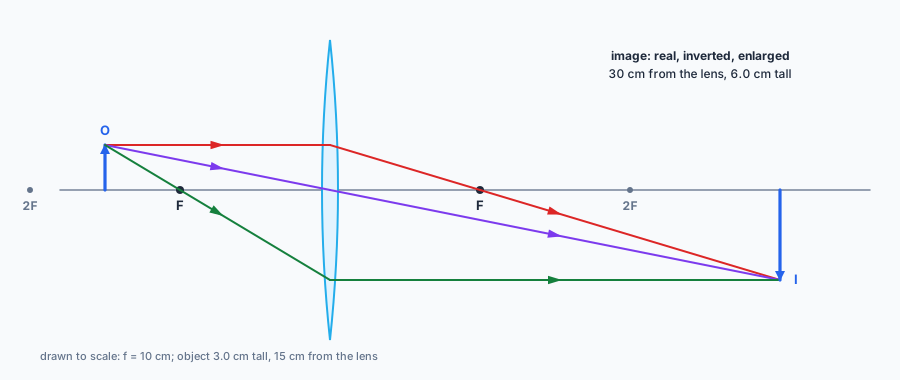
(b) Two rays (any two of the three shown) from the top of O meet 30 cm from the lens, 6.0 cm below the axis. Draw the image arrow from the axis to that point and label it I.
(c) Real, inverted, enlarged (magnified twice).
📝Practise
In the style of the multiple-choice and theory papers. EXTENDED marks Supplement content.
1. (Multiple choice.) Which list gives three colours of the spectrum in order of decreasing frequency? A: red, green, violet. B: violet, green, red. C: green, red, violet. D: violet, red, green.
2. (Multiple choice.) EXTENDED A long-sighted student reads a book. Where does her eye form the image, and which lens corrects it? A: in front of the retina, converging. B: in front of the retina, diverging. C: behind the retina, converging. D: behind the retina, diverging. (Modelled on 0625/22 June 2026 Q21.)
3. (Theory.) An object is 30 cm from a converging lens of focal length 10 cm. Describe the image formed. [3]
4. (Theory.) State the difference between a real image and a virtual image. [2]
5. (Theory.) EXTENDED Explain how a converging lens can be used as a magnifying glass. [2]
6. (Practical.) Describe how to measure the focal length of a converging lens quickly. [3]
7. (Theory.) EXTENDED What is meant by monochromatic light? [1]
🔗Go deeper — other people’s work
These are external resources, not mine. If one stops working, tell me and everything above it on this page still stands.
- PhET “Geometric Optics” — move an object and watch the image
- The Physics Classroom — ray diagrams for converging lenses