Transfer of thermal energy
🎯What you need to be able to do
- Describe experiments on good and bad thermal conductors; explain conduction by lattice vibrations and free electrons EXTENDED.
- Explain convection in liquids and gases in terms of density changes, and describe experiments to show it.
- Know that thermal radiation is infrared, needs no medium, and depends on surface colour and texture; describe experiments on emitters and absorbers EXTENDED.
- Explain the energy balance of an object and of the Earth, and how emission depends on temperature and area EXTENDED.
- Explain everyday applications, including cases where more than one method matters EXTENDED.
📚The physics
Conduction
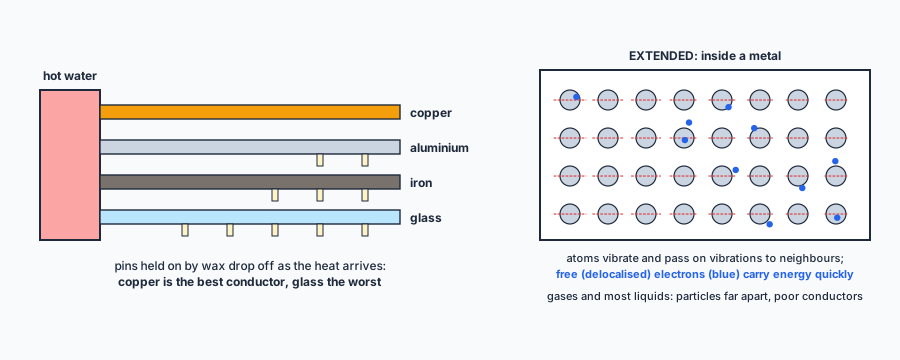
Conduction is the transfer of thermal energy through a material without the material itself moving. EXTENDED In all solids, hotter atoms vibrate more and pass vibrations on to their neighbours through the lattice. Metals also have free (delocalised) electrons that move through the metal and carry energy quickly, so metals conduct far better. Gases and most liquids conduct badly because their particles are far apart and collide less often. Many solids lie between good conductors and insulators.
Convection
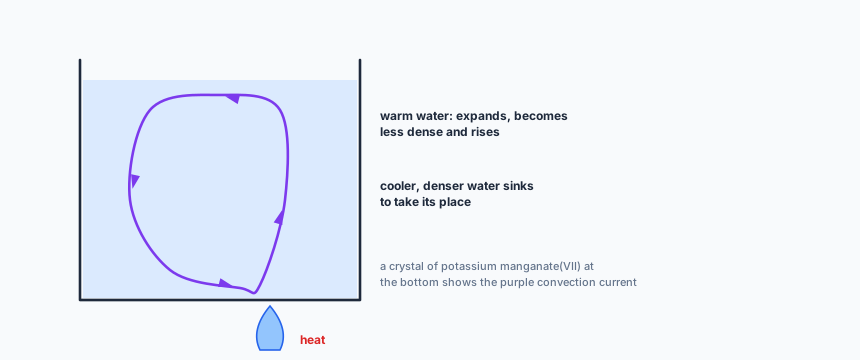
Convection is an important method of thermal energy transfer in liquids and gases. The fluid near the heat source expands, becomes less dense and rises; cooler, denser fluid sinks to replace it, setting up a convection current. That is why a room heater warms the whole room and why the freezing compartment is at the top of a fridge.
Thermal radiation
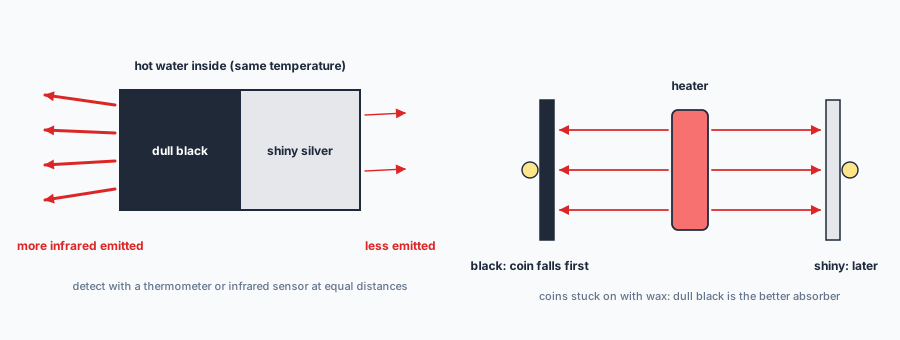
Thermal radiation is infrared radiation; all objects emit it, and it needs no medium — it crosses the vacuum of space from the Sun. Dull black surfaces are the best emitters and absorbers; shiny white or silver surfaces are the worst emitters and absorbers and the best reflectors.
- EXTENDED An object stays at a constant temperature when it transfers energy away at the same rate as it receives it. If it receives energy faster than it loses it, its temperature rises; if slower, it falls.
- EXTENDED The Earth’s temperature depends on the balance between incoming radiation from the Sun and the infrared emitted from its surface. Greenhouse gases absorb some outgoing infrared, so more gas means a warmer balance.
- EXTENDED The rate of emission increases with the surface temperature and the surface area.
Consequences and applications
- Cooking pans: metal base (good conductor) with a plastic or wooden handle (insulator).
- Heating a room: convection currents carry warm air from a heater around the room.
- EXTENDED A fire burning wood or coal: radiation heats you in front of it; convection carries hot gases up the chimney and draws in fresh air; conduction heats the grate.
- EXTENDED A car radiator: coolant conducts energy away from the engine, is pumped to the radiator, and the thin metal fins pass it to air driven through by the fan (forced convection), with some radiation.
✏️Worked example
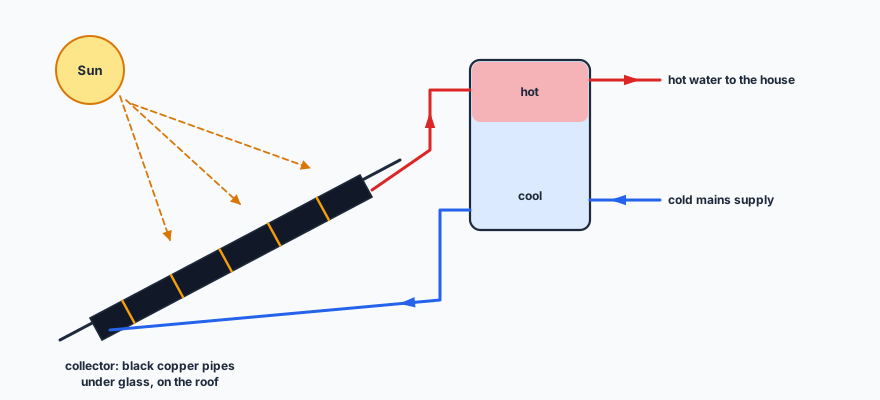
(a) (Thermal) radiation — infrared, which needs no medium.
(b) Dull black surfaces are the best absorbers of infrared radiation, so the pipes (and water) gain energy faster.
(c) Conduction.
(d) Hot water expands and is less dense than cold water, so it rises (floats on the denser cold water): a convection current.
📝Practise
In the style of the multiple-choice, theory and practical papers. EXTENDED marks Supplement content.
1. (Multiple choice.) In which states of matter can convection occur? A: solids only. B: liquids only. C: liquids and gases. D: solids, liquids and gases.
2. (Multiple choice.) EXTENDED A warm, dull black surface emits infrared radiation. Which changes increase the rate of emission? 1: raising its temperature. 2: painting it shiny white. 3: increasing its surface area. A: 1 only. B: 1 and 2. C: 1 and 3. D: 1, 2 and 3.
3. (Theory.) EXTENDED Explain why metals are much better thermal conductors than non-metals. [3]
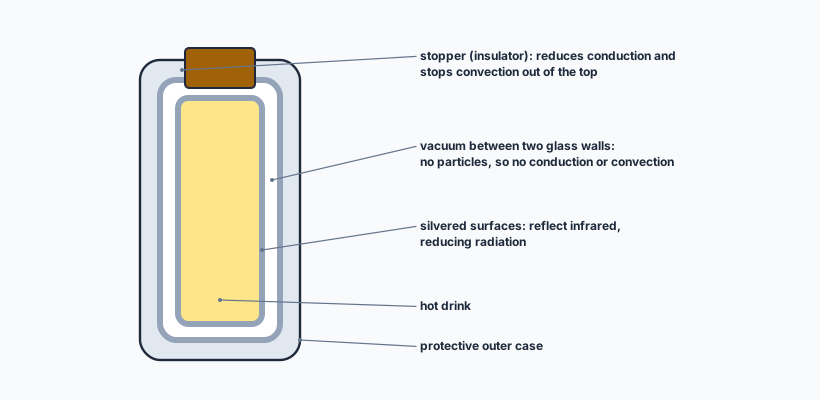
4. (Theory.) Explain how a vacuum flask keeps a drink hot. [4]
5. (Practical.) Describe an experiment to show that a dull black surface is a better absorber of infrared radiation than a shiny surface. [4]
6. (Theory.) EXTENDED A satellite in sunlight stays at a constant temperature. Explain, in terms of energy, why. [2]
7. (Theory.) Explain why the heating element of an electric kettle is at the bottom. [2]
🔗Go deeper — other people’s work
These are external resources, not mine. If one stops working, tell me and everything above it on this page still stands.
- Institute of Physics — demonstrations of conduction, convection and radiation
- PhET “The Greenhouse Effect” — the Earth’s radiation balance