General properties of waves
🎯What you need to be able to do
- Know that waves transfer energy without transferring matter; describe wave motion in ropes, springs and water.
- Describe wavefront, wavelength, frequency, crest, trough, amplitude and wave speed; use \( v = f\lambda \).
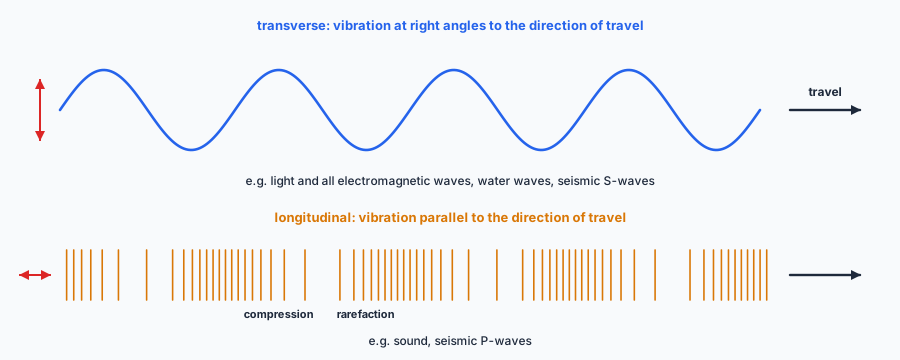
- Tell transverse from longitudinal waves, with examples.
- Describe reflection, refraction and diffraction, and how a ripple tank shows them; how wavelength and gap size affect diffraction EXTENDED.
📚The physics
What a wave is
Waves transfer energy without transferring matter: a cork on a pond bobs up and down as ripples pass, but is not carried along.
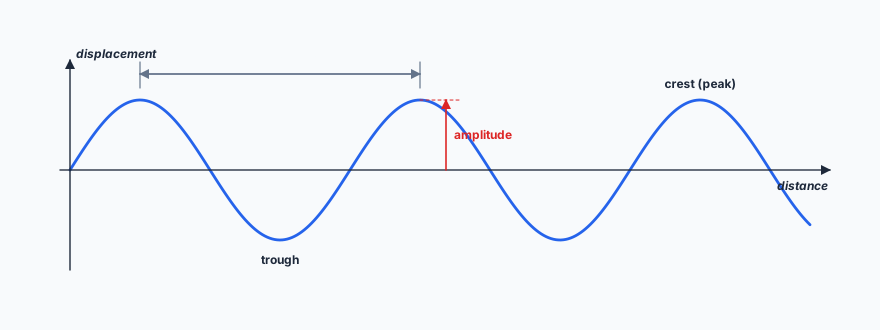
wavelength λ: distance between two neighbouring crests (or any two matching points), in m
frequency f: number of waves passing a point per second, in hertz (Hz)
amplitude: maximum displacement from the undisturbed position
wavefront: a line joining points on the same crest
wave speed v: distance a crest travels per second
\[ v = f\lambda \]
Transverse and longitudinal waves
Reflection, refraction and diffraction
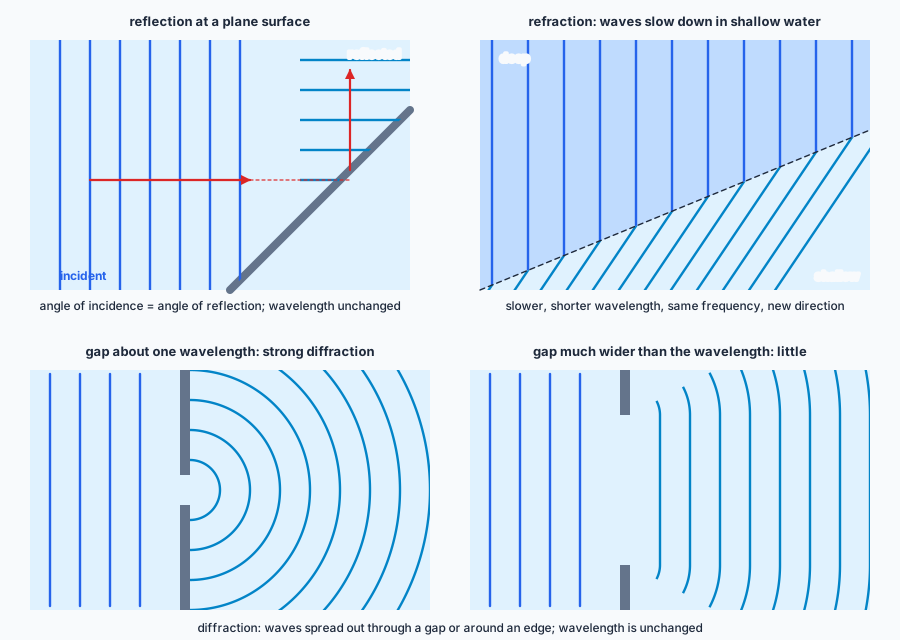
- Reflection at a plane surface: angle of incidence = angle of reflection; speed, wavelength and frequency unchanged.
- Refraction is due to a change of speed: in a ripple tank, waves slow down in shallow water (made with a glass plate), so the wavelength decreases and the direction changes if they meet the boundary at an angle. The frequency does not change.
- Diffraction: waves spread out after passing through a gap or past an edge. EXTENDED It is greatest when the gap is about the same size as the wavelength; the narrower the gap (or the longer the wavelength), the more the spreading. At an edge, longer wavelengths diffract more. That is why you hear round a corner (sound, λ about 1 m) but cannot see round it (light, λ below 10−6 m).
✏️Worked example
In a ripple tank, 12 wavefronts pass a mark in 4.0 s. The distance between the first and the sixth wavefront is 10 cm.
(a) Calculate the frequency. [1]
(b) Calculate the wavelength. [1]
(c) Calculate the wave speed. [2]
(d) The waves move into shallower water. State what happens to their speed, frequency and wavelength. [2]
(a) f = 12 / 4.0 = 3.0 Hz.
(b) First to sixth wavefront is 5 wavelengths: λ = 10 / 5 = 2.0 cm.
(c) v = fλ = 3.0 × 2.0 = 6.0 cm/s.
(d) Speed decreases; frequency stays the same; wavelength decreases.
Check it. Ripple tank waves move a few centimetres per second — you can follow them with your eye. 6 cm/s is right.
Dividing by 6. Six wavefronts enclose only five gaps: count the spaces, not the lines.
📝Practise
In the style of the multiple-choice and theory papers. EXTENDED marks Supplement content.
1. (Multiple choice.) Which is a longitudinal wave? A: a radio wave. B: a sound wave. C: a seismic S-wave. D: a water wave.
B.
2. (Theory.) The speed of sound in sea water is 1500 m/s. Calculate the wavelength of an ultrasound pulse of frequency 30 kHz. [2]
λ = v/f = 1500 / 30 000 = 0.050 m (5.0 cm). Convert kHz to Hz first.
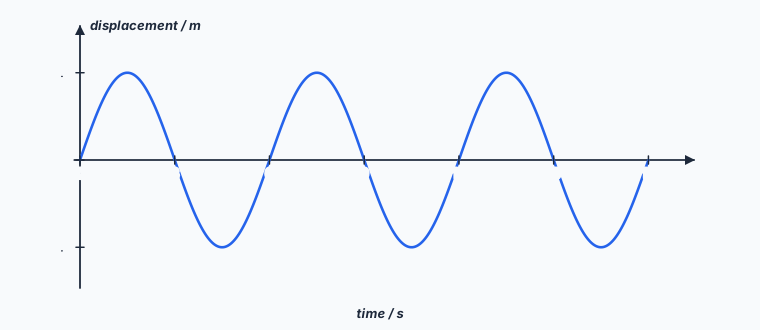
3. (Multiple choice.) EXTENDED The graph shows how the displacement of a point on a transverse wave varies with time. The wave travels at 1.5 m/s. What is its wavelength? A: 0.8 m. B: 4.0 m. C: 6.0 m. D: 9.0 m. (Modelled on 0625/22 June 2026 Q17.)
D. The period is 6.0 s, so f = 1/6.0 Hz and λ = v/f = 1.5 × 6.0 = 9.0 m. (A time axis gives the period, not the wavelength.)
4. (Theory.) Describe the difference between a transverse and a longitudinal wave, with one example of each. [3]
Transverse: vibrations at right angles to the direction the wave travels (e.g. light, water waves). Longitudinal: vibrations parallel to the direction of travel (e.g. sound).
5. (Theory.) EXTENDED Water waves of wavelength 2.0 cm pass through a gap. Describe the pattern when the gap is 2.0 cm and when it is 20 cm wide. [2]
2.0 cm (same as the wavelength): strong diffraction, the waves spread out in semicircles. 20 cm: little diffraction, the waves pass mostly straight through, curving only at the edges.
6. (Theory.) Explain what is meant by the statement that waves transfer energy but not matter. [2]
Energy is carried from one place to another by the wave, but the particles of the medium only vibrate about fixed positions and do not travel with the wave.
7. (Theory.) Describe how to use a ripple tank to show refraction. [2]
Place a glass plate in the tank to make a region of shallow water, with its edge at an angle to the waves. The waves slow down over the plate: they are closer together and change direction.
🔗Go deeper — other people’s work
These are external resources, not mine. If one stops working, tell me and everything above it on this page still stands.
- PhET “Waves Intro” and “Wave on a String” — frequency, amplitude and wavelength
- PhET “Wave Interference” — diffraction through gaps of different widths