The electromagnetic spectrum
🎯What you need to be able to do
- Know the main regions of the electromagnetic spectrum in order of frequency and of wavelength.
- Know that all electromagnetic waves travel at the same high speed in a vacuum, 3.0 × 10⁸ m/s EXTENDED.
- Describe the uses and the harmful effects of each region; know that satellites communicate mainly by microwaves.
- Explain the choice of radiation for mobile phones, Bluetooth and optical fibres; digital and analogue signals and the benefits of digital EXTENDED.
📚The physics
The spectrum
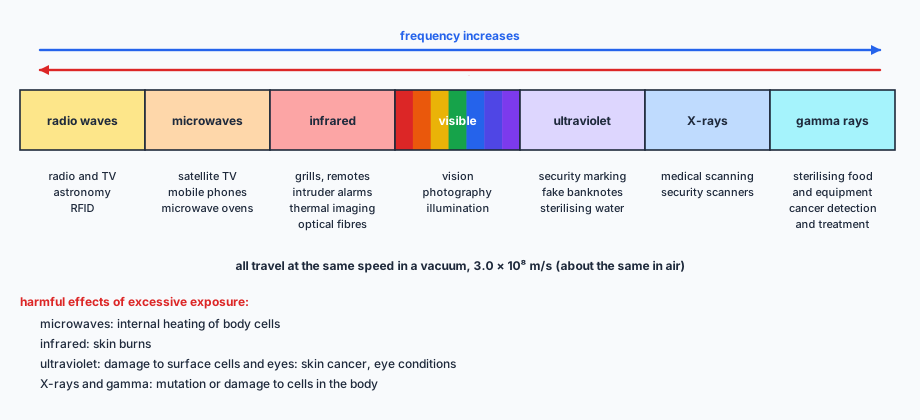
All electromagnetic waves are transverse and travel at the same high speed in a vacuum. EXTENDED That speed is 3.0 × 10⁸ m/s, and approximately the same in air. The Sun radiates most of its energy as infrared, visible light and ultraviolet.
Communication
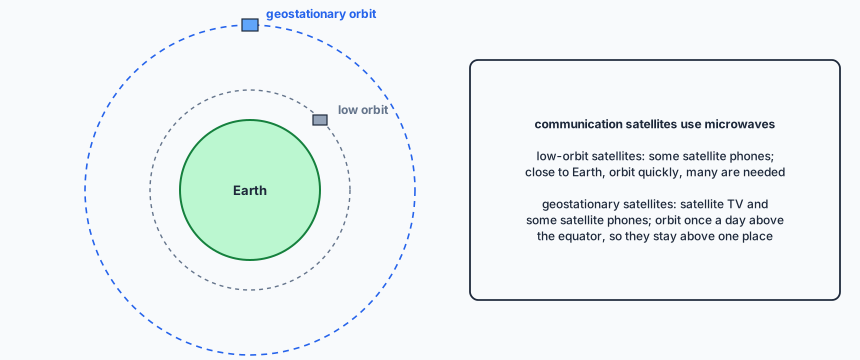
- EXTENDED Mobile phones and wireless internet use microwaves: they penetrate some walls and need only a short aerial.
- EXTENDED Bluetooth uses radio waves: they pass through walls, though the signal is weakened.
- EXTENDED Optical fibres (cable television, high-speed broadband) use visible light or infrared: glass is transparent to them, and they can carry very high rates of data.
Analogue and digital signals EXTENDED
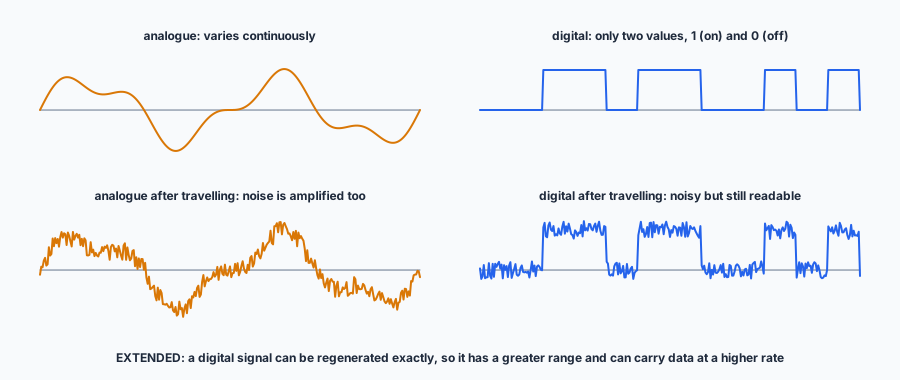
An analogue signal can take any value; a digital signal has only two values (1 and 0). Digital signals can be regenerated accurately, so they have a greater range, and they allow a higher rate of data transmission.
✏️Worked example
(a) Microwaves.
(b) Distance = 2 × 3.6 × 107 m = 7.2 × 10⁷ m; \( t = \dfrac{s}{v} = \dfrac{7.2 \times 10^7}{3.0 \times 10^8} = \) 0.24 s.
(c) It orbits once a day above the equator, so it stays above the same point: home dishes can be pointed at it once and left fixed.
📝Practise
In the style of the multiple-choice and theory papers. EXTENDED marks Supplement content.
1. (Theory.) Part of the spectrum reads: radio waves, ____, infrared, visible light, ____, X-rays, gamma rays. Name the two missing regions, and state which property increases from radio waves to gamma rays. [3] (Modelled on 0625/32 June 2026 Q6.)
2. (Theory.) State the three regions of the spectrum in which the Sun emits most of its energy. [1]
3. (Multiple choice.) Which region is used to detect forged banknotes? A: infrared. B: microwaves. C: ultraviolet. D: X-rays.
4. (Theory.) Compare the speed of X-rays with the speed of radio waves in a vacuum. [1]
5. (Theory.) Give one harmful effect of excessive exposure to (a) ultraviolet, (b) gamma rays. [2]
6. (Multiple choice.) EXTENDED Which statement about digital signals is correct? A: They cannot carry sound. B: They travel more slowly than analogue signals. C: They have only two values, 1 and 0. D: They cannot carry data faster than analogue signals.
7. (Theory.) EXTENDED Explain why mobile phones use microwaves. [2]
8. (Theory.) EXTENDED Calculate the frequency of radio waves of wavelength 3.0 m. [2]
🔗Go deeper — other people’s work
These are external resources, not mine. If one stops working, tell me and everything above it on this page still stands.
- NASA — “Tour of the Electromagnetic Spectrum”
- BBC Bitesize — uses and dangers of electromagnetic waves