Simple magnetism
🎯What you need to be able to do
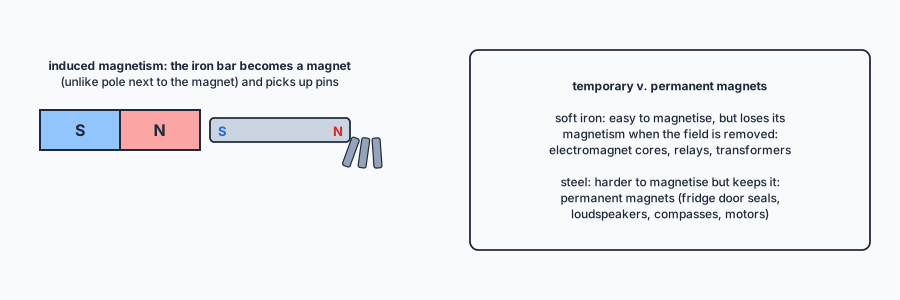
- Describe the forces between magnetic poles and between magnets and magnetic materials; describe induced magnetism.
- State the differences between temporary (soft iron) and permanent (steel) magnets, and between magnetic and non-magnetic materials.
- Describe a magnetic field; draw the field around a bar magnet and state the direction of the field; plot field lines with a compass or iron filings.
- Describe uses of permanent magnets and electromagnets; explain magnetic forces as interactions between fields, and field strength from line spacing EXTENDED.
📚The physics
Poles and forces
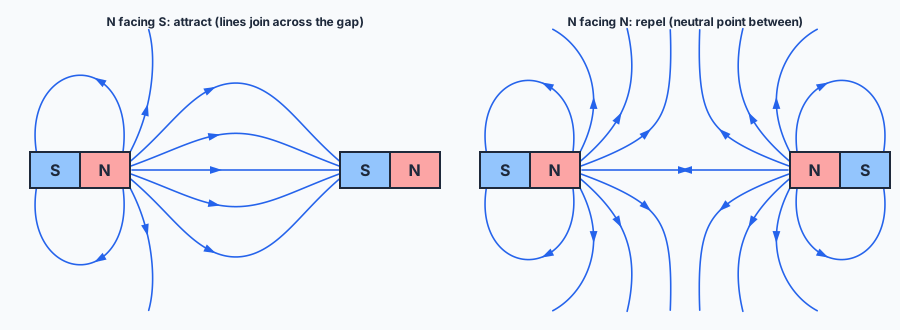
Every magnet has a north (N) pole and a south (S) pole. Like poles repel; unlike poles attract. A magnet also attracts magnetic materials (iron, steel, nickel, cobalt) that are unmagnetised. Non-magnetic materials (copper, aluminium, plastic, wood) are not attracted. Repulsion is the only sure test that an object is itself a magnet.
Magnetic fields
A magnetic field is a region in which a magnetic pole experiences a force. The direction of the field at a point is the direction of the force on the N pole of a magnet at that point — so field lines run from N to S outside a magnet.
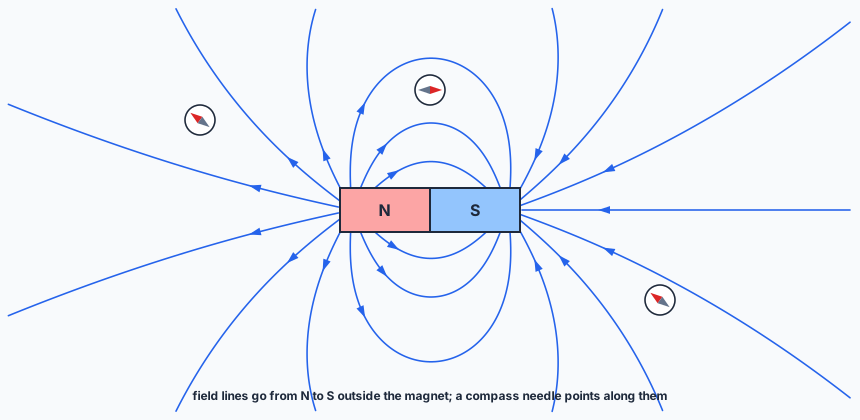
To plot the field: place a small plotting compass near one pole, mark where its needle points, move it on so its tail is at the last mark, and repeat, joining the dots into a line from N to S; repeat from other starting points. Iron filings sprinkled on paper over the magnet show the pattern quickly but not the direction.
Uses
✏️Worked example
(a) Bring the bars together in pairs. The aluminium bar is attracted by neither of the others. The other two attract each other. To tell them apart, touch the end of one bar to the middle of the other: if the bar you are holding is the magnet, its pole attracts the iron’s middle strongly; if you are holding the iron, there is almost no attraction, because the field at the middle of a magnet is very weak.
(b) Soft iron is easily magnetised and loses its magnetism as soon as the current is switched off; steel would stay magnetised.
(c) It can be switched off to drop the load.
📝Practise
In the style of the multiple-choice and theory papers. EXTENDED marks Supplement content.
1. (Multiple choice.) Why does a scrap-yard crane use an electromagnet? A: Electromagnets are always stronger than permanent magnets. B: Electromagnets attract all metals. C: Electromagnets can be switched on and off. D: Electromagnets repel non-metals.
2. (Theory.) State the direction of a magnetic field at a point. [1]
3. (Theory.) Draw (describe) the field pattern of a bar magnet, including direction. [3]
4. (Theory.) Describe how to plot the magnetic field around a bar magnet using a plotting compass. [3]
5. (Theory.) Give two differences between soft iron and steel as magnetic materials. [2]
6. (Theory.) EXTENDED How does a field-line diagram show where the field is strongest? [1]
7. (Theory.) Which of these are attracted to a magnet: aluminium can, steel paperclip, copper coin, nickel coin, plastic ruler? [2]
🔗Go deeper — other people’s work
These are external resources, not mine. If one stops working, tell me and everything above it on this page still stands.
- PhET “Magnets and Electromagnets” — field lines and compasses
- Institute of Physics — plotting magnetic fields