Forces, moments and centre of gravity
🎯What you need to be able to do
- Know that forces change size and shape; plot and interpret load–extension graphs; use \( k = \dfrac{F}{x} \) and the limit of proportionality EXTENDED.
- Find the resultant of forces along a line; describe how a resultant force changes velocity; use \( F = ma \) EXTENDED.
- Describe friction and drag; describe circular motion qualitatively EXTENDED.
- Define the moment of a force and apply the principle of moments, including several forces on each side EXTENDED.
- State what centre of gravity is, find it for a plane lamina, and relate it to stability.
📚The physics
Stretching a spring
Forces can change the size and shape of an object. Hang loads on a spring, measure its length each time against a vertical ruler, and plot extension (new length − original length) against load.
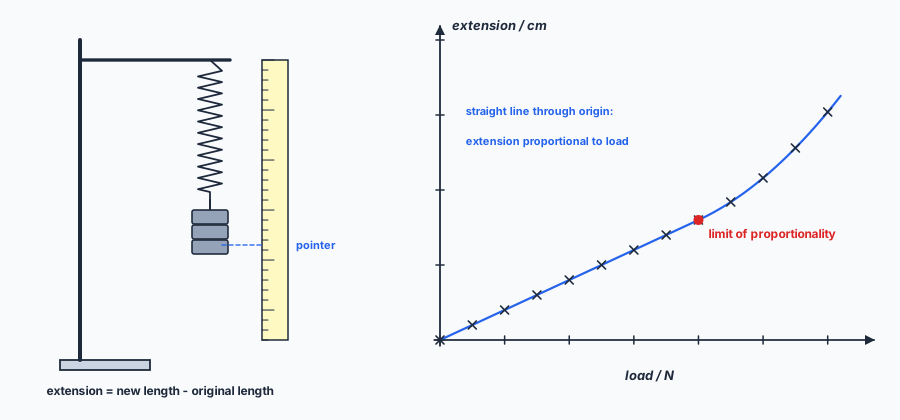
EXTENDED The spring constant is force per unit extension, \( k = \dfrac{F}{x} \) (N/m or N/cm): the gradient of a force–extension graph. The limit of proportionality is the point where the graph stops being a straight line; beyond it, extension is no longer proportional to load.
Resultant force
Forces along the same line add (same direction) or subtract (opposite directions) to give the resultant force. An object remains at rest, or continues in a straight line at constant speed, unless a resultant force acts. A resultant force changes the velocity: its speed, its direction, or both.
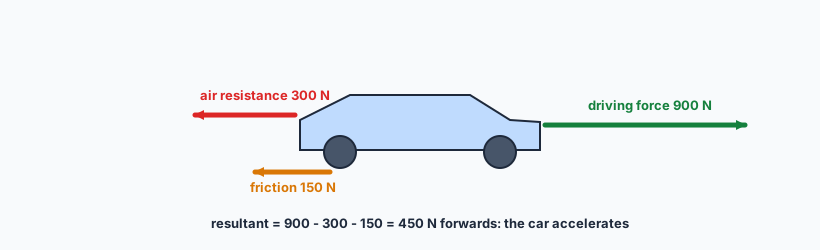
Friction between two solid surfaces may impede motion and produces heating. Drag is friction on an object moving through a liquid or a gas (air resistance).
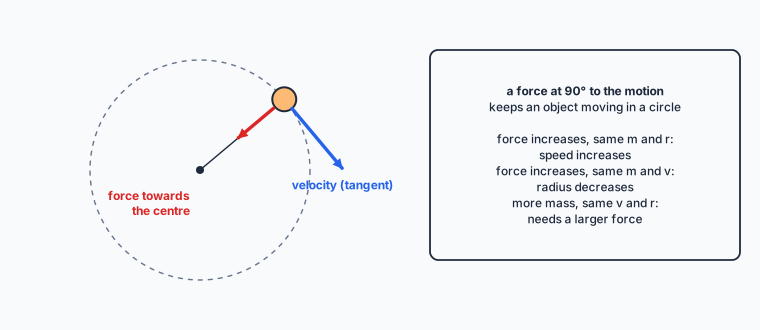
EXTENDED The force and the acceleration are in the same direction. A force always at right angles to the motion makes an object move in a circle:
Turning effect of forces
The moment of a force measures its turning effect (a spanner, a door handle, a see-saw):
The principle of moments: for an object in equilibrium, the sum of the clockwise moments about any point equals the sum of the anticlockwise moments about that point. When there is no resultant force and no resultant moment, an object is in equilibrium. EXTENDED You can check this with a metre rule balanced on a pivot, loads hung at measured distances on both sides: the moments on each side agree.
Centre of gravity and stability
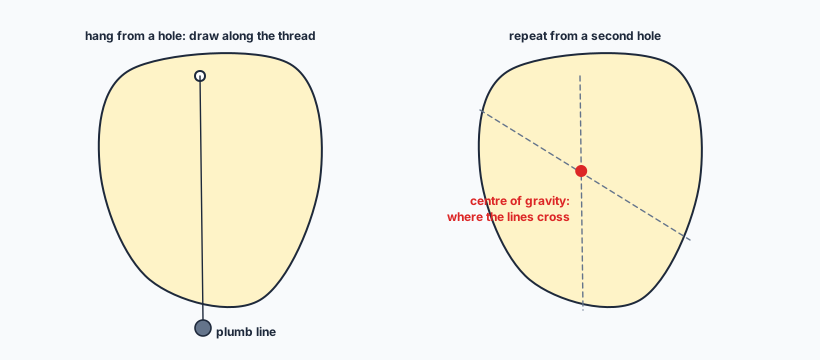
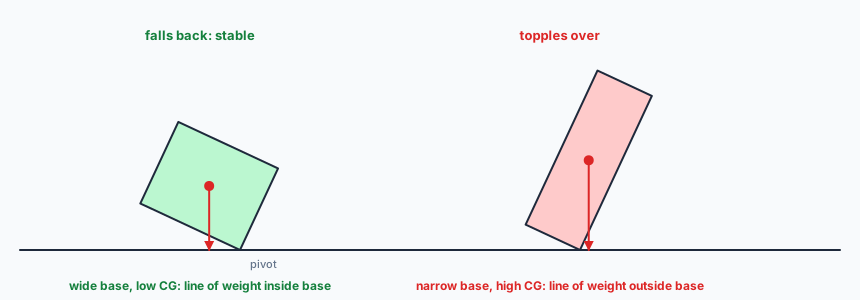
The centre of gravity is the point through which all of an object’s weight appears to act.
✏️Worked example
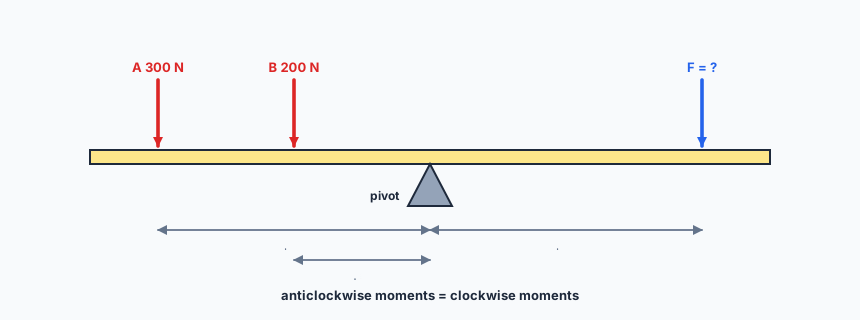
(a) Anticlockwise moments: \( 300 \times 1.6 + 200 \times 0.8 = 480 + 160 = 640 \) N m. Clockwise: \( F \times 1.6 \). So \( F = \dfrac{640}{1.6} = \) 400 N.
(b) 300 + 200 + 400 = 900 N upwards: the plank is in equilibrium, so there is no resultant force.
📝Practise
In the style of the multiple-choice, theory and practical papers. EXTENDED marks Supplement content.
1. (Multiple choice.) Which statement completely describes any object in equilibrium? A: No forces act on it. B: There is no resultant force. C: There is no resultant moment. D: There is no resultant force and no resultant moment.
2. (Theory.) A nut needs a moment of 36 N m to loosen it. A mechanic uses a wrench 0.45 m long. Calculate the smallest force needed. [2] (Modelled on 0625/12 June 2026 Q6.)
3. (Multiple choice.) EXTENDED A uniform rod 30 cm long, weight 0.80 N, is pivoted 10 cm from its left end. A 2.0 N model hangs from the right end. What weight at the left end balances it? A: 2.2 N. B: 4.0 N. C: 4.4 N. D: 4.8 N. (Modelled on 0625/22 June 2026 Q5.)
4. (Theory.) EXTENDED A rocket and its satellite have a mass of 2.0 × 10⁴ kg. The rocket engines give an upward force of 3.2 × 10⁵ N. Calculate the initial acceleration. [3] (Modelled on 0625/42 June 2026 Q2(a).)
5. (Theory.) EXTENDED A satellite moves in a circular orbit at constant speed. State the direction of the force on it, and explain why it is accelerating. [2]
6. (Theory.) EXTENDED A spring stretches by 6.0 cm when a 1.5 N load hangs from it, within the limit of proportionality. Calculate its spring constant, and the extension with a 2.5 N load. [3]
7. (Theory.) EXTENDED A model car of mass 0.40 kg starts from rest. A resultant force of 1.2 N acts on it for 4.0 s. Calculate its final speed. [3]
8. (Practical.) Describe how to find the centre of gravity of a flat, irregular piece of card. [4]
🔗Go deeper — other people’s work
These are external resources, not mine. If one stops working, tell me and everything above it on this page still stands.
- PhET “Hooke’s Law” and “Balancing Act” — springs and moments
- PhET “Forces and Motion: Basics” — resultant force and acceleration