Home › Learning Hub › IGCSE Physics › 1d Momentum
Topic 1 · 1.6

Momentum and impulse

Extended only · Papers 2, 4, 5 and 6

Momentum is Supplement content in its entirety EXTENDED: Core candidates are not examined on this page.

🎯What you need to be able to do

  • Define momentum and use \( p = mv \).
  • Define impulse as force × time and use impulse \( = F\Delta t = \Delta(mv) \).
  • Apply the conservation of momentum to simple problems in one dimension.
  • Define resultant force as the change in momentum per unit time and use \( F = \dfrac{\Delta p}{\Delta t} \).

📚The physics

Momentum

\[ p = mv \]

Momentum is mass × velocity, in kg m/s. It is a vector: choose one direction as positive, and a velocity the other way is negative.

Conservation of momentum

When objects collide or push apart, and no external resultant force acts, the total momentum before equals the total momentum after.
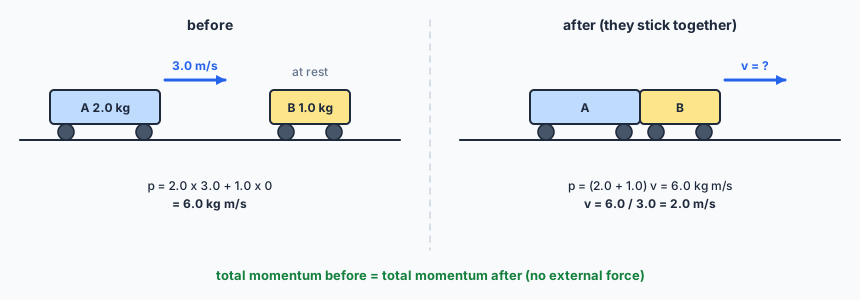
Before: trolley A of mass 2.0 kg moves at 3.0 metres per second towards trolley B of mass 1.0 kg at rest; total momentum 6.0 kilogram metres per second. After: they stick together and move off at v; 3.0 v equals 6.0, so v is 2.0 metres per second.
Collisions: add the momenta before and after, with signs.
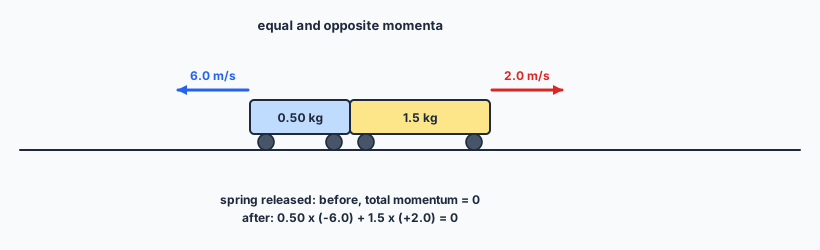
Two trolleys at rest are pushed apart by a spring. A 0.50 kg trolley moves left at 6.0 metres per second and a 1.5 kg trolley moves right at 2.0 metres per second. Before, the total momentum is zero; after, 0.50 times minus 6.0 plus 1.5 times 2.0 is also zero.
Explosions and recoil: from rest, the momenta after are equal and opposite.

Impulse and force

\[ \text{impulse} = F\Delta t = \Delta(mv) \qquad F = \frac{\Delta p}{\Delta t} \]

Impulse is force × time for which it acts (N s, the same as kg m/s), and it equals the change in momentum. Resultant force is the change in momentum per unit time. For a given change in momentum, making the time longer makes the force smaller: this is how crumple zones, seat belts, air bags, padded helmets and bent knees protect you.
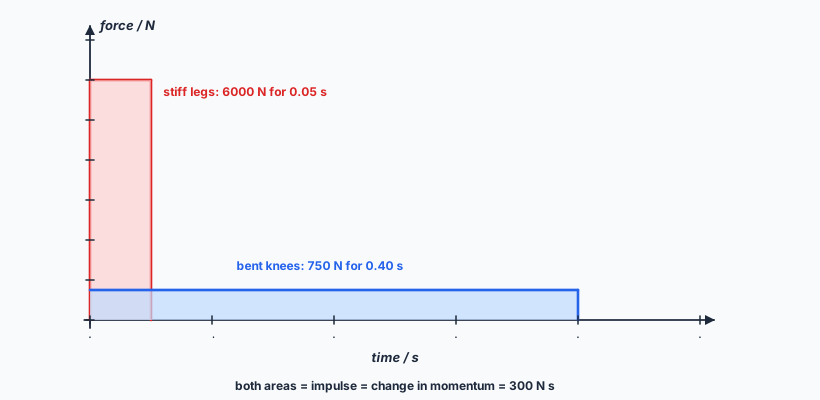
A graph of force against time for a 60 kg person landing at 5.0 metres per second. With stiff legs, a force of 6000 N acts for 0.05 s. With bent knees, 750 N acts for 0.40 s. Both rectangles have the same area, 300 newton seconds, the change in momentum.
Same change in momentum, eight times the time, one eighth of the force. (Average forces shown as rectangles.)

✏️Worked example

A gymnast of mass 60 kg drops from a beam and reaches the mat at 5.0 m/s. (Modelled on 0625/42 June 2026 Q4.) (a) Define impulse in words. [1] (b) She comes to rest 0.40 s after touching the mat. Calculate the average resultant force on her. [2] (c) Explain, using ideas about momentum, force and time, why landing on a soft mat with bent knees prevents injury. [3]

(a) Force multiplied by the time for which it acts (equal to the change in momentum).

(b) \( \Delta p = 60 \times 5.0 = 300 \) kg m/s; \( F = \dfrac{\Delta p}{\Delta t} = \dfrac{300}{0.40} = \) 750 N.

(c) Her change in momentum (the impulse) is the same however she lands. The mat and bent knees make the stopping time longer, so the force (change of momentum ÷ time) is smaller.

Check it. Her weight is about 590 N, so a stopping force of 750 N is only a little more than her weight — a gentle landing. Stiff legs stopping her in 0.05 s would need 6000 N.
“The mat reduces her momentum.” It does not: her momentum goes from 300 kg m/s to zero either way. The mat increases the time.

📝Practise

In the style of the multiple-choice and theory papers (Extended).

1. (Multiple choice.) Which unit is equivalent to kg m/s? A: N/s. B: N s. C: N m. D: J/s.
B. Impulse = FΔt, measured in N s, equals change in momentum.
2. (Theory.) Calculate the momentum of a 1200 kg car travelling at 15 m/s. [2]
p = mv = 1200 × 15 = 18 000 kg m/s.
3. (Theory.) A 0.16 kg ball moving at 12 m/s is caught and stopped in 0.080 s. Calculate the average force on the catcher’s hands. [2]
Δp = 0.16 × 12 = 1.92 kg m/s; F = 1.92 / 0.080 = 24 N.
4. (Theory.) A 3.0 kg trolley moving at 4.0 m/s collides with a 1.0 kg trolley at rest. They stick together. Calculate their speed after the collision. [3]
Momentum before = 3.0 × 4.0 = 12 kg m/s. After: (3.0 + 1.0)v = 12, so v = 3.0 m/s.
5. (Theory.) A 50 kg skater at rest pushes a 70 kg skater, who moves off at 1.5 m/s. Calculate the velocity of the 50 kg skater. [3]
Total momentum stays 0: 70 × 1.5 + 50v = 0, so v = −105 / 50 = −2.1 m/s: 2.1 m/s in the opposite direction.
6. (Theory.) A ball of mass 0.20 kg hits a wall at 8.0 m/s and rebounds at 6.0 m/s. Calculate the change in momentum. [2]
Taking towards the wall as positive: before +1.6, after −1.2 kg m/s; change = −1.2 − 1.6 = −2.8, so a change of 2.8 kg m/s (away from the wall). Forgetting the sign gives 0.4 — wrong.
7. (Theory.) Explain how a car’s crumple zone reduces the force on passengers in a collision. [3]
The crumple zone deforms, so the car (and passengers) take a longer time to stop. The change in momentum is the same, and force = change in momentum ÷ time, so the force is smaller.

🔗Go deeper — other people’s work

These are external resources, not mine. If one stops working, tell me and everything above it on this page still stands.

  • PhET “Collision Lab” — one-dimensional collisions with momentum readouts
  • The Physics Classroom — momentum and its conservation