Energy, work, power and energy resources
🎯What you need to be able to do
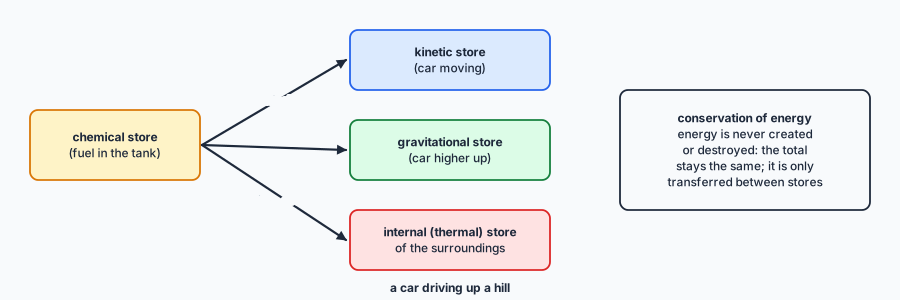
- Name the energy stores and describe transfers between them; apply conservation of energy with flow diagrams, and Sankey diagrams EXTENDED.
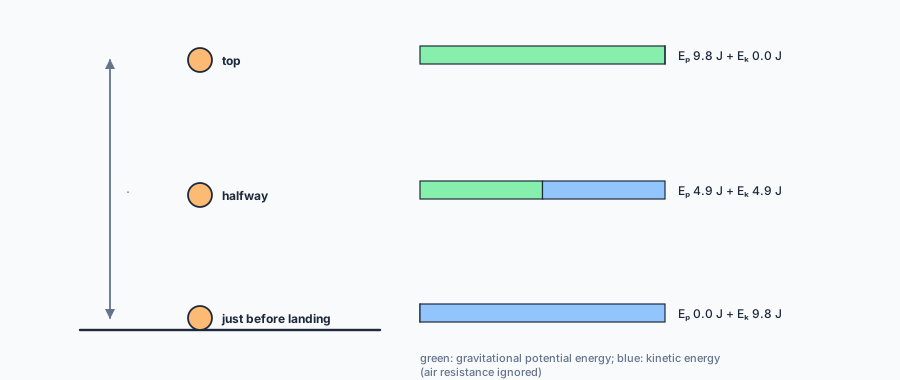
- Use \( E_k = \tfrac12 mv^2 \) and \( \Delta E_p = mg\Delta h \) EXTENDED.
- Use \( W = Fd = \Delta E \) for work done and \( P = \dfrac{W}{t} = \dfrac{\Delta E}{t} \) for power.
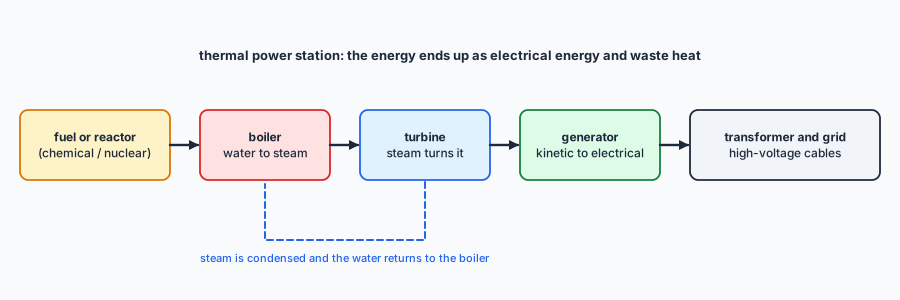
- Describe how electricity is generated from each energy resource, with advantages and disadvantages; use efficiency EXTENDED.
📚The physics
Energy stores and transfers
Energy may be stored as kinetic, gravitational potential, chemical, elastic (strain), nuclear, electrostatic and internal (thermal) energy. It is transferred between stores by forces (mechanical work done), electrical currents (electrical work done), heating, and by electromagnetic, sound and other waves.
Kinetic and gravitational potential energy EXTENDED
Work and power
Mechanical or electrical work done equals the energy transferred. Power is work done (energy transferred) per unit time:
Work is in joules (J); power in watts (W), where 1 W = 1 J/s.
Efficiency EXTENDED
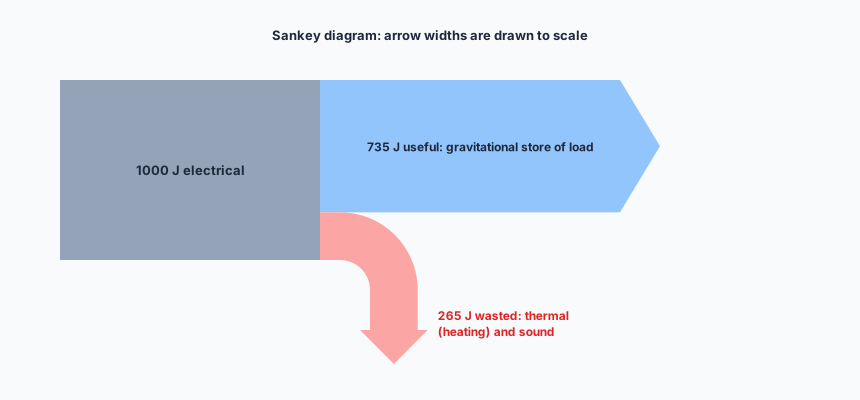
No device is 100% efficient: some energy is always wasted, usually by heating the surroundings. A Sankey diagram shows this with arrows whose widths are proportional to the energy.
Energy resources
- Fossil fuels (coal, oil, gas) and biofuels: burned to heat water to steam, which turns turbines and generators. Reliable and available on demand; fossil fuels are non-renewable and release carbon dioxide; biofuels are renewable but need farmland.
- Nuclear fuel: fission heats water to steam. Large scale, reliable, no carbon dioxide; radioactive waste, costly to build and decommission.
- Water: waves, tides and hydroelectric dams drive turbines directly. Renewable and no fuel cost; waves are unreliable, tidal and hydroelectric schemes flood or change habitats and suit only some places.
- Geothermal: hot rocks heat water to steam. Renewable and reliable, but only in volcanic areas (Indonesia uses it).
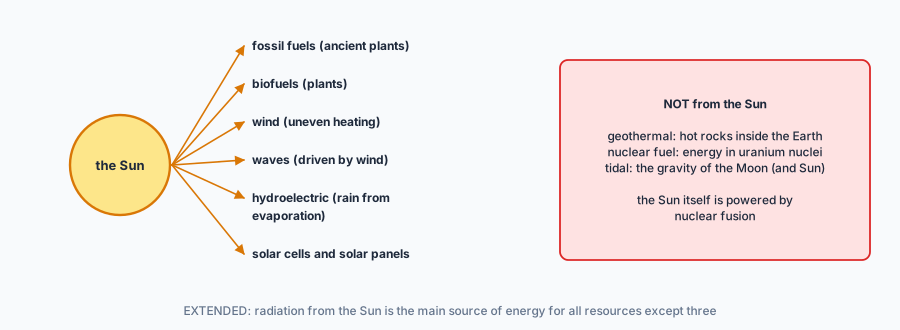
- Solar: solar cells turn light into electricity; solar panels heat water. The Sun also drives the wind. Renewable, but only available when the Sun shines or the wind blows, and large areas are needed.
✏️Worked example
(a) W = mg = 25 × 9.8 = 245 N; work done = Fd = 245 × 3.0 = 735 J.
(b) P = W/t = 735 / 5.0 = 147 W.
(c) Energy input = 200 × 5.0 = 1000 J; efficiency = 735 / 1000 × 100% = 74% (73.5%).
📝Practise
In the style of the multiple-choice and theory papers. EXTENDED marks Supplement content.
1. (Multiple choice.) Which energy resource does not have the Sun as its main source of energy? A: biofuel. B: tidal. C: wind. D: waves.
2. (Theory.) A forklift lifts a crate of weight 820 N through a vertical height of 1.5 m. Calculate the work done on the crate, with its unit, and the crate’s mass. [4] (Modelled on 0625/32 June 2026 Q2(a).)
3. (Multiple choice.) EXTENDED A skier of mass 70 kg starts from rest and descends a vertical height of 40 m, reaching 18 m/s at the bottom. How much energy is transferred to the surroundings? A: less than 10 kJ. B: 10–20 kJ. C: 20–30 kJ. D: more than 30 kJ. (Modelled on 0625/22 June 2026 Q7.)
4. (Theory.) A 2.0 kW kettle is switched on for 3.0 minutes. Calculate the energy transferred. [2]
5. (Theory.) EXTENDED A 1500 kg car travels at 20 m/s. Calculate its kinetic energy. The brakes stop it in 40 m: calculate the average braking force. [4]
6. (Theory.) Give one advantage and one disadvantage of generating electricity from nuclear fuel rather than from solar cells. [2] (Modelled on 0625/42 June 2026 Q10(a)(iii).)
7. (Theory.) EXTENDED A lamp is supplied with 60 J each second and emits 9.0 J of light each second. Calculate its efficiency and state what happens to the rest of the energy. [3]
8. (Theory.) An electric car travels at constant velocity along a level road. Describe the energy transfers. [2]
🔗Go deeper — other people’s work
These are external resources, not mine. If one stops working, tell me and everything above it on this page still stands.
- PhET “Energy Skate Park: Basics” — kinetic and potential energy with friction
- PhET “Energy Forms and Changes” — energy stores and transfers