Pressure
🎯What you need to be able to do
- Define pressure as force per unit area and use \( p = \dfrac{F}{A} \).
- Describe how pressure varies with force and area in everyday examples.
- Describe how pressure beneath a liquid surface changes with depth and density.
- Use \( \Delta p = \rho g \Delta h \) for the change in pressure beneath a liquid surface EXTENDED.
📚The physics
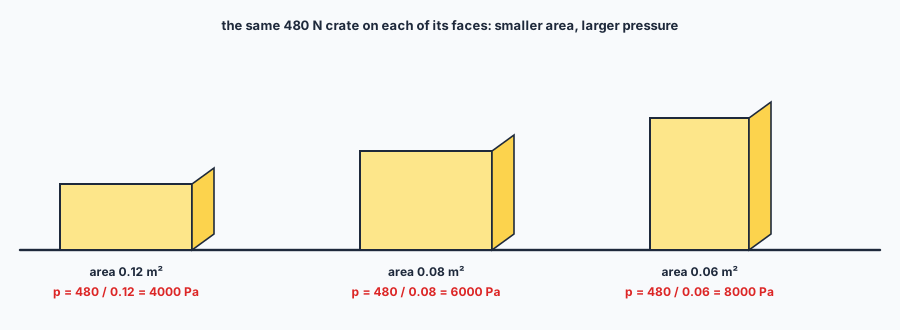
Pressure = force ÷ area
Pressure is in pascals (Pa), where 1 Pa = 1 N/m2; N/cm2 is also used (1 N/cm2 = 10 000 Pa). The same force on a smaller area gives a larger pressure.
Pressure in liquids
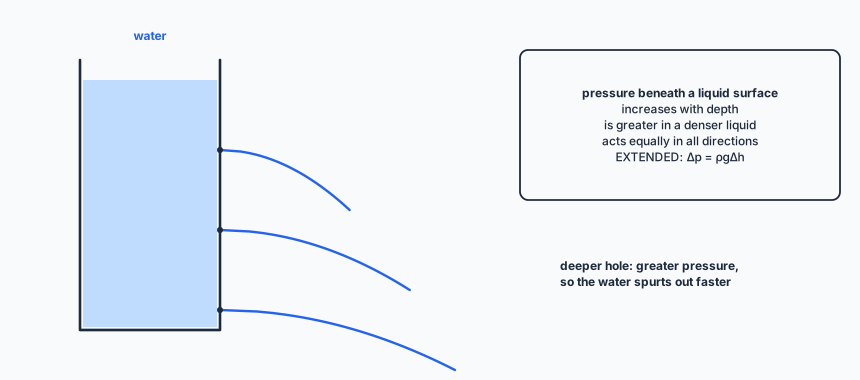
Pressure beneath the surface of a liquid increases with depth and is greater in a denser liquid. It does not depend on the shape or width of the container. That is why dams are thicker at the bottom and divers feel more pressure the deeper they go.
EXTENDED ρ is the density of the liquid in kg/m3, g = 9.8 N/kg, and Δh the change in depth in metres. The total pressure also includes the atmospheric pressure pressing on the surface (about 1.0 × 10⁵ Pa).
✏️Worked example
(a) \( \Delta p = \rho g \Delta h = 1030 \times 9.8 \times 25 = 252\,350 \) Pa = 2.5 × 10⁵ Pa.
(b) 2.52 × 10⁵ + 1.0 × 105 = 3.5 × 10⁵ Pa.
(c) F = pA = 3.52 × 105 × 0.018 = 6300 N (using the total pressure; 4500 N from the water alone).
📝Practise
In the style of the multiple-choice and theory papers. EXTENDED marks Supplement content.
1. (Theory.) A student of weight 610 N stands on the floor. His shoes touch the floor over an area of 420 cm2. Calculate the pressure on the floor, with the unit. [3] (Modelled on 0625/42 June 2026 Q4(b)(iii).)
2. (Theory.) A block of ice weighs 650 N and measures 0.80 m × 0.40 m × 0.25 m. Calculate the greatest pressure it can exert on the ground. [3] (Modelled on 0625/32 June 2026 Q2(b).)
3. (Multiple choice.) EXTENDED A submarine is 400 m below the surface of the sea. Apart from g, which quantities determine the pressure on it due to the water? A: depth and the submarine’s surface area. B: depth and the density of the water. C: depth, density and the submarine’s mass. D: density and the submarine’s volume.
4. (Theory.) Explain why a sharp knife cuts more easily than a blunt one. [2]
5. (Theory.) A water tank is 2.5 m deep. EXTENDED Calculate the pressure due to the water at the bottom (density 1000 kg/m3). [2]
6. (Theory.) Explain why a dam is built much thicker at the bottom than at the top. [2]
7. (Multiple choice.) Which is a unit of pressure? A: N m. B: N/m2. C: N/kg. D: kg/m3.
🔗Go deeper — other people’s work
These are external resources, not mine. If one stops working, tell me and everything above it on this page still stands.
- PhET “Under Pressure” — pressure in liquids of different densities
- BBC Bitesize — pressure in solids and liquids