Thermal properties and temperature
🎯What you need to be able to do
- Describe thermal expansion and its applications and consequences; explain the relative expansion of solids, liquids and gases EXTENDED.
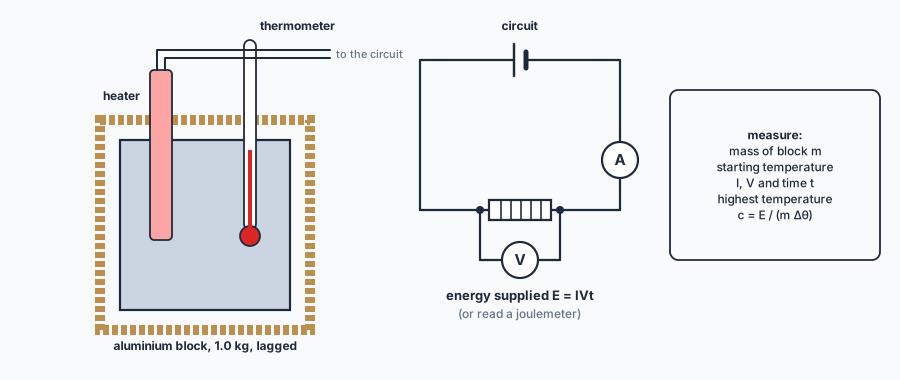
- Know that a rise in temperature increases internal energy; define specific heat capacity, use \( c = \dfrac{\Delta E}{m\Delta\theta} \) and describe experiments to measure it EXTENDED.
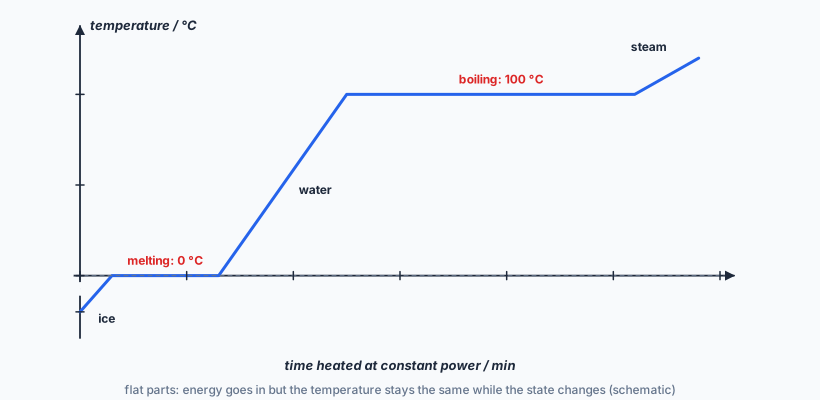
- Describe melting, boiling, condensation, solidification and evaporation; know the melting and boiling points of water.
- Distinguish boiling and evaporation; explain the factors affecting evaporation and cooling by evaporation EXTENDED.
📚The physics
Thermal expansion
Solids, liquids and gases expand when heated (at constant pressure). For the same temperature rise, solids expand least, liquids more and gases most.
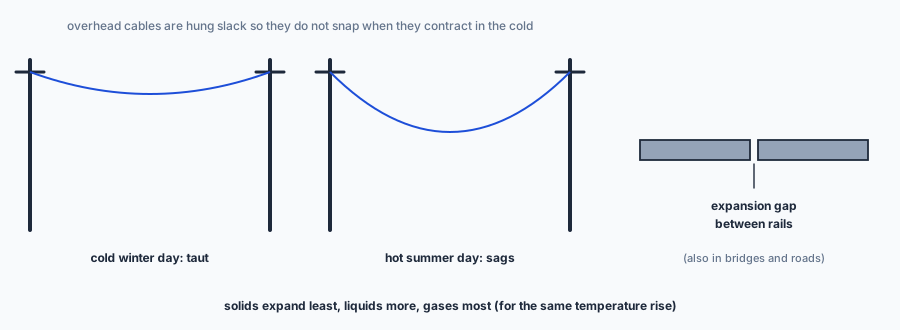
EXTENDED In a solid the particles are held tightly by strong forces, so heating makes them vibrate further but they stay close; in a liquid the forces are weaker and the particles move further apart; in a gas the forces are negligible, so the particles move much further apart.
Specific heat capacity
A rise in the temperature of an object increases its internal energy. EXTENDED The increase in temperature is an increase in the average kinetic energy of all the particles. Specific heat capacity is the energy required per unit mass per unit temperature increase:
Units: J/(kg °C). Water has a high value, 4200 J/(kg °C).
Melting, boiling, condensation, solidification
While a substance melts or boils, energy is supplied but the temperature does not change: the energy separates the particles rather than speeding them up. At standard atmospheric pressure, water melts at 0 °C and boils at 100 °C. In condensation and solidification the particles come closer together and give out energy.
Evaporation
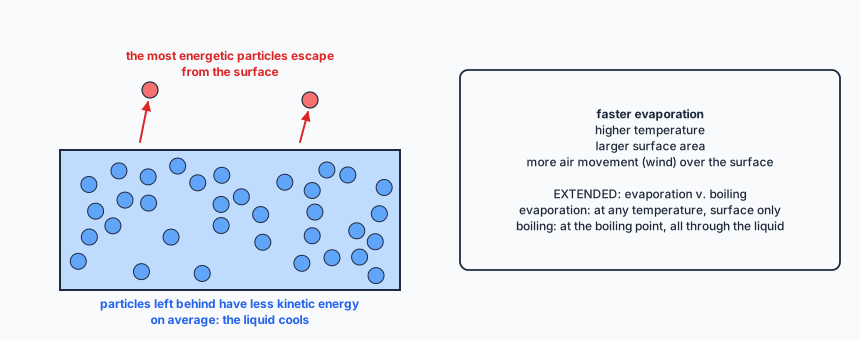
Evaporation is the escape of more-energetic particles from the surface of a liquid, and it cools the liquid. EXTENDED It is faster at a higher temperature, with a larger surface area and with more air movement over the surface. An object in contact with an evaporating liquid cools, because energy passes from the object to the liquid to replace what the escaping particles take away — which is how sweating cools you.
✏️Worked example
(a) E = Pt = 50 × 300 = 15 000 J.
(b) \( c = \dfrac{15\,000}{1.0 \times 16.5} = \) 910 J/(kg °C) (909).
(c) Some energy is lost to the surroundings, so the temperature rise is smaller than it should be and c comes out too large. Improve: better insulation (lagging) around the block, a lid, or oil in the thermometer hole for better thermal contact.
📝Practise
In the style of the multiple-choice and theory papers. EXTENDED marks Supplement content.
1. (Theory.) EXTENDED Water flows through an electric shower at 0.0060 m3/min and is heated from 12 °C to 40 °C. Density of water 1000 kg/m3; c = 4200 J/(kg °C). (a) Show that 30 kg of water flows through in 5.0 min. (b) Calculate the energy needed to heat it. (c) Calculate the power supplied to the water. [6] (Modelled on 0625/42 June 2026 Q3.)
2. (Theory.) The same shower, at the same power, delivers hotter water on another day. Suggest one reason. [1]
3. (Theory.) EXTENDED A girl splashes water on her arms on a hot day. Explain, in terms of particles, why her skin cools as the water evaporates. [3] (Modelled on 0625/42 June 2026 Q5(a).)
4. (Theory.) EXTENDED Give two ways to make washing on a line dry faster. [2]
5. (Multiple choice.) EXTENDED 630 kJ of energy heats some water from 15 °C to 45 °C (c = 4200 J/(kg °C)). What is the mass of the water? A: 0.20 kg. B: 3.3 kg. C: 5.0 kg. D: 10 kg.
6. (Theory.) Explain why the temperature of boiling water stays at 100 °C even though the heater stays on. [2]
7. (Theory.) EXTENDED State two differences between boiling and evaporation. [2]
8. (Theory.) Railway rails are laid with small gaps between them. Explain why. [2]
🔗Go deeper — other people’s work
These are external resources, not mine. If one stops working, tell me and everything above it on this page still stands.
- Institute of Physics — practical guidance on measuring specific heat capacity
- PhET “States of Matter” — heating and phase changes at the particle level