Reflection and refraction of light
🎯What you need to be able to do
- Define normal, angle of incidence and angle of reflection; state and use the law of reflection.
- Describe the image in a plane mirror; use constructions and calculations for it EXTENDED.
- Describe refraction through transparent blocks and an experiment to show it; explain critical angle and total internal reflection.
- Define refractive index; use \( n = \dfrac{\sin i}{\sin r} \) and \( n = \dfrac{1}{\sin c} \); describe optical fibres EXTENDED.
📚The physics
Reflection
The normal is a line at 90° to the surface where the ray strikes it. Angles are always measured from the normal. The law of reflection: the angle of incidence equals the angle of reflection.
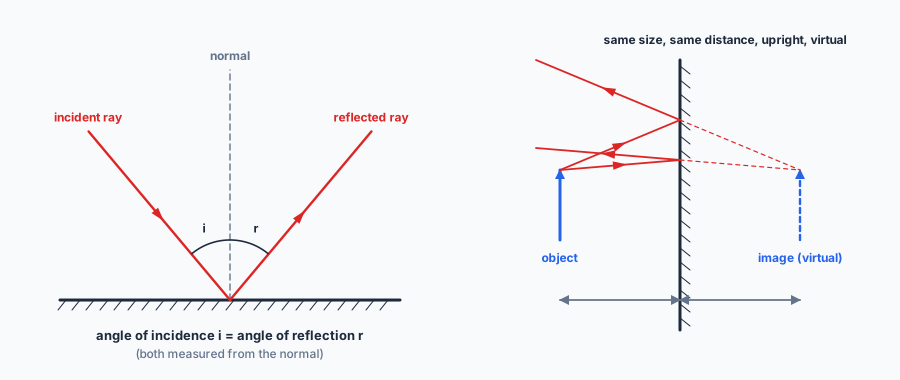
A virtual image cannot be formed on a screen: the reflected rays only appear to come from it. EXTENDED To locate an image by construction, draw two rays from a point on the object to the mirror, reflect each with equal angles, then extend the reflected rays back behind the mirror: they meet at the image.
Refraction
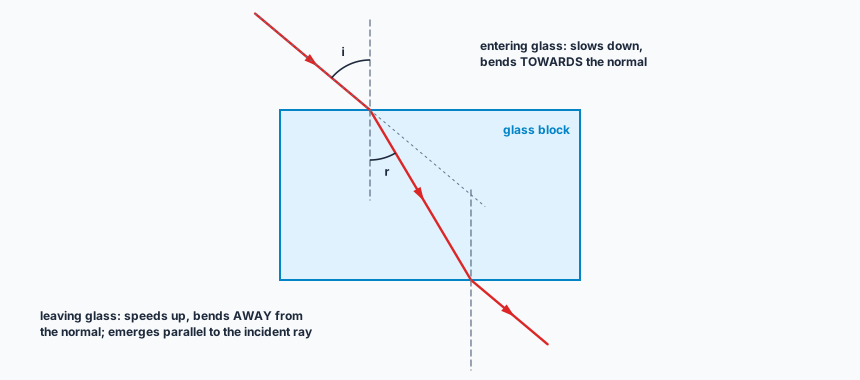
To show refraction, place a glass or Perspex block on paper, shine a ray box beam at it (or use optics pins), mark the rays, then join them through the block and measure the angles with a protractor. Blocks of different shapes (rectangular, semicircular, triangular prism) all show the same rules. A ray along the normal passes straight through.
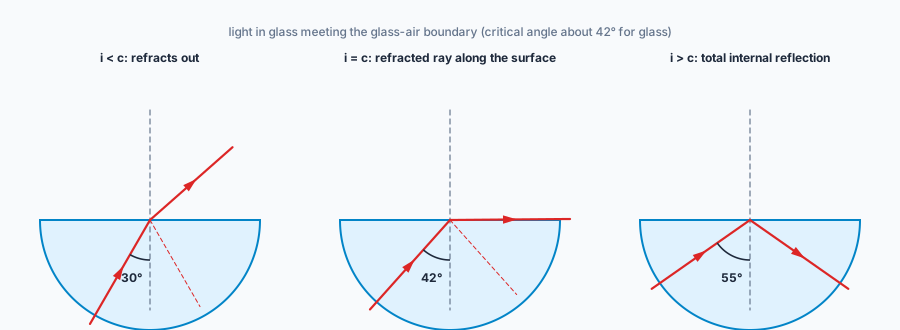
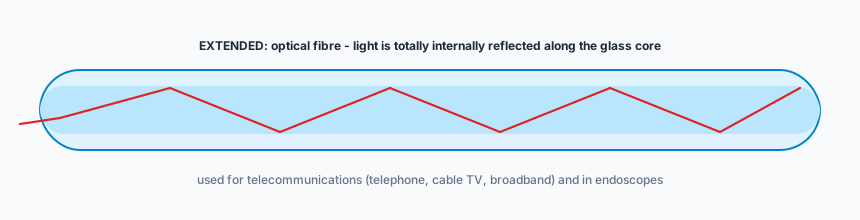
The critical angle is the angle of incidence (inside the denser material) for which the angle of refraction is 90°. At larger angles all the light is reflected: total internal reflection. Examples: prisms in periscopes and binoculars, the sparkle of diamonds, optical fibres.
Refractive index EXTENDED
The refractive index n is the ratio of the speeds of a wave in two regions: \( n = \dfrac{\text{speed of light in air (vacuum)}}{\text{speed of light in the material}} \).
✏️Worked example
(a) \( n = \dfrac{\sin 40^\circ}{\sin 26^\circ} = \dfrac{0.643}{0.438} = \) 1.47.
(b) \( \sin c = \dfrac{1}{1.47} = 0.681 \), so c = 43°.
(c) \( v = \dfrac{3.0 \times 10^8}{1.47} = \) 2.0 × 10⁸ m/s.
📝Practise
In the style of the multiple-choice, theory and practical papers. EXTENDED marks Supplement content.
1. (Theory.) A ray strikes a plane mirror. State the name of the line drawn at 90° to the mirror where the ray strikes, state the law of reflection, and give three characteristics of the image of a toy placed in front of the mirror. [5] (Modelled on 0625/32 June 2026 Q7(a).)
2. (Multiple choice.) A ray strikes a plane mirror. Which angle is always equal to the angle of reflection? A: the angle between the incident ray and the mirror. B: the angle between the incident ray and the normal. C: the angle between the reflected ray and the mirror. D: the angle between the incident and reflected rays.
3. (Multiple choice.) EXTENDED Green light of wavelength 540 nm in air slows from 3.0 × 10⁸ m/s to 2.0 × 10⁸ m/s in glass. What is its wavelength in the glass? A: 360 nm. B: 540 nm. C: 810 nm. D: 1100 nm. (Modelled on 0625/22 June 2026 Q18.)
4. (Theory.) EXTENDED The refractive index of diamond is 2.42. Calculate its critical angle. [2]
5. (Theory.) EXTENDED Light enters water (n = 1.33) with an angle of incidence of 60°. Calculate the angle of refraction. [2]
6. (Practical.) Describe how to trace the path of a ray through a rectangular glass block using optics pins. [4]
7. (Theory.) State two conditions for total internal reflection. [2]
8. (Theory.) EXTENDED Explain why optical fibres are used to carry broadband data. [2]
🔗Go deeper — other people’s work
These are external resources, not mine. If one stops working, tell me and everything above it on this page still stands.
- PhET “Bending Light” — refraction, refractive index and total internal reflection
- The Physics Classroom — reflection and plane mirrors