Sound
🎯What you need to be able to do
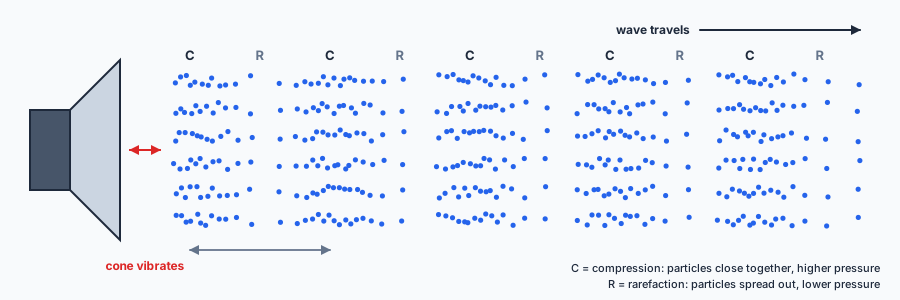
- Describe how sound is produced by vibrating sources and its longitudinal nature; describe compressions and rarefactions EXTENDED.
- State the human audible range (20 Hz to 20 000 Hz); know that sound needs a medium and travels at about 330–350 m/s in air.
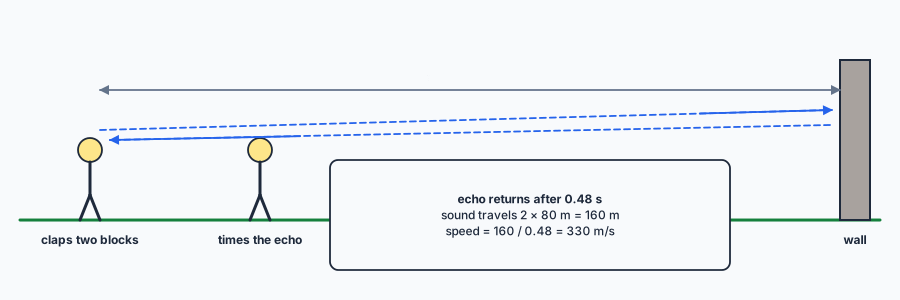
- Describe a method to measure the speed of sound in air; know that sound is faster in liquids and solids EXTENDED.
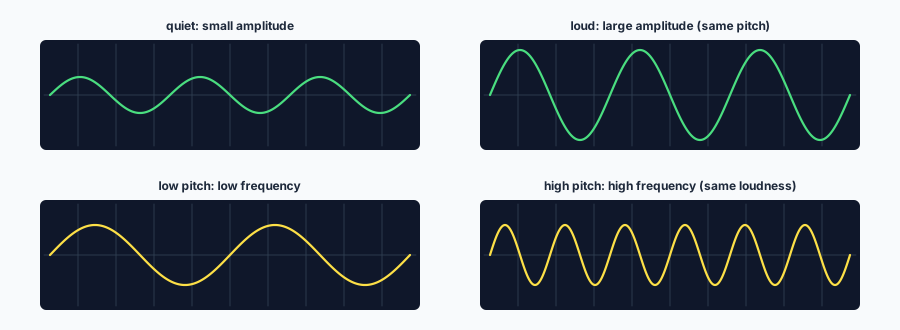
- Relate loudness to amplitude and pitch to frequency; describe echoes and define ultrasound; describe its uses and calculate distances EXTENDED.
📚The physics
What sound is
Sound is produced by vibrating sources (a loudspeaker cone, a guitar string, vocal cords). It travels as a longitudinal wave: the air particles vibrate backwards and forwards along the direction the sound travels. A medium is needed — sound cannot cross a vacuum.
- Humans hear frequencies from about 20 Hz to 20 000 Hz.
- The speed of sound in air is about 330–350 m/s. EXTENDED In general, sound travels faster in solids than in liquids, and faster in liquids than in gases.
- An echo is the reflection of sound waves.
Loudness and pitch
Ultrasound
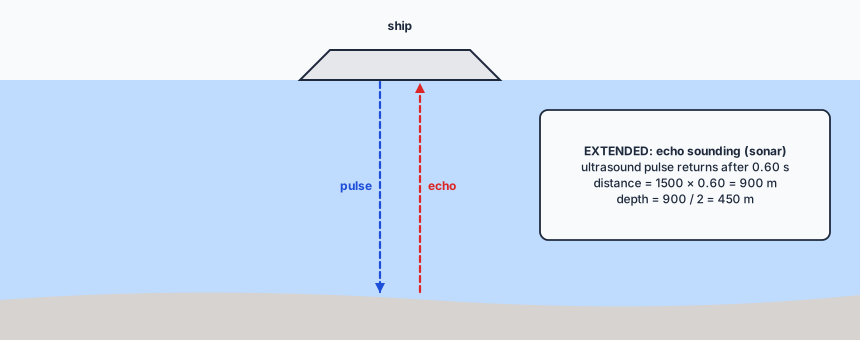
Ultrasound is sound with a frequency higher than 20 kHz — above the range of human hearing. EXTENDED Its short pulses reflect from boundaries, so the time for an echo gives a distance:
- EXTENDED Non-destructive testing: echoes from a crack inside a metal casting or weld show the flaw.
- EXTENDED Medical scanning of soft tissue (e.g. a fetus), without the dangers of X-rays.
- EXTENDED Sonar: finding the depth of the sea or locating shoals of fish.
✏️Worked example
(a) This field interacts with the field of the permanent magnet, so there is a force on the coil that changes direction as the current alternates; the coil and cone vibrate, making the air particles vibrate, which carries energy to the listener as sound.
(b) \( \lambda = \dfrac{v}{f} = \dfrac{330}{512} = \) 0.64 m.
(c) Sound with a frequency above 20 kHz (above the upper limit of human hearing).
📝Practise
In the style of the multiple-choice, theory and practical papers. EXTENDED marks Supplement content.
1. (Multiple choice.) A loudspeaker plays a note more loudly without changing its pitch. Which property of the wave increases? A: amplitude. B: frequency. C: speed. D: wavelength.
2. (Multiple choice.) EXTENDED In still air the pressure is p. In a compression of a sound wave the pressure is P. Which is correct? A: P < p and the particles are further apart. B: P > p and the particles are closer together. C: P > p and the particles are further apart. D: P = p.
3. (Theory.) Hearing ranges: cat 48–85 000 Hz; elephant 14–12 000 Hz; goldfish 20–3000 Hz; rat 200–76 000 Hz. Which animals can hear ultrasound, and which can hear frequencies too low for humans? [2]
4. (Practical.) Describe how to measure the speed of sound in air outdoors. [4]
5. (Theory.) EXTENDED An ultrasound pulse in steel returns from a crack after 12 μs. The speed of sound in steel is 6000 m/s. How deep is the crack? [2]
6. (Theory.) Explain why astronauts on the Moon must use radios to talk to each other, even when standing close together. [2]
7. (Theory.) EXTENDED State the order of the speed of sound in air, water and steel, from slowest to fastest. [1]
🔗Go deeper — other people’s work
These are external resources, not mine. If one stops working, tell me and everything above it on this page still stands.
- PhET “Sound Waves” — compressions, rarefactions, frequency and amplitude
- Academo — online tone generator and oscilloscope for pitch and loudness