Charge, current, p.d. and resistance
🎯What you need to be able to do
- Describe positive and negative charge, charging by friction (transfer of electrons), and conductors and insulators; describe electric fields EXTENDED.
- Know that current is a flow of charge; use ammeters; use \( I = \dfrac{Q}{t} \) and conventional current EXTENDED.
- Define e.m.f. and p.d.; use voltmeters; use \( E = \dfrac{W}{Q} \) and \( V = \dfrac{W}{Q} \) EXTENDED.
- Use \( R = \dfrac{V}{I} \); describe the experiment; sketch and explain I–V graphs and use R ∝ L, R ∝ 1/A EXTENDED.
- Use \( P = IV \) and \( E = IVt \); define the kilowatt-hour and calculate costs.
📚The physics
Electric charge
There are positive and negative charges. Like charges repel; unlike charges attract. Charging a solid by friction involves only the transfer of negative charge (electrons). Charge can be detected with a gold-leaf electroscope or by seeing whether an object attracts small pieces of paper. EXTENDED Charge is measured in coulombs (C).
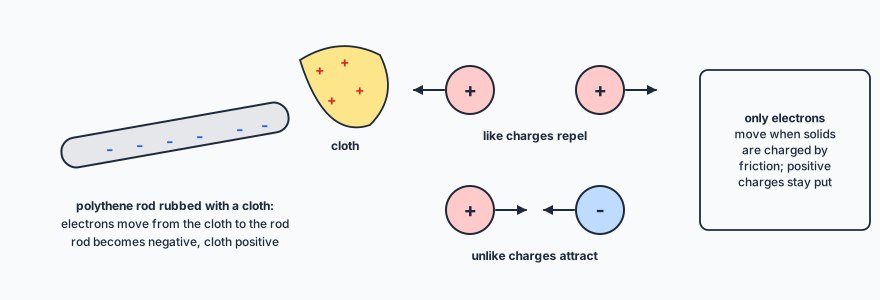
Conductors (metals, graphite) let charge flow because they contain free electrons; insulators (plastic, rubber, glass, dry wood) do not, because their electrons are held in their atoms. To test a material, connect it in a circuit with a cell and a lamp (or ammeter): the lamp lights only for a conductor.
Electric fields EXTENDED
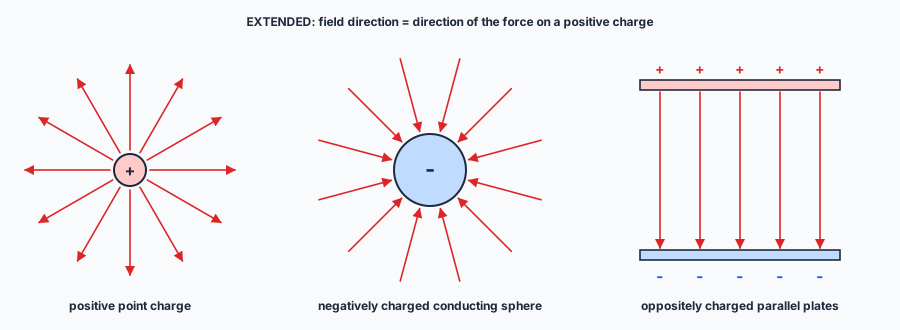
An electric field is a region in which an electric charge experiences a force. The direction of the field at a point is the direction of the force on a positive charge at that point.
Current, e.m.f. and potential difference
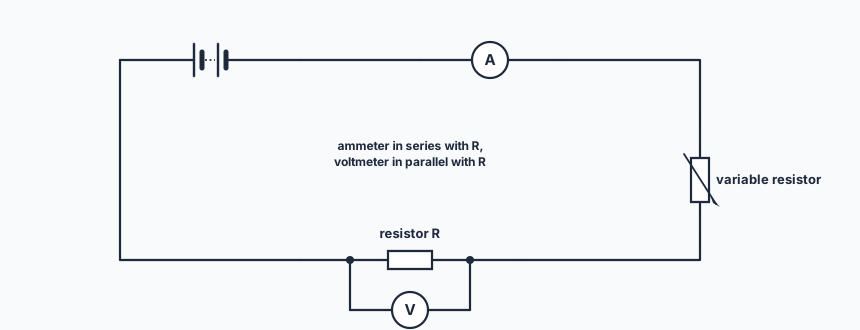
Electric current is a flow of charge; in metals it is the movement of free electrons. It is measured with an ammeter in series (analogue or digital, with different ranges). Direct current (d.c.) flows one way; alternating current (a.c.) keeps reversing.
EXTENDED Current is the charge passing a point per unit time. Conventional current flows from positive to negative; free electrons flow from negative to positive.
- E.m.f. is the electrical work done by a source in moving a unit charge around a complete circuit, measured in volts (V).
- Potential difference (p.d.) is the work done by a unit charge passing through a component, in volts, measured with a voltmeter connected in parallel.
- EXTENDED \( E = \dfrac{W}{Q} \) and \( V = \dfrac{W}{Q} \): 1 V = 1 J/C.
Resistance
The resistance of a metal wire increases with its length and decreases as its cross-sectional area increases. EXTENDED R is directly proportional to length and inversely proportional to cross-sectional area: double the length, double R; double the area, half R.
Electrical energy and power
Circuits transfer energy from the source (a cell or the mains) to the components and then to the surroundings. The kilowatt-hour (kWh) is the energy transferred by a 1 kW appliance in 1 hour (3.6 × 10⁶ J). Cost = number of kWh × price per kWh.
✏️Worked example
(a) R = V/I = 230 / 9.2 = 25 Ω.
(b) P = IV = 9.2 × 230 = 2100 W (2116 W, about 2.1 kW).
(c) Energy = 2.116 kW × 3.0 h = 6.35 kWh; cost = 6.35 × 1500 = Rp 9500 (9522).
(d) Q = It = 9.2 × 60 = 550 C (552).
📝Practise
In the style of the multiple-choice and theory papers. EXTENDED marks Supplement content.
1. (Theory.) EXTENDED Complete the definition: an electric field is a region in which … ; and describe the field between two oppositely charged parallel plates. [4] (Modelled on 0625/42 June 2026 Q8(a).)
2. (Theory.) EXTENDED A current of 2.5 A flows through a motor for 4.0 minutes. Calculate the charge that flows. [2]
3. (Multiple choice.) A lamp rated 6.0 V, 18 W works normally for 30 s. How much energy does it transfer? A: 3.0 J. B: 108 J. C: 540 J. D: 3240 J.
4. (Theory.) Explain, in terms of electrons, why a plastic comb becomes negatively charged when it is pulled through dry hair. [2]
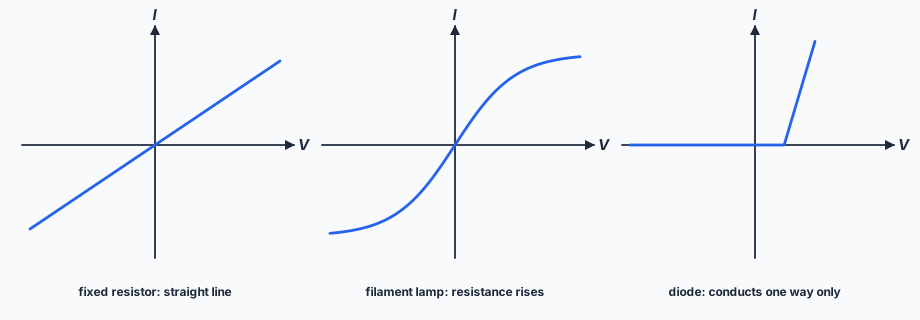
5. (Theory.) EXTENDED Sketch the I–V graph for a filament lamp and explain its shape. [3]
6. (Theory.) EXTENDED A wire has a resistance of 12 Ω. What is the resistance of a wire of the same metal that is twice as long and has twice the cross-sectional area? [2]
7. (Theory.) EXTENDED A battery of e.m.f. 9.0 V drives 40 C of charge round a circuit. Calculate the energy transferred by the battery. [2]
8. (Theory.) A 1.5 kW kettle is used for 20 minutes each day. Calculate the energy used per week in kWh. [2]
🔗Go deeper — other people’s work
These are external resources, not mine. If one stops working, tell me and everything above it on this page still stands.
- PhET “Balloons and Static Electricity” and “Charges and Fields”
- PhET “Ohm’s Law” and “Resistance in a Wire”