Electrical safety
🎯What you need to be able to do
- State the hazards of damaged insulation, overheating cables, damp conditions and overloading plugs, extension leads and sockets.
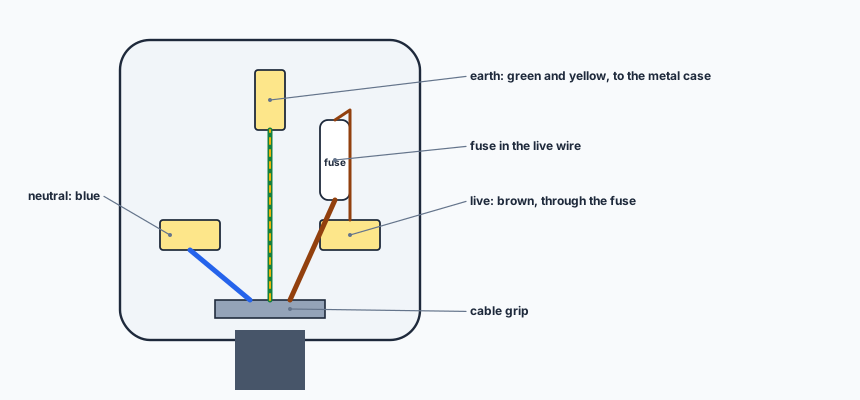
- Know that a mains circuit has a live, a neutral and an earth wire, and explain why a switch must be in the live wire.
- Explain the use and operation of fuses and trip switches, and choose suitable ratings.
- Explain why an appliance’s outer casing must be earthed or non-conducting (double-insulated).
📚The physics
Hazards
The mains circuit
A mains circuit has a live (line) wire, a neutral wire and an earth wire. The live wire is at a high voltage; the neutral wire is close to 0 V. The switch must be in the live wire, so that when it is off the appliance is disconnected from the high voltage; with the switch in the neutral wire, the appliance would still be live and dangerous even when switched off.
Fuses and trip switches
A fuse is a thin wire that heats up and melts if the current is larger than its rating, breaking the circuit. A trip switch (circuit breaker) does the same job with an electromagnet that opens a switch; it can be reset. Both protect the wiring from overheating. Choose a rating a little above the normal current: small enough to break the circuit in a fault, large enough not to break it in normal use.
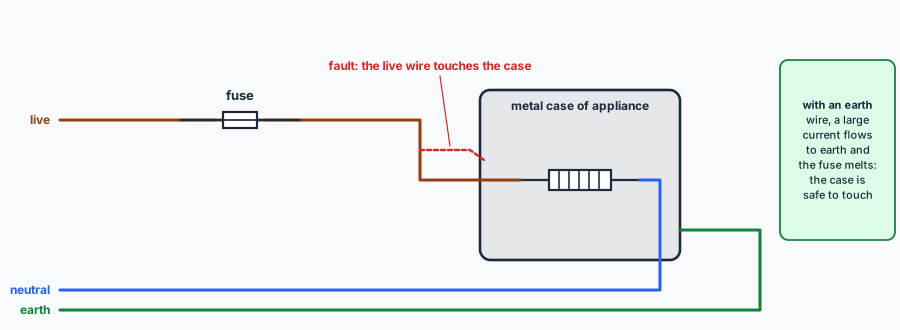
An appliance’s outer casing must be either earthed (if it is metal) or non-conducting (double-insulated), so a person touching it cannot become part of a circuit to the live wire. A fuse without an earth wire still protects the circuit and cabling of a double-insulated appliance.
✏️Worked example
(a) I = P/V = 2300 / 230 = 10 A.
(b) 13 A: the smallest rating above the normal 10 A. A 3 A or 5 A fuse would melt every time the kettle was used.
(c) If the current becomes larger than 13 A, the fuse wire overheats and melts, breaking the circuit before the cables overheat.
(d) They heat the cables, which can melt the insulation and cause a fire (or a shock).
📝Practise
In the style of the multiple-choice and theory papers.
1. (Multiple choice.) An electric oven takes a current of 26 A. Which trip switch rating is most suitable? A: 6 A. B: 20 A. C: 32 A. D: 100 A. (Modelled on 0625/12 June 2026 Q33.)
2. (Multiple choice.) Which situation is most likely to make an extension lead overheat? A: fuses of low rating in the plugs. B: the lead is kept dry. C: several high-power appliances plugged into it at once. D: the earth wire is connected.
3. (Theory.) Explain why a light switch must be connected in the live wire. [2]
4. (Theory.) A hair dryer has a plastic case and no earth wire. Explain why it is still safe to use. [2]
5. (Theory.) Give two advantages of a trip switch over a fuse. [2]
6. (Theory.) A 60 W lamp works from 230 V. Which fuse is suitable: 1 A, 3 A or 13 A? [2]
🔗Go deeper — other people’s work
These are external resources, not mine. If one stops working, tell me and everything above it on this page still stands.
- BBC Bitesize — mains electricity and safety
- Electrical Safety First — home electrical safety guidance