The nuclear model of the atom
🎯What you need to be able to do
- Describe the atom as a positive nucleus with negative electrons in orbit; describe how atoms form positive and negative ions.
- Describe the nucleus in terms of protons and neutrons, with their relative charges; define proton number and nucleon number; use nuclide notation.
- Explain what isotopes are.
- Describe how alpha-particle scattering supports the nuclear model EXTENDED.
- Describe fission and fusion with nuclide equations; relate proton number to nuclear charge and nucleon number to nuclear mass EXTENDED.
📚The physics
The atom
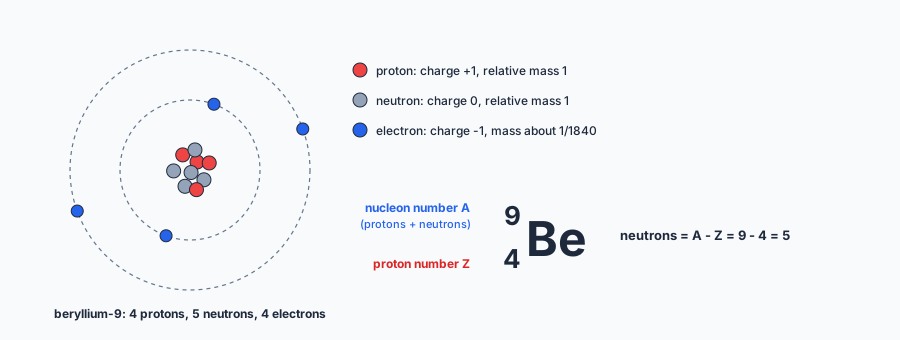
An atom has a small, positively charged nucleus of protons and neutrons, surrounded by negatively charged electrons in orbit. A neutral atom has equal numbers of protons and electrons. An atom that loses electrons becomes a positive ion; one that gains electrons becomes a negative ion.
Isotopes
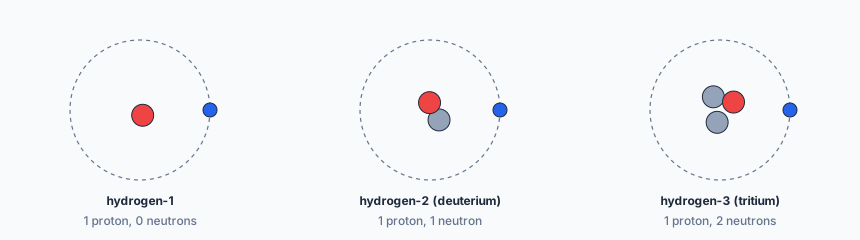
Isotopes are atoms of the same element with the same number of protons but different numbers of neutrons. An element may have more than one isotope; they behave identically in chemical reactions but may differ in whether they are radioactive.
Evidence for the nucleus EXTENDED
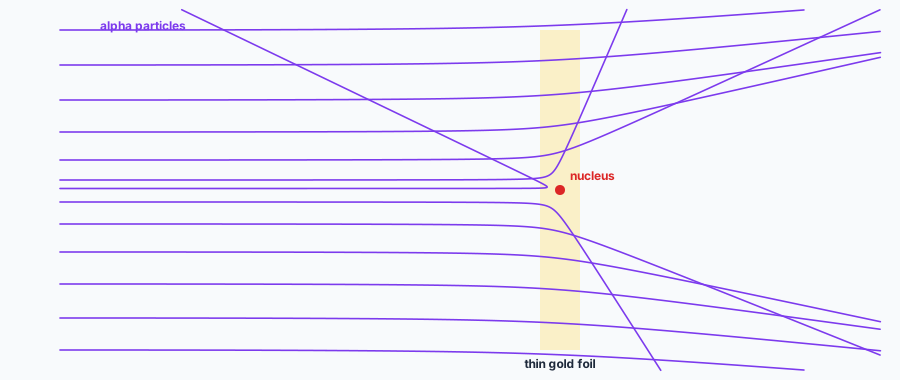
- EXTENDED Most alpha particles pass straight through: the atom is mostly empty space with a very small nucleus.
- EXTENDED Some are deflected: the nucleus is positively charged (it repels the positive alpha particles).
- EXTENDED A very few bounce back: the nucleus contains most of the mass of the atom.
Fission and fusion EXTENDED
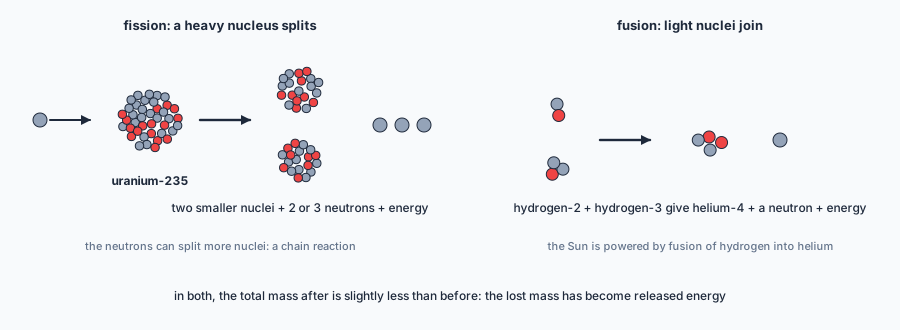
EXTENDED In every nuclide equation the nucleon numbers and the proton numbers balance. Fission is the splitting of a heavy nucleus (after absorbing a neutron) into two smaller nuclei, with neutrons and energy released. Fusion is the joining of two light nuclei into a heavier one, releasing energy. In both, the mass of the products is slightly less than the mass before; the difference has been released as energy.
✏️Worked example
(a) Protons 17; neutrons 37 − 17 = 20; electrons 17.
(b) Same number of protons (17); different number of neutrons (18 and 20).
(c) A negative ion, with a charge of −1.
📝Practise
In the style of the multiple-choice and theory papers. EXTENDED marks Supplement content.
1. (Theory.) The nuclide notation for an isotope of sodium is \( {}^{23}_{11}\mathrm{Na} \). Determine the numbers of protons and neutrons in its nucleus. [2] (Modelled on 0625/32 June 2026 Q9(b).)
2. (Multiple choice.) How does an atom become a positive ion? A: it gains protons. B: it gains electrons. C: it loses electrons. D: it loses neutrons.
3. (Theory.) State the relative charges of the proton, the neutron and the electron. [1]
4. (Theory.) EXTENDED Describe the results of the alpha-scattering experiment and what each shows about the atom. [3]
5. (Theory.) EXTENDED Describe what happens when heavy nuclei undergo fission in a nuclear reactor. [3] (Modelled on 0625/42 June 2026 Q10(a)(i).)
6. (Theory.) EXTENDED Complete the equation: \( {}^{235}_{92}\mathrm{U} + {}^{1}_{0}\mathrm{n} \rightarrow {}^{141}_{56}\mathrm{Ba} + {}^{A}_{Z}\mathrm{Kr} + 3\,{}^{1}_{0}\mathrm{n} \). [2]
7. (Theory.) EXTENDED State one difference between nuclear fission and nuclear fusion. [1]
🔗Go deeper — other people’s work
These are external resources, not mine. If one stops working, tell me and everything above it on this page still stands.
- PhET “Rutherford Scattering” and “Build an Atom”
- PhET “Nuclear Fission” — chain reactions