The Earth and the Solar System
🎯What you need to be able to do
- Use the Earth’s tilted, spinning axis and its orbit to explain day and night, the Sun’s apparent daily motion and the seasons; use the Moon’s orbit to explain its phases.
- Describe the Solar System and the order of the planets; explain the rocky/gaseous difference with the accretion model.
- Know how gravitational field strength depends on planet mass and distance; calculate light travel times; know the Sun holds most of the mass.
- Use \( v = \dfrac{2\pi r}{T} \); describe elliptical orbits; analyse planetary data; explain orbital speed changes EXTENDED.
📚The physics
The Earth
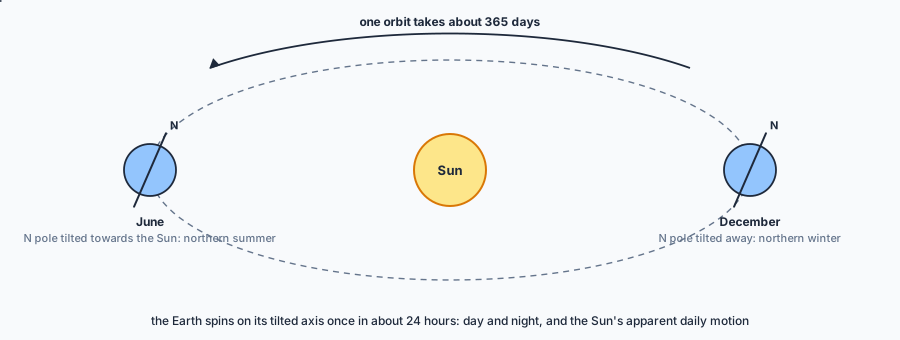
- The Earth rotates on its tilted axis once in about 24 hours: this gives day and night, and makes the Sun appear to rise in the east, move across the sky and set in the west.
- The Earth orbits the Sun once in about 365 days. Because the axis is tilted, each hemisphere is tilted towards the Sun for part of the year (summer: longer days, Sun higher in the sky) and away for the other part (winter): the seasons.
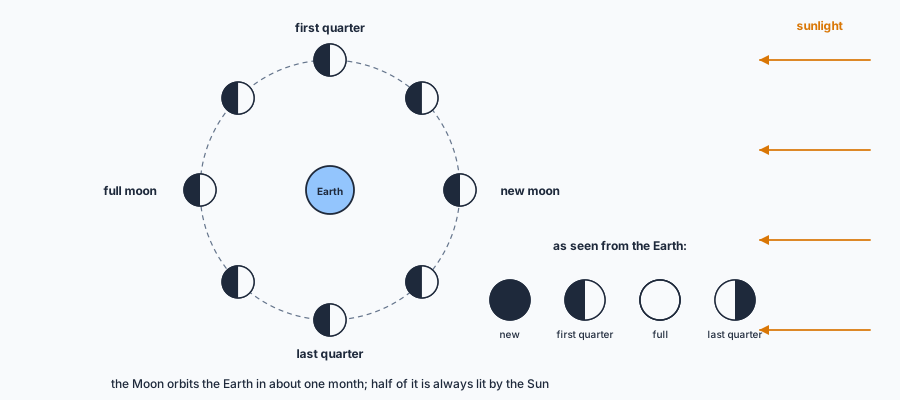
- The Moon orbits the Earth in about one month, giving the cycle of the Moon’s phases.
The Solar System
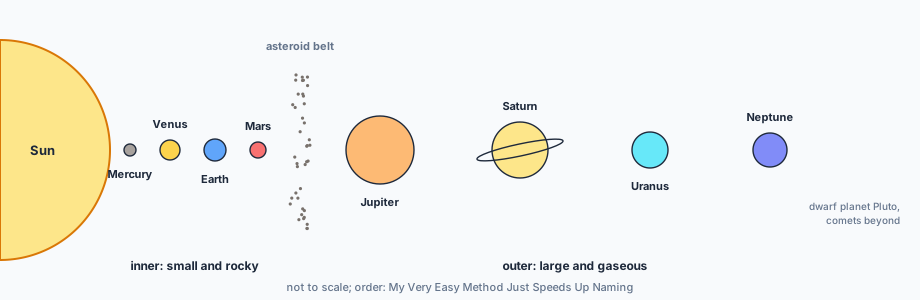
The Solar System contains one star (the Sun), the eight planets, minor planets (dwarf planets such as Pluto, and asteroids in the asteroid belt), moons orbiting planets, and smaller bodies such as comets. The four inner planets are small and rocky; the four outer ones are large and gaseous. The accretion model explains this: the Solar System formed from a rotating interstellar cloud of gas and dust containing many elements; gravity pulled it together into an accretion disc around the young Sun; near the hot Sun only rocky materials could condense, while further out gases and ices collected into giant planets.
- The gravitational field strength at a planet’s surface depends on the planet’s mass; around it, the field gets weaker with distance.
- The Sun contains most of the mass of the Solar System, so its gravitational attraction keeps the planets in orbit.
- Light (speed 3.0 × 10⁸ m/s) takes about 8.3 minutes to reach us from the Sun: time = distance ÷ speed.
Orbits EXTENDED
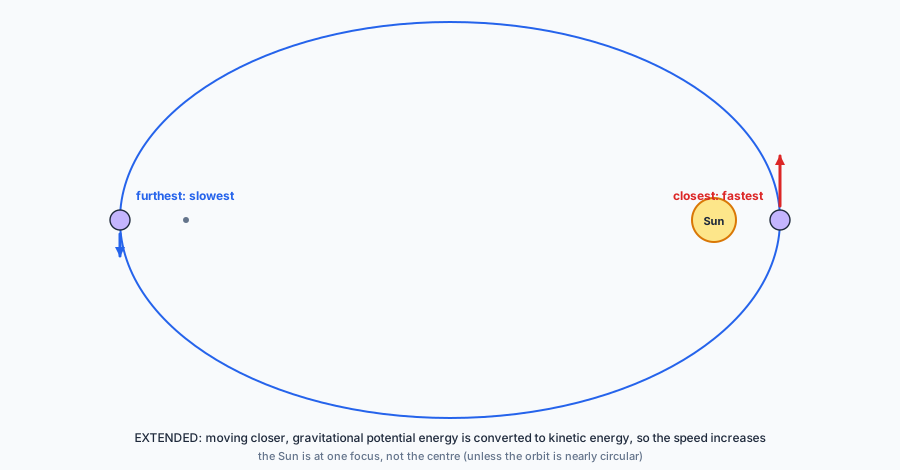
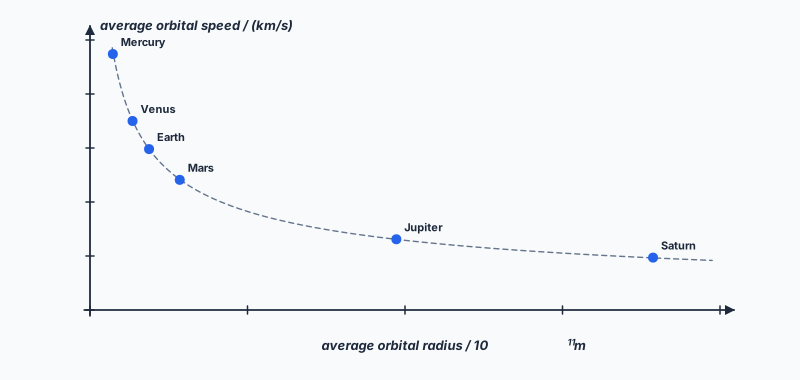
EXTENDED r is the average orbital radius and T the orbital period. Planets, minor planets and comets have elliptical orbits with the Sun not at the centre (except for nearly circular orbits). The Sun’s field gets weaker further out, so the orbital speeds of the planets decrease with distance from the Sun.
✏️Worked example
(a) \( T = \dfrac{2\pi r}{v} = \dfrac{2\pi \times 1.43 \times 10^{9}}{3.49 \times 10^{4}} = 2.57 \times 10^{5} \) hours; \( \dfrac{2.57 \times 10^{5}}{24 \times 365} = \) 29.4 years.
(b) t = d/v = 1.43 × 10¹² m / 3.0 × 10⁸ m/s = 4770 s = 79 minutes (1.3 hours).
📝Practise
In the style of the multiple-choice and theory papers. EXTENDED marks Supplement content.
1. (Theory.) Match each event to its approximate time: the Earth orbits the Sun; the Earth rotates once; the Moon orbits the Earth. Times: 24 hours, 1 month, 365 days. [2]
2. (Theory.) A rover on Mars sends a radio signal to the Earth when Mars is 7.8 × 10¹⁰ m away. Radio waves travel at 3.0 × 10⁸ m/s. Calculate the time the signal takes. [2] (Modelled on 0625/32 June 2026 Q10(c).)
3. (Theory.) Name the force that keeps the Moon in orbit around the Earth. [1]
4. (Theory.) Explain why the four planets nearest the Sun are small and rocky. [3]
5. (Theory.) Explain why it is summer in the southern hemisphere in December. [2]
6. (Multiple choice.) EXTENDED Which expression gives the orbital period T of the Moon, orbital radius r and speed v? A: 2πrv. B: 2πr/v. C: 2πr2/v. D: v/2πr.
7. (Theory.) EXTENDED A comet has a very elliptical orbit. Explain, using the conservation of energy, why it moves fastest when closest to the Sun. [3]
🔗Go deeper — other people’s work
These are external resources, not mine. If one stops working, tell me and everything above it on this page still stands.
- NASA Solar System Exploration — planetary data
- PhET “Gravity and Orbits” — orbital speed and distance