Stars and the Universe
🎯What you need to be able to do
- Describe the Sun as a medium-sized star of hydrogen and helium radiating mostly infrared, visible light and ultraviolet; know stars are powered by fusion EXTENDED.
- State that galaxies contain billions of stars, that the Sun is in the Milky Way, and that distances are measured in light-years.
- Describe the life cycle of a star EXTENDED.
- Describe redshift and how it supports the Big Bang Theory; know the diameter of the Milky Way.
- Describe the CMBR; use \( H_0 = \dfrac{v}{d} \) and \( \dfrac{1}{H_0} \) as the age of the Universe EXTENDED.
📚The physics
The Sun and the galaxies
The Sun is a star of medium size, consisting mostly of hydrogen and helium; it radiates most of its energy in the infrared, visible and ultraviolet regions. EXTENDED Stars are powered by nuclear reactions; in stable stars these are the fusion of hydrogen into helium.
- Galaxies are each made up of many billions of stars. The Sun is a star in the Milky Way.
- The other stars in the Milky Way are much further away from the Earth than the Sun is.
- A light-year is the distance travelled in (the vacuum of) space by light in one year: about 9.5 × 10¹⁵ m.
- The Milky Way is one of many billions of galaxies in the Universe; its diameter is about 100 000 light-years.
The life cycle of a star EXTENDED
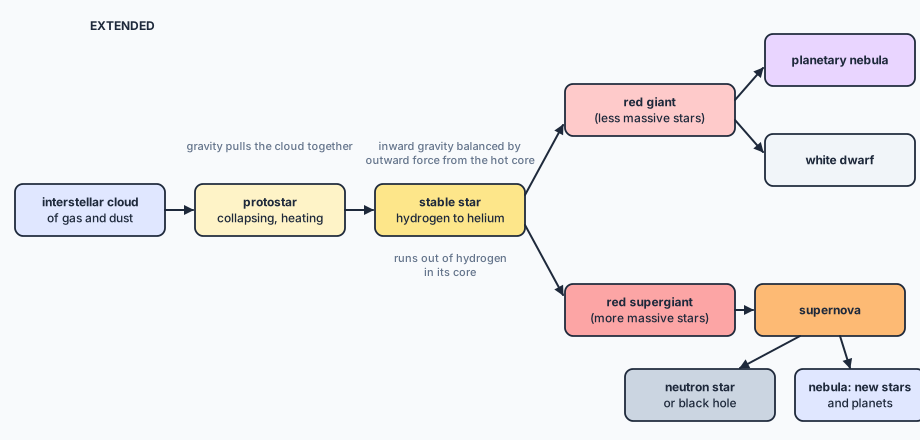
- EXTENDED A star forms from an interstellar cloud of gas and dust containing hydrogen.
- A protostar is the cloud collapsing and heating up because of its internal gravitational attraction.
- It becomes a stable star when the inward force of gravity is balanced by an outward force due to the high temperature at its centre.
- All stars eventually run out of hydrogen for their nuclear reactions.
- Most stars expand into red giants; more massive stars into red supergiants, once most of the core’s hydrogen is helium.
- A red giant forms a planetary nebula with a white dwarf at its centre.
- A red supergiant explodes as a supernova, forming a nebula containing hydrogen and new heavier elements, leaving a neutron star or a black hole.
- The nebula from a supernova may form new stars with orbiting planets.
The expanding Universe
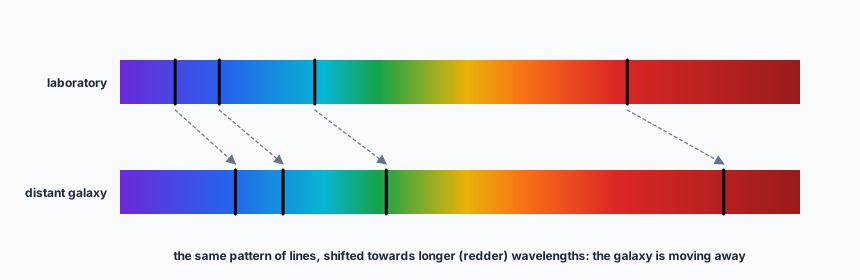
Light from distant galaxies is redshifted compared with light emitted on the Earth. Redshift is evidence that the Universe is expanding and supports the Big Bang Theory. EXTENDED Microwave radiation of a specific frequency is observed at all points in space: the cosmic microwave background radiation (CMBR). It was produced shortly after the Universe was formed and has been stretched into the microwave region as the Universe expanded.
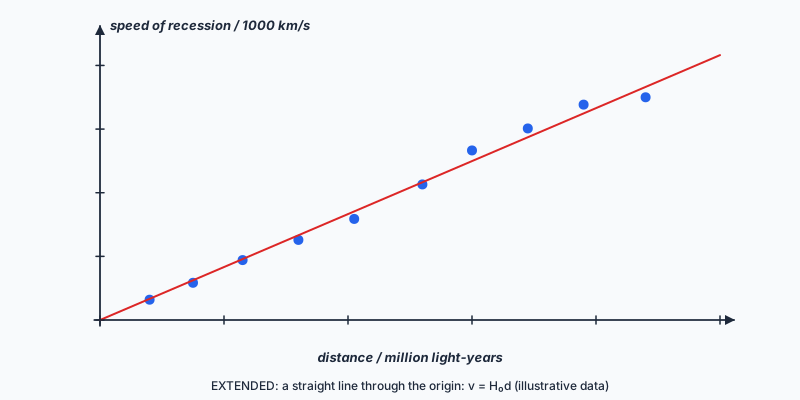
EXTENDED The speed v of a galaxy is found from the redshift of its starlight; its distance d from the brightness of a supernova in it. The current estimate of H0 is 2.2 × 10⁻¹⁸ per second. \( 1/H_0 \) estimates the age of the Universe, evidence that all the matter in the Universe was once at a single point.
✏️Worked example
(a) The distance travelled by light in (the vacuum of) space in one year.
(b) d = 2.5 × 108 × 9.46 × 1015 = 2.37 × 1024 m; v = H0d = 2.2 × 10−18 × 2.37 × 1024 = 5.2 × 10⁶ m/s.
(c) 1/H0 = 4.5 × 10¹⁷ s; ÷ (3.15 × 10⁷ s per year) = 1.4 × 10¹⁰ years (about 14 billion years).
📝Practise
In the style of the multiple-choice and theory papers. EXTENDED marks Supplement content.
1. (Multiple choice.) The star Sirius is 8.6 light-years from the Earth. What is this distance in kilometres? (1 light-year = 9.5 × 10¹² km.) A: 1.1 × 10¹² km. B: 8.2 × 10¹³ km. C: 9.5 × 10¹³ km. D: 8.2 × 10¹⁶ km.
2. (Theory.) Describe what is meant by redshift, and state what it shows about the Universe. [3]
3. (Theory.) State the approximate diameter of the Milky Way. [1]
4. (Theory.) EXTENDED Explain why a stable star does not collapse or expand. [2]
5. (Theory.) EXTENDED Describe what happens to a star much more massive than the Sun at the end of its life. [3]
6. (Theory.) EXTENDED What is the CMBR, and why is it now in the microwave region? [2]
7. (Theory.) EXTENDED State how the distance to a far galaxy can be found, and how its speed is found. [2]
🔗Go deeper — other people’s work
These are external resources, not mine. If one stops working, tell me and everything above it on this page still stands.
- ESA — Planck and the cosmic microwave background
- NASA — “Star Life Cycle” and the Hubble constant