Technology
🎯What you need to be able to do
- Explain what a sensor does, and why it is also called an input transducer.
- Distinguish analogue from digital sensors and signals.
- State the three real advantages of a sensor and data logger over a person with a stopwatch.
- Describe how databases, simulations, and image and video analysis are used to gather data.
- Explain the iterative technique, and why it is needed when an analytic formula will not do.
- Say what happens to the accuracy and the cost of an iterative model as the time step is reduced.
📡What a sensor actually is
A sensor is any device that measures a physical quantity. Nearly all of them work by converting that quantity into an electrical one — usually a potential difference — which is why they are also called input transducers. A microphone takes a sound wave and gives out a varying voltage; a thermistor turns temperature into resistance; a light-dependent resistor does the same for illumination.
That conversion is what makes the rest possible. Once a quantity is a voltage, a data logger can sample it thousands of times a second and a computer can store, plot and process the result.
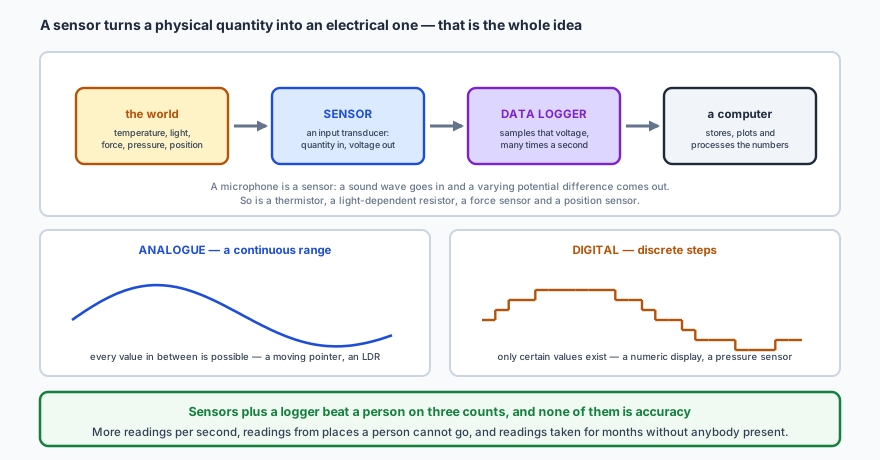
The three advantages are worth stating precisely, because “it is better” earns nothing:
📊Data you did not take yourself
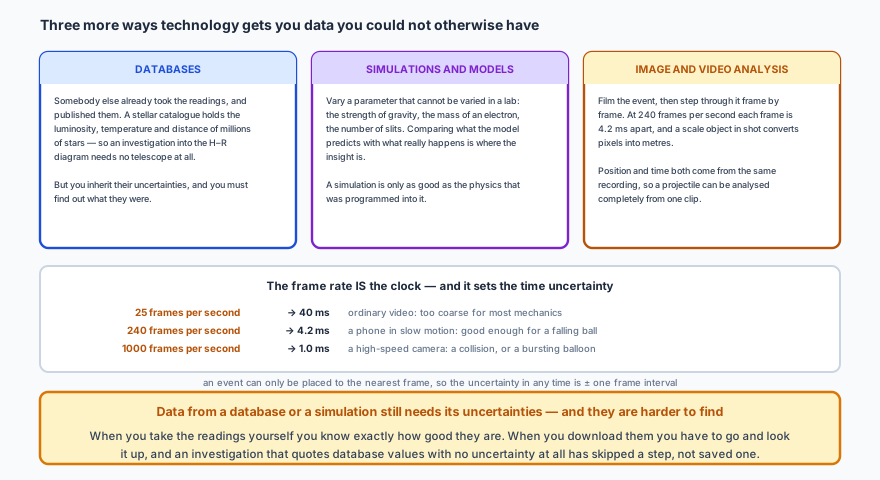
Databases hold measurements the scientific community has already made and shared. A stellar catalogue is the obvious example for this course — the whole of E.5 can be investigated from published luminosities, temperatures and parallaxes without owning a telescope.
Simulations and models let you vary what a laboratory will not: the strength of gravity, the mass of a particle, the number of slits. The physics is in the comparison — where the model and reality agree, and more interestingly where they do not.
Image and video analysis extracts both position and time from a single recording. The frame rate is the clock: at 240 frames per second the frames are 4.2 ms apart, and an event can only be placed to the nearest frame, so ± 4.2 ms is the time uncertainty. Include something of known size in the shot and pixels convert into metres.
🔢Spreadsheets and the iterative technique
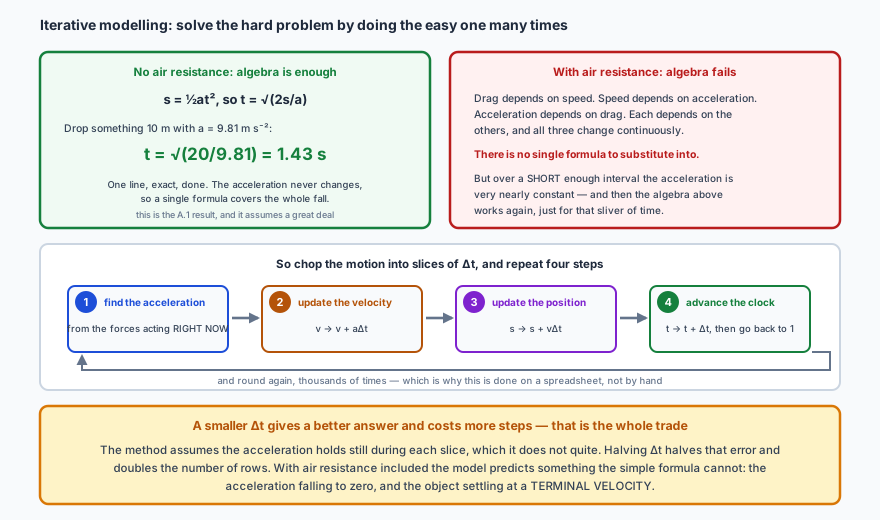
Some problems have no formula. Drop an object with air resistance and the drag depends on the speed, the speed depends on the acceleration, and the acceleration depends on the drag — each quantity depends on the others and all of them change continuously. There is nothing to substitute into.
The iterative technique gets round this by exploiting a simple fact: over a short enough interval, the acceleration barely changes, and the constant-acceleration equations of A.1 become good enough again. So chop the motion into slices of \( \Delta t \) and step through them.
✏️Worked example 1 — the first two rows of an iterative model
Step 1, at \( t = 0 \). The object is at rest, so \( v = 0 \) and there is no drag at all. The only force is the weight:
Step 2, at \( t = 0.10 \) s. Now there is a speed, so there is drag, and the acceleration has already fallen:
✏️Worked example 2 — choosing a frame rate
How long is the fall? With no air resistance, \( t = \sqrt{2s/g} = \sqrt{2(1.2)/9.81} = 0.49 \) s.
What uncertainty does each frame rate give? An event can only be placed to the nearest frame, so the uncertainty is one frame interval:
So 25 frames per second misses the target by a factor of eight; 240 just meets it.
📝Practise
Work through these, then reveal the answer. Each question targets a different objective from the list above.
1. Explain what a sensor does, and why it is also called an input transducer. Give two examples.
Examples: a microphone converts a sound wave into a varying voltage; a thermistor converts temperature into resistance; a light-dependent resistor does the same for illumination; a force sensor converts an applied force into a voltage. The conversion is what allows a data logger to record the quantity at all.
2. Distinguish an analogue sensor from a digital one, and give an example of each.
A digital sensor represents it using discrete values only, so the output steps between allowed levels — a meter with a numeric display, or a pressure sensor connected to a data logger.
The distinction matters because converting analogue to digital always discards some information: the size of the step is a limit on the resolution, in exactly the way the last digit of a digital display is.
3. State three advantages of using a sensor and data logger rather than taking readings by hand. Is greater accuracy one of them?
Greater accuracy is not one of them. A logger removes human reaction time and human tedium, both of which are random effects, so results become more precise and more repeatable. It does nothing about a badly calibrated sensor or a zero error — those are systematic, and logging a wrong value ten thousand times gives ten thousand wrong values.
4. A student investigates the H–R diagram using a published stellar database rather than making observations. State one advantage and one thing they must still do.
What they must still do: find and quote the uncertainties attached to that data. When you take a reading yourself you know its uncertainty because you chose the instrument; downloaded data carries uncertainties that somebody else determined, and they have to be looked up rather than assumed away. Quoting database values as though they were exact is a real omission, not a saving.
5. Explain why an analytic formula cannot give the motion of a falling object when air resistance is significant.
The constant-acceleration equations assume, as their name says, that \(a\) is constant — which is exactly what is not true here. There is no single expression to substitute into, so the motion must be built up numerically instead.
6. State the four steps of one cycle of an iterative model of motion, in order.
2. Update the velocity: \( v \rightarrow v + a\Delta t \).
3. Update the position: \( s \rightarrow s + v\Delta t \).
4. Advance the clock: \( t \rightarrow t + \Delta t \), and return to step 1.
Each cycle is one row of a spreadsheet, and the final values of one row become the starting conditions of the next.
7. An object of mass 0.20 kg falls from rest against a drag force \( F_d = 0.40v \). Using \( \Delta t = 0.05 \) s and \( g = 9.81 \) m s−2, find the velocity after two time steps.
8. For that same object, find the terminal velocity, and explain how the iterative model reaches it.
9. What happens to an iterative model's accuracy and its cost when \( \Delta t \) is halved? Can \( \Delta t \) be made small enough to give an exact answer?
It cannot be made exact. The method's error comes from assuming the acceleration is constant across each slice, and that assumption is wrong for every non-zero \( \Delta t \), however small. The error can be made as small as you have patience and computing time for, but it never reaches zero. Saying that a small enough step would make the model exact is the misconception to avoid.
10. A collision lasts about 15 ms. A student films it at 120 frames per second. Explain whether this is adequate, and what they should do instead.
They need a much higher frame rate: at 600 frames per second the interval is 1.7 ms, giving roughly nine frames across the collision, which is enough to track the deformation and find the contact time. Alternatively, use a force sensor connected to a data logger, which can sample far faster than any affordable camera and gives the force directly rather than requiring it to be inferred from positions.
🔗Go deeper — other people’s work
These are external resources, not mine. If one stops working, tell me and everything above it on this page still stands.
- Tracker — free video-analysis software, and the standard tool for this kind of work
- PhET — simulations across the whole DP syllabus, useful for the modelling half of this topic