The greenhouse effect
In the old syllabus this sat inside Unit 8, Energy production. It now stands on its own inside the matter theme, and it carries more weight than it used to. The whole topic is one equation — energy in equals energy out — applied to a planet. What makes it worth a page is that the simple version of that equation gives an answer that is wrong by 33 K, and the reason it is wrong is the greenhouse effect itself.
🎯What you need to be able to do
- Use the solar constant, and explain why the average intensity over a planet’s surface is a quarter of it.
- Define and use albedo, and describe what makes a surface’s albedo high or low.
- Define and use emissivity, and distinguish a black body from a grey body.
- Construct an energy balance model of a planet and solve it for the equilibrium temperature.
- Explain, in terms of molecular resonance, why greenhouse gases absorb infrared and nitrogen and oxygen do not.
- Explain why the wavelength of the incoming radiation differs from that of the outgoing radiation, and why that asymmetry matters.
- Name the main greenhouse gases and their sources.
- Distinguish the natural greenhouse effect from the enhanced greenhouse effect.
☀️The incoming energy, and the factor of four
The Sun radiates in all directions, so at a distance \(d\) its power is spread over a sphere of area \( 4\pi d^{2} \) and the intensity is the apparent brightness from B.1:
At the Earth’s orbital distance this evaluates to about 1360 W m\(^{-2}\), a number called the solar constant, \(S\). It is the power falling on one square metre held square-on to the Sun, just outside the atmosphere.
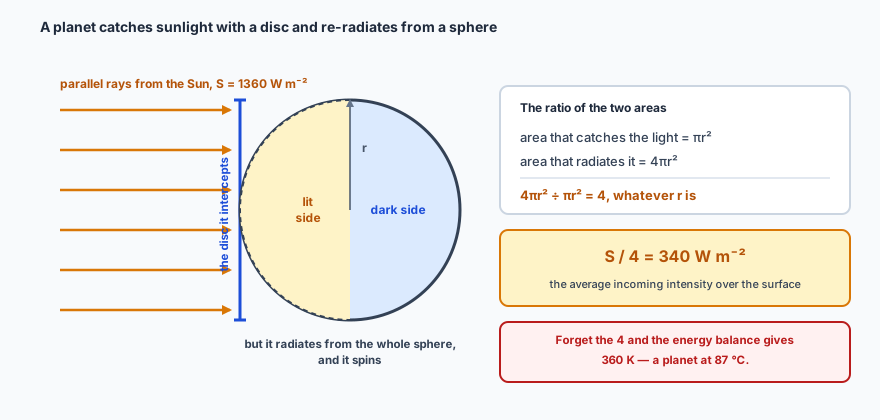
Almost nowhere on Earth is that the actual intensity, for two reasons that are both geometry. The planet presents a disc of area \( \pi r^{2} \) to the incoming beam, so that is what it intercepts. But it radiates from its whole sphere, area \( 4\pi r^{2} \), and it spins, so the incoming energy ends up spread over four times the area that caught it.
🪝Albedo: how much is thrown straight back
Not all of that 340 W m\(^{-2}\) is absorbed. The albedo of a surface is the fraction of the incident power that is scattered back:
It is a ratio, so it has no units, and it runs from 0 (a perfect absorber) to 1 (a perfect reflector).
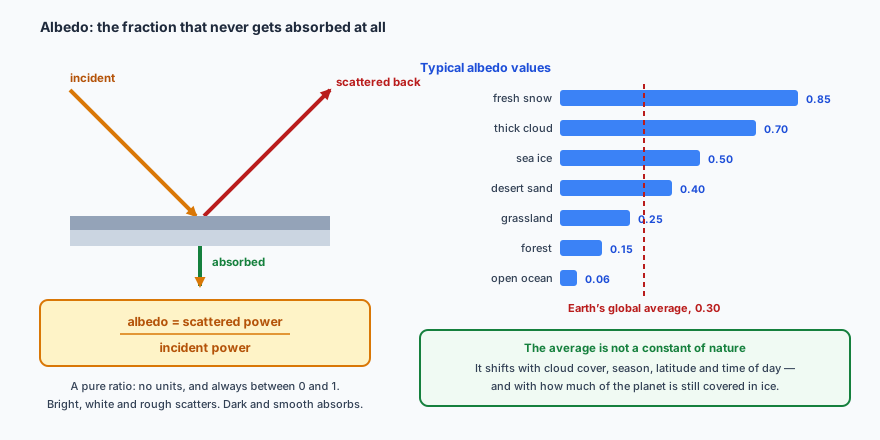
A planet’s overall albedo therefore changes with the seasons, the latitude, the time of day and above all the cloud cover. Roughly 0.30 of the sunlight arriving at the Earth is scattered back to space, so the absorbed intensity is
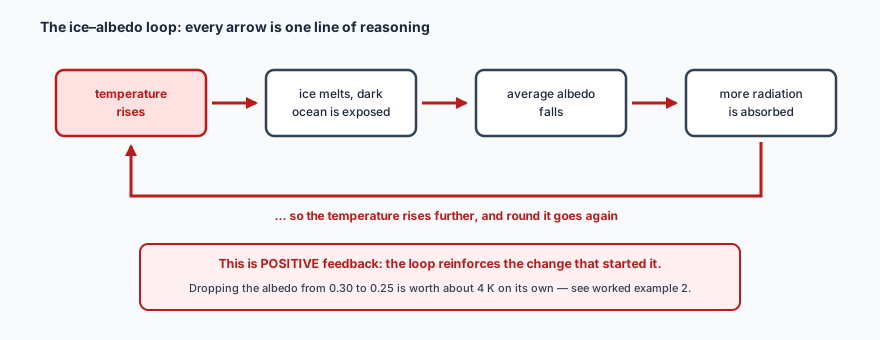
Because ice is bright and water is dark, albedo is also the mechanism behind one of the clearest positive feedback loops in the climate system.
⬜Emissivity: real bodies are not black bodies
B.1 treated everything as a perfect black body. Real surfaces radiate less than that. The emissivity \(e\) of a body is the ratio of the power it radiates to the power a black body at the same temperature would radiate:
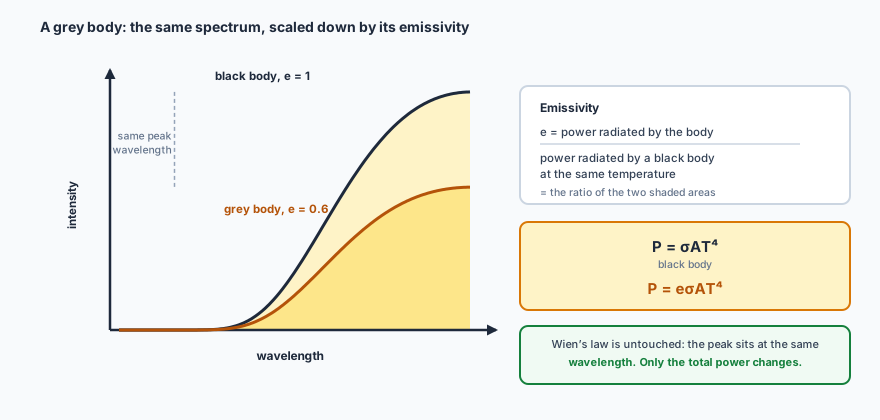
Stefan’s law then picks up one extra factor:
A black body has \( e = 1 \) by definition; every real surface is a grey body with \( e < 1 \). The Earth’s effective emissivity, treating the whole planet as one radiating surface at its mean surface temperature of 288 K, works out at about 0.61 — and that number is not an input to the model below, it is a measure of how much the atmosphere holds back.
⚖️The energy balance model of a planet
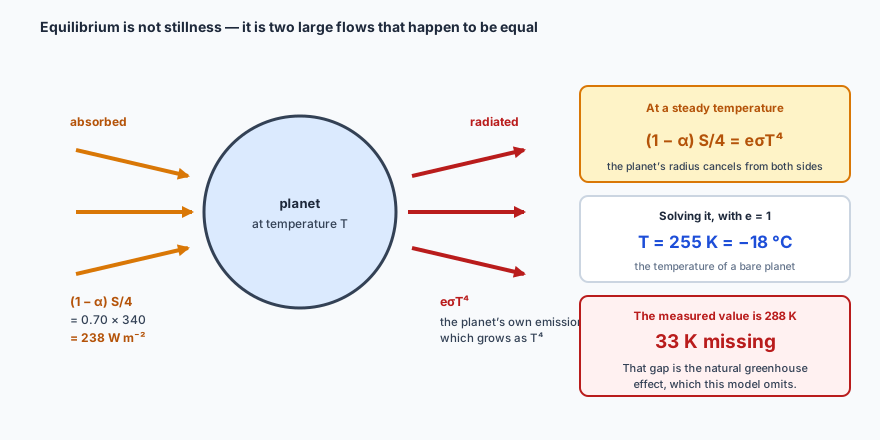
A planet at a steady temperature must be radiating exactly as fast as it absorbs. That single sentence is the whole model:
✏️Worked example 1 — the temperature of a bare planet
Write both sides for the whole planet before cancelling anything.
Setting them equal, \( \pi r^{2} \) cancels from both sides — the planet’s size is irrelevant, which is a satisfying result in its own right. That leaves
✏️Worked example 2 — how much does albedo matter?
🌐Where the energy actually goes
The two-arrow model is enough to pass an exam question, but it hides the fact that the surface and the atmosphere are two separate systems, each of which must balance on its own. Following the flows makes the greenhouse mechanism visible before any molecules are mentioned.
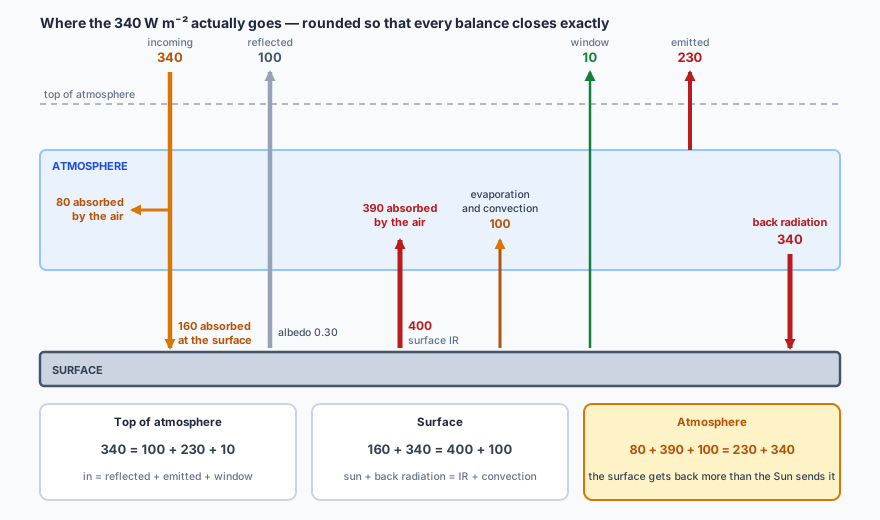
Three checks, and they all have to work:
The surface is warm not because sunlight is intense — only 160 W m\(^{-2}\) of it gets down there — but because it sits under an atmosphere that returns 340 W m\(^{-2}\) to it. Remove the greenhouse gases and that return flow largely disappears.
🔬Why greenhouse gases, and not the rest of the air
The atmosphere is 78% nitrogen and 21% oxygen, and neither absorbs infrared to any useful degree. Both are diatomic molecules made of two identical atoms: the charge is distributed symmetrically, the molecule has no dipole moment, and a vibration cannot change one. An electromagnetic wave has nothing to push on.
The greenhouse gases — water vapour, carbon dioxide, methane and nitrous oxide — are different. Their molecules can vibrate in ways that change the distribution of charge, so the oscillating electric field of a passing wave can drive them. And crucially, the natural frequencies of those vibrations lie in the infrared.
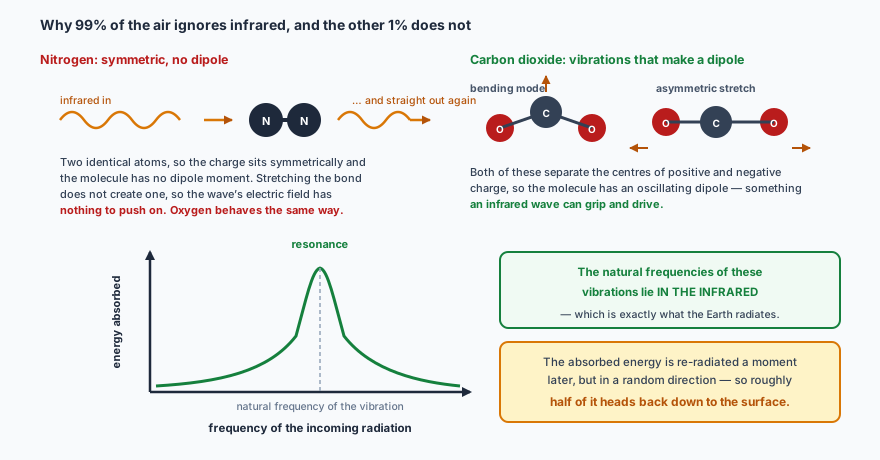
So an infrared photon of the right frequency drives a greenhouse-gas molecule at resonance, is strongly absorbed, and the energy is re-radiated a moment later — but in a random direction. Roughly half of it heads back down. That is the whole mechanism.
🔭The open window and the closed one
The mechanism only matters because the radiation going out is at completely different wavelengths from the radiation coming in, and Wien’s law says why.
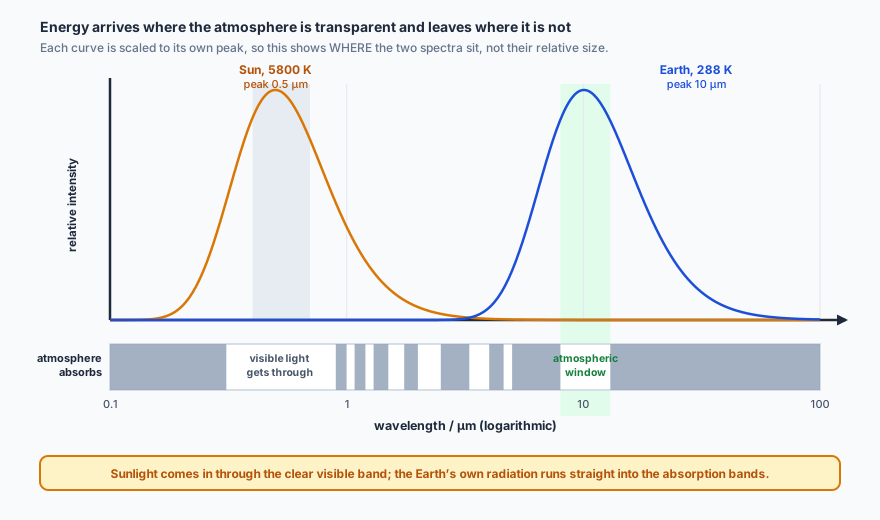
Sunlight arrives mostly as visible light, and the atmosphere is largely transparent there, so it reaches the ground and warms it. The warmed ground re-radiates at around 10 µm — right where carbon dioxide and water vapour absorb. Energy comes in through an open window and has to leave through a closed one. The narrow gap between about 8 and 13 µm where the atmosphere is reasonably transparent is called the atmospheric window, and it is the 10 W m\(^{-2}\) that escapes directly in the budget above.
🏭The gases, and natural versus enhanced
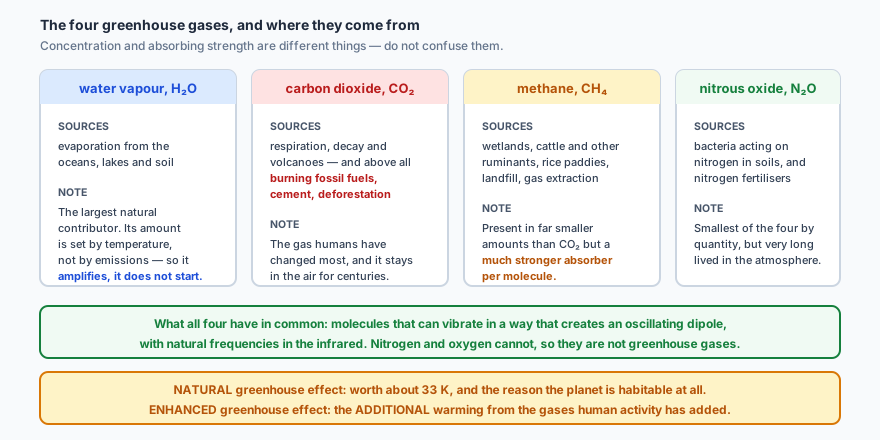
Keep the two effects distinct, because examiners test the distinction directly:
- The natural greenhouse effect is not a problem — it is the reason the planet is habitable. Without it the mean surface temperature would be the 255 K calculated above rather than 288 K, and the oceans would be ice.
- The enhanced greenhouse effect is the additional warming caused by the greenhouse gases human activity has added, principally carbon dioxide from burning fossil fuels. It shifts the balance point, so the planet settles at a higher temperature.
🔭See it happen
PhET — The Greenhouse Effect simulation. Add and remove greenhouse gases and watch the surface temperature follow. The version with the photon view is the useful one: you can watch infrared photons leave the ground, get absorbed, and come back down, which is the step most written answers skip.
📝Practise
Work through these, then reveal the answer. Each question targets a different objective from the list above.
1. The solar constant at Earth is 1360 W m\(^{-2}\). Mars orbits at 1.52 AU. Find the intensity of sunlight at Mars.
2. Explain why the average intensity of solar radiation over a planet’s whole surface is a quarter of the solar constant.
3. A planet receives an average 340 W m\(^{-2}\) over its whole surface and has an albedo of 0.45. Find the intensity it absorbs, and its equilibrium temperature if it behaves as a black body.
4. A body of surface area 2.0 m\(^{2}\) at 350 K has an emissivity of 0.40. Find the power it radiates.
5. Explain why nitrogen and oxygen, which make up 99% of the atmosphere, are not greenhouse gases.
6. Explain why the atmosphere is transparent to incoming solar radiation but not to outgoing radiation from the surface.
7. State the difference between the natural and the enhanced greenhouse effect.
8. Describe the ice–albedo feedback loop and say whether it is positive or negative feedback.
9. In the energy budget, the surface emits about 400 W m\(^{-2}\) but only receives about 160 W m\(^{-2}\) directly from the Sun. Explain how this is possible without violating conservation of energy.
10. A planet with no atmosphere has an albedo of 0.12 and receives a solar constant of 2600 W m\(^{-2}\). Estimate its mean surface temperature.
🔗Go deeper — other people’s work
These are external resources, not mine. If one stops working, tell me and everything above it on this page still stands.
- NASA Earth Observatory — the Earth’s energy budget
- HyperPhysics — greenhouse effect and atmospheric absorption
- PhET — The Greenhouse Effect