Thermal energy transfers
Theme A treated objects as points with a mass. Theme B opens them up. Every idea on this page comes from one shift of viewpoint: a block of metal is not a smooth solid thing but about \(10^{25}\) molecules, each with its own kinetic energy and each pulled on by its neighbours. Temperature, heat, specific heat capacity, melting, boiling, conduction and even the glow of a star all turn out to be statements about those molecules — and once you can move between the macroscopic and the microscopic description of the same event, the whole topic is one story rather than eight formulas.
🎯What you need to be able to do
- Describe solids, liquids and gases in terms of molecular spacing, motion and intermolecular forces, and use \( \rho = m/V \).
- Explain thermal equilibrium and the direction of thermal energy transfer, and convert between Celsius and kelvin.
- Distinguish temperature, internal energy and thermal energy, and say what each one is a measure of.
- Use \( Q = mc\Delta T \) for heating and \( Q = mL \) for a change of phase, including multi-stage problems.
- Explain why the temperature stays constant during a change of phase.
- Describe the electrical and mixtures methods of measuring \(c\) and \(L\), and their main sources of error.
- Describe conduction, convection and radiation, and say which of them needs a medium.
- Use \( \dfrac{\Delta Q}{\Delta t} = kA\dfrac{\Delta T}{\Delta x} \), including two materials in series at steady state.
- Use the Stefan–Boltzmann law \( P = \sigma A T^{4} \) and Wien’s displacement law \( \lambda_{\max}T = 2.9 \times 10^{-3} \) m K.
- Distinguish luminosity from apparent brightness and use \( b = \dfrac{L}{4\pi d^{2}} \).
🌡️Temperature, thermal equilibrium and the Kelvin scale
Hot and cold are labels for a direction, not for a substance. Put two objects in thermal contact and thermal energy flows, every time, from the hotter to the colder. The temperature of each object is what decides which way: energy runs “down” the temperature difference. Eventually the two arrive at the same temperature, the flow stops, and they are said to be in thermal equilibrium.
Nothing material has moved. Heat is not a fluid that leaks out of hot things — it is the name we give to a transfer of energy between a system and its surroundings that happens because of a temperature difference. That is why it makes no sense to ask how much heat an object contains: an object contains internal energy, and heat is one of the two ways of changing it.
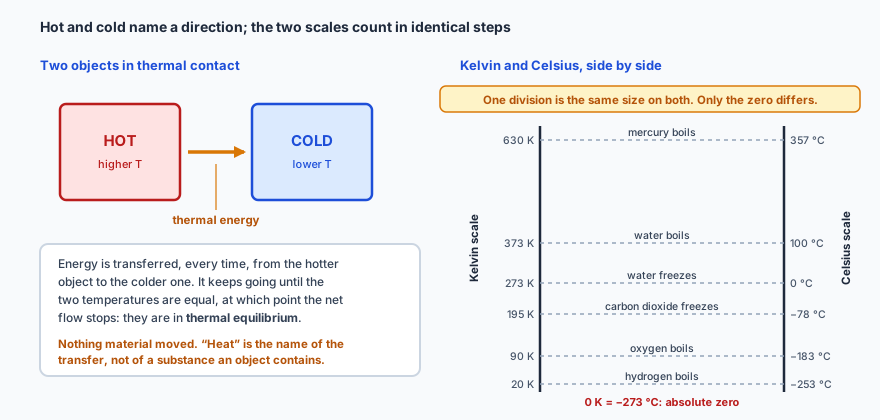
Two temperature scales matter. Everyday thermometers are marked in degrees Celsius; physics is done in kelvin, the absolute thermodynamic scale:
The divisions are deliberately the same size, so a temperature change of 1 °C is a change of 1 K exactly. What differs is where zero sits. Zero on the Kelvin scale, absolute zero, is the temperature at which molecular motion is as small as it can be; there is no colder temperature to have, which is precisely what makes the scale absolute. And because the average random kinetic energy of a molecule turns out to be proportional to the absolute temperature,
(derived from the kinetic model in B.3), kelvin is the only scale on which “twice as hot” means anything at all.
🧪Kinetic theory: solids, liquids and gases
According to kinetic theory, the molecules of any substance are in constant random motion, and the three phases differ only in how tightly they are held.
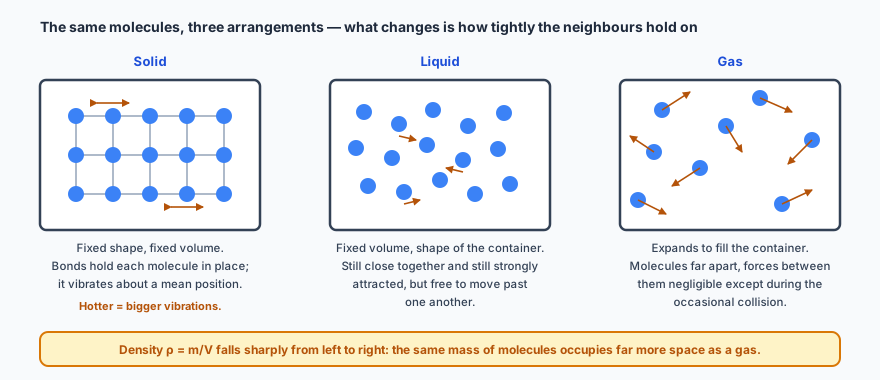
Solids have a fixed volume and a fixed shape because the molecules are held in position by bonds. The bonds are not rigid: each molecule vibrates about a mean position, and the higher the temperature the larger those vibrations.
Liquids have a fixed volume but take the shape of their container. The molecules are still close together with strong forces between them, but they are no longer locked in place — they can move around each other.
Gases expand to fill whatever they are put in. The molecules are far apart, the forces between them are so weak that they are essentially independent, and they interact only in occasional collisions. This is the picture B.3 turns into the gas laws.
The macroscopic quantity that tracks this packing is density, the mass per unit volume:
🔬Internal energy: kinetic plus potential
When you analyse anything physical you have a choice of viewpoint. The macroscopic view treats the system as a whole and asks how it interacts with its surroundings. The microscopic view goes inside and asks what the component molecules are doing. Temperature is a macroscopic measurement; internal energy is the microscopic total behind it.
Molecules carry energy in two forms, and both count:
- Kinetic energy, because they are moving — translating through space, and for a molecule made of several atoms, rotating as well.
- Potential energy, because of the intermolecular forces. Pulling two molecules further apart means working against the force that attracts them, exactly as lifting a mass works against gravity, so their separation stores energy.
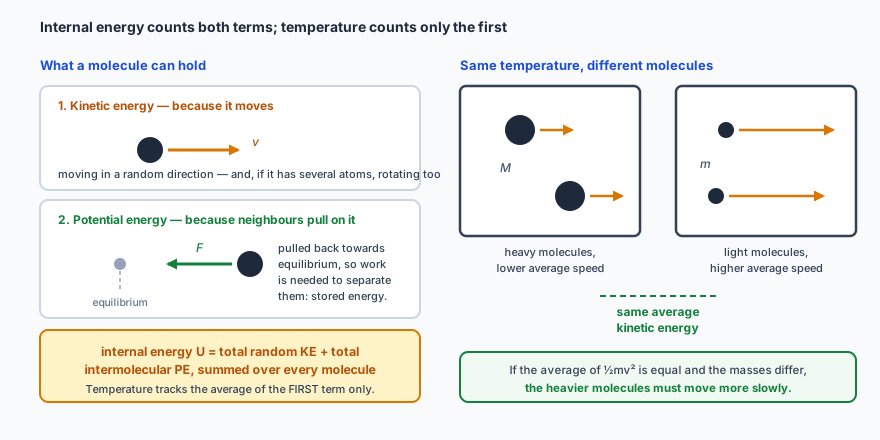
The total of all that random molecular kinetic energy plus all that intermolecular potential energy is the internal energy \(U\) of the substance. Heat a substance and you raise its internal energy.
Temperature is narrower. Temperature is a measure of the average random kinetic energy of the molecules — the potential term does not appear in it. That single sentence is the reason a change of phase has a flat plateau, and it is the reason two substances at the same temperature have the same average molecular kinetic energy even when one is made of much heavier molecules. If the masses differ and the average \( \frac{1}{2}mv^{2} \) is equal, the heavier molecules must be moving more slowly.
⚖️Heat and work: the two ways energy gets in
There are exactly two ways to change the internal energy of a system, and they are distinguished by scale, not by how much energy is involved.
Work is the macroscopic transfer: a force moves through a distance, or a power supply drives a current through a heater for a time. You can point at the thing that moved.
Heating is the microscopic transfer: energy passes because the molecules on one side are on average more energetic than those on the other, and collisions even the score. Nothing you can see has to move at all.
In both cases energy is transferred, and in both cases it can end up as molecular kinetic energy, molecular potential energy, or both. Keeping the two words straight is what makes B.4’s first law, \( Q = \Delta U + W \), readable rather than mysterious. It is also why “heat rises” is a sentence to avoid in an exam: hot fluid rises, and the transfer of thermal energy that results is upwards, but heat itself is not a thing that can go anywhere.
🔥Specific heat capacity
Give the same amount of energy to two different objects and they will not warm by the same amount. The temperature rise depends on the energy supplied \(Q\), the mass \(m\), and what the object is made of.
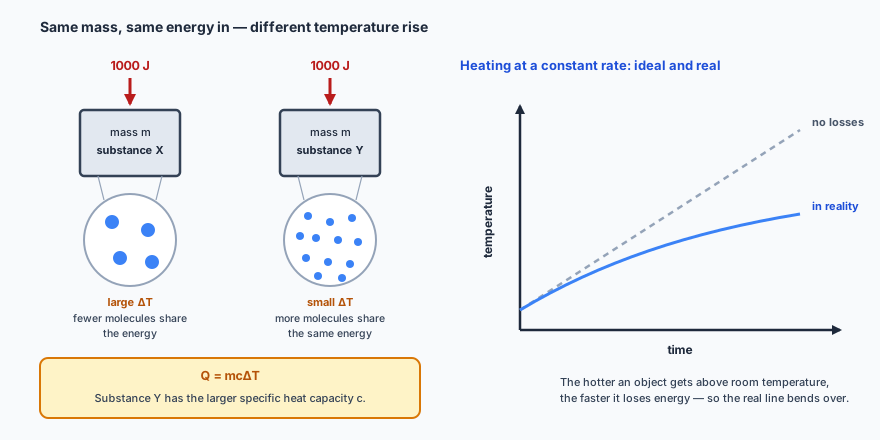
The thermal capacity \(C\) of a particular object is the energy needed to raise that object by 1 K. Divide it by the mass and you get a property of the material instead of a property of the lump: the specific heat capacity \(c\), the energy needed to raise 1 kg of the substance by 1 K. “Specific” here just means “per unit mass”.
Water’s specific heat capacity, about 4200 J kg\(^{-1}\) K\(^{-1}\), is unusually large. That is why coastal climates are milder than inland ones, why water is the coolant of choice in engines and power stations, and why a hot-water bottle stays useful for hours.
Two cautions the guide is careful about. First, these equations concern the temperature difference, so it takes the same energy to go from 25 °C to 35 °C as from 402 °C to 412 °C — provided no energy escapes. Second, a real object raised above room temperature starts losing energy to its surroundings, and loses it faster the hotter it gets, which is why a real heating graph bends away from the straight line an ideal one would follow.
Measuring \(c\)
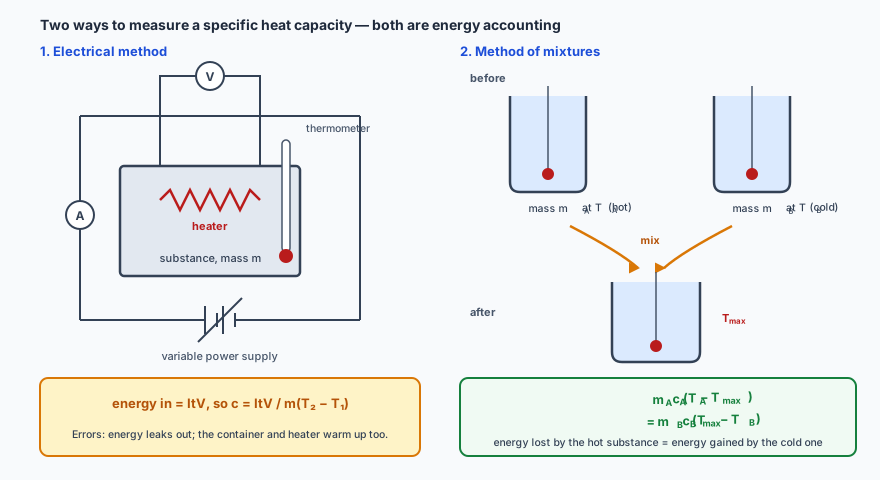
1. The electrical method. An immersion heater of known current and voltage runs for a measured time inside the substance, so the energy delivered is \( ItV \):
Sources of error: thermal energy leaks from the apparatus, the container and the heater themselves get warmed, and it takes time for the energy to spread evenly through the substance so the thermometer may not read the average.
2. The method of mixtures. If you already know the specific heat capacity of one substance you can find another’s. Measure the two masses and the two starting temperatures, mix, and record the maximum temperature reached. If no energy escapes,
— energy lost by the hot substance equals energy gained by the cold one. The dominant error is again the energy lost to the surroundings, particularly while the liquids are being transferred, and a more careful treatment also allows for the container changing temperature.
✏️Worked example 1 — a multi-stage heating problem
Break the journey into stages at every point where the physics changes, and never skip the plateau.
- Warm the ice from −15 °C to 0 °C: \( Q = 0.30 \times 2100 \times 15 = 9450 \) J.
- Melt it at 0 °C: \( Q = 0.30 \times 3.34 \times 10^{5} = 100200 \) J.
- Warm the water from 0 °C to 25 °C: \( Q = 0.30 \times 4200 \times 25 = 31500 \) J.
🧊Phase change and specific latent heat
When a substance changes phase its temperature stays constant even though thermal energy is still pouring in. The energy involved is called latent heat — latent meaning hidden, because no thermometer registers it. Solid to liquid is fusion, liquid to gas is vaporization, and gas to liquid is condensing.
The specific latent heat \(L\) of a substance is the energy per unit mass absorbed or released during a change of phase:
Notice what is not in that equation: there is no \( \Delta T \), because there is no \( \Delta T \).
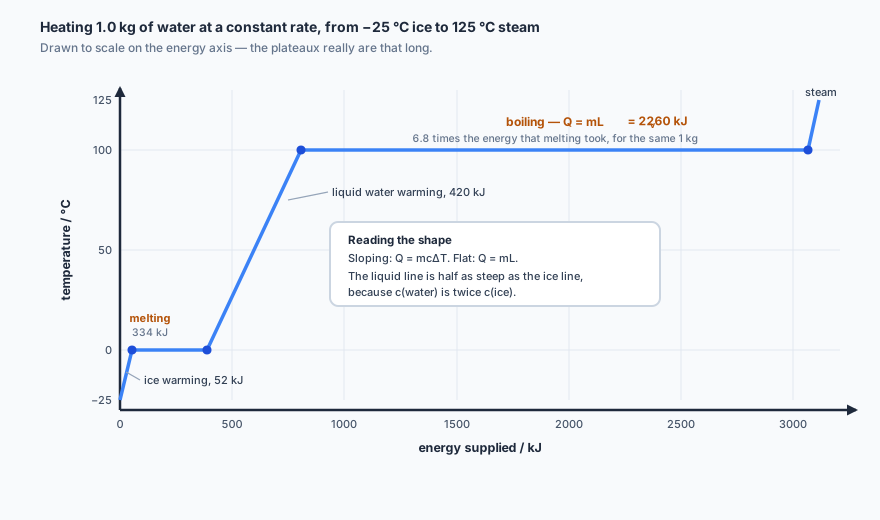
Why the thermometer stalls. The energy supplied during a phase change does not increase the molecules’ kinetic energy. It increases their potential energy: intermolecular bonds are being broken, and separating molecules against their mutual attraction costs energy. Since temperature measures average kinetic energy, and that is unchanged, the reading holds still. Run the process backwards and the same logic gives the energy back: when a substance freezes, bonds form and energy is released.
For water, \( L_f = 3.34 \times 10^{5} \) J kg\(^{-1}\) and \( L_v = 2.26 \times 10^{6} \) J kg\(^{-1}\) — vaporization costs about seven times more than fusion, which makes sense: melting only loosens the molecules’ grip on each other, while boiling separates them completely.
Measuring \(L\)
Both methods mirror the specific-heat ones. For vaporization, an electrical heater boils water already at 100 °C and the mass vaporized is measured by weighing, so \( L_v = \dfrac{ItV}{m_1 - m_2} \); the errors are thermal losses from the apparatus and vapour escaping before and after the timing. For fusion, ice at 0 °C is added to warm water of known mass and temperature, and the final mixture temperature recorded:
Read the right-hand side as two jobs the energy has to do: melt the ice, then warm the melt-water up from 0 °C to the final temperature. If the ice did not start at exactly 0 °C there is a third term. Water clinging to the ice as it is transferred is the other classic error.
🔄Conduction, convection and radiation
Thermal energy gets from a hot object to a cold one by three processes, and most real situations involve more than one of them at once. A fourth, evaporation, cools a liquid by letting its faster-moving molecules leave the surface below the boiling point.
Conduction
In conduction, thermal energy travels through a substance with no bulk movement of the substance itself: kinetic energy is passed from molecule to molecule by collisions, the faster ones at the hot end handing energy to their slower neighbours. Put one end of a metal spoon in hot tea and the other end warms without anything visibly moving.
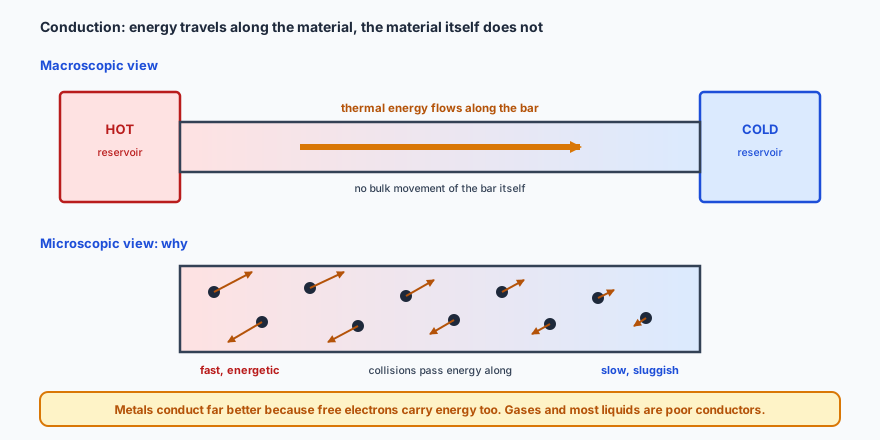
Poor conductors are called thermal insulators. Metals are very good conductors because a second mechanism is available to them — free conduction electrons move through the lattice and carry energy far faster than vibrations alone could. Gases, and most liquids, are poor conductors.
This explains a set of everyday observations that make good exam contexts. Clothes keep you warm by trapping layers of air, a poor conductor. A tiled floor feels colder underfoot than a carpet at the same temperature, because the tile conducts energy away from your skin faster. A vacuum flask attacks all three processes at once: a partial vacuum between double glass walls to stop conduction and convection, silvered surfaces to reduce radiation, an insulating spacer and a cork stopper to block the remaining paths.
Convection
In convection, energy moves because matter moves in bulk, so it can only happen in a fluid — a liquid or a gas, never a solid. Heat part of a fluid and it expands, so its density falls, so it rises; colder denser fluid sinks to take its place, and the loop that results is a convection current.
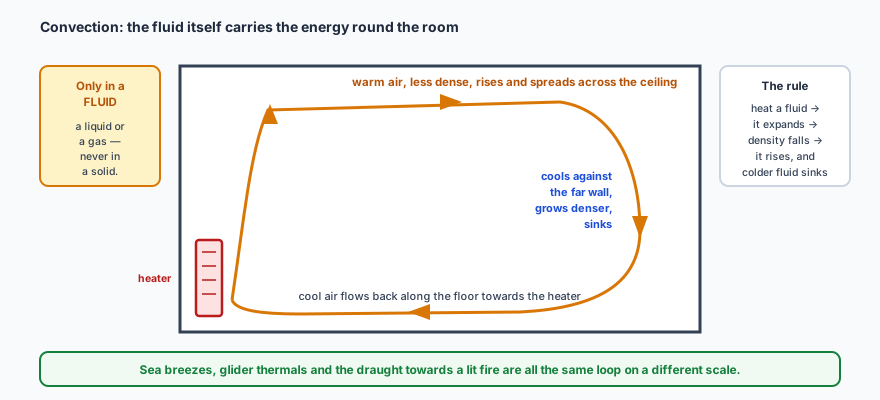
Glider pilots and soaring birds ride naturally occurring convection currents. Sea breezes are convection on a large scale: by day the land is hotter than the sea, air rises above it, and the breeze blows in from the water; at night the flow reverses.
Radiation
In radiation, no matter is involved at all. Every object above absolute zero radiates electromagnetic waves, and for everyday temperatures those waves are mostly in the infrared. This is the only mechanism that works through a vacuum, which is the only reason the Sun’s energy reaches us. The rest of this page is about what that radiation looks like.
📏Thermal conductivity: putting numbers on conduction
Specific heat capacity answers “how much energy does this substance absorb for a given temperature rise?” A completely different question is “how fast does thermal energy travel through it?” That property is the thermal conductivity \(k\).
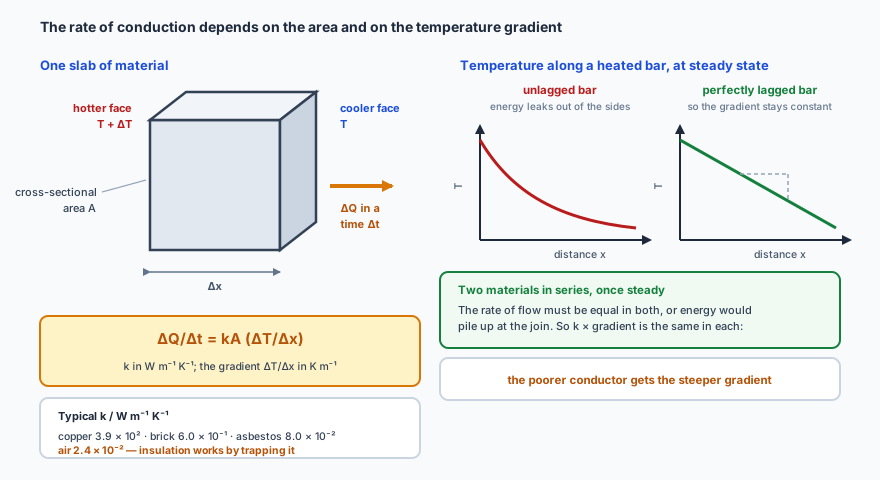
Experiment shows that for small temperature differences the rate of energy flow is proportional to the area and to the temperature gradient:
Strictly the right-hand side should carry a minus sign, because energy flows from hot to cold so \(T\) falls as \(x\) increases. The data booklet omits it, and so does this page; just remember that the sign is bookkeeping, not physics.
The spread of values of \(k\) is enormous, which is why insulation works at all:
Copper conducts roughly sixteen thousand times better than still air — and note that most insulating materials work by trapping air rather than by being remarkable themselves.
Two materials in series. When thermal energy flows through one material and then another, then once steady state has been reached the rate of flow must be the same in both — otherwise energy would be piling up at the join. With a common area \(A\), that gives
and one immediate consequence worth remembering: the temperature gradient is steeper across the poorer conductor. The material that resists the flow is the one that has to develop a big temperature difference to push the same energy through.
✏️Worked example 2 — a compound rod at steady state
Silver, at 420 W m\(^{-1}\) K\(^{-1}\), is the better conductor by a factor of about 4.6. The rod is lagged, so no energy leaves through the sides and the rate of flow is the same in both halves. Convert everything first: \( A = 5.0 \times 10^{-6} \) m\(^{2}\), \( x_{\text{Ag}} = 0.30 \) m, \( x_{\text{Ni}} = 0.12 \) m.
Let the join sit at \(T\). Energy enters through the nickel and leaves through the silver at the same rate:
Now put that back into either side, with the area included:
⬤Black-body radiation: Stefan–Boltzmann and Wien
The radiation a hot object gives out depends on many things, so physics models the ideal case first. A black body is a perfect emitter of radiation, and also a perfect absorber — a black object absorbs all the light falling on it, which is where the name comes from. Its radiation does not depend on what it is made of. It depends on one thing only: its absolute temperature.
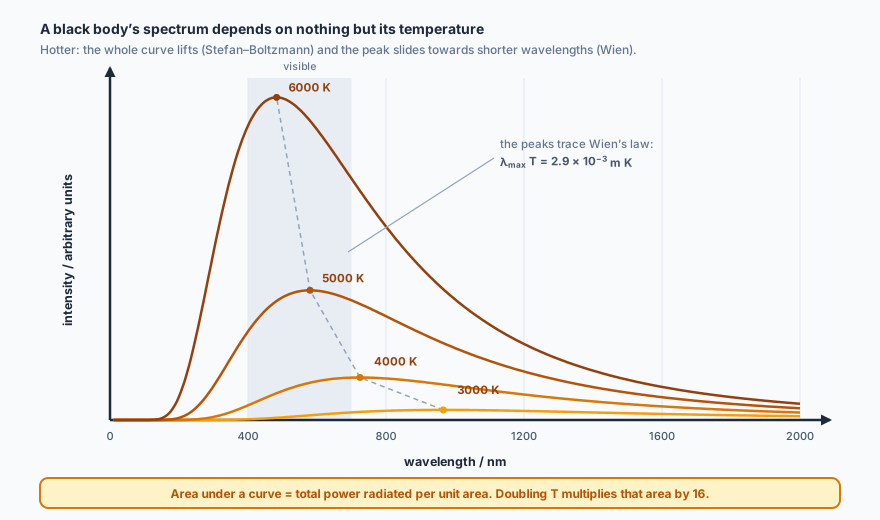
The Stefan–Boltzmann law gives the total power radiated, which is the area under the curve:
where \(A\) is the surface area in m\(^{2}\) and \(T\) the absolute temperature in K. The fourth power does a great deal of work: double the absolute temperature and the object radiates sixteen times as much.
Wien’s displacement law gives the wavelength at which the emitted intensity peaks:
with \( \lambda_{\max} \) in metres and \(T\) in kelvin. This is why a heated metal glows dull red, then orange, then white as it gets hotter, and why blue stars are hotter than red ones. Cool objects — you, this room, a planet — peak in the infrared, which is invisible but perfectly real.
Three consequences worth stating in words, because they are frequently asked for:
- A good radiator is also a good absorber. Dark, rough surfaces are good at both; light, smooth, shiny surfaces are poor at both.
- An object at constant temperature is absorbing and radiating at exactly the same rate. It is not doing nothing — it is doing two things that cancel.
- Raise the temperature and both the frequency of the peak and the total rate of radiation increase.
✏️Worked example 3 — the total power radiated by the Sun
Treat it as a sphere and as a black body. First the surface area:
Then Wien’s law for the peak:
✨Luminosity and apparent brightness
The total power radiated by a star is its luminosity \(L\), measured in watts — exactly the \( P = \sigma AT^{4} \) just calculated. That is a property of the star alone.
What an observer on Earth actually receives is quite different. The power spreads out over a sphere that grows as it travels, so the power arriving per unit area — the apparent brightness \(b\), in W m\(^{-2}\) — falls off as the inverse square of the distance:
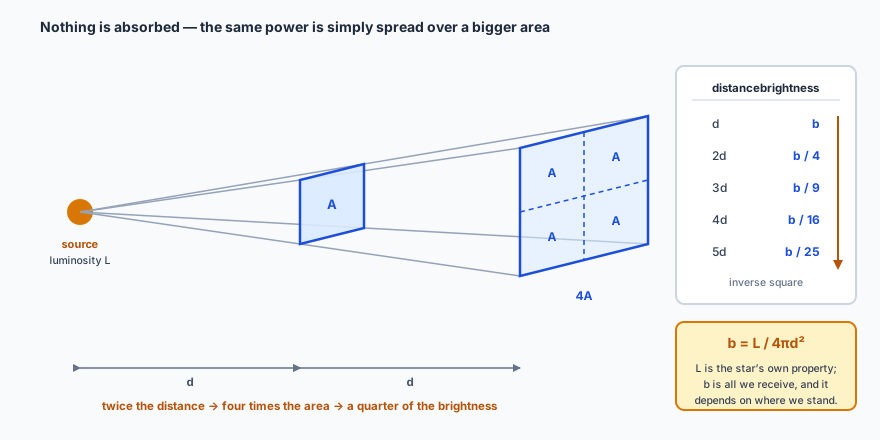
The consequence is that apparent brightness alone tells you nothing about a star. A faint-looking star may be a dim one nearby or a monstrous one far away; two stars of wildly different luminosity can look identical from Earth. Only when the distance is known independently can brightness be converted into luminosity — and only then can \( L = \sigma AT^{4} \) be turned around to give the star’s surface area.
That is the chain of reasoning behind almost everything known about stars. From a star’s spectrum you get its surface temperature, using Wien’s law on the peak, and its composition, from the dark absorption lines where particular elements in its outer layers have removed particular wavelengths. Add a distance and the apparent brightness gives the luminosity; add the temperature and the Stefan–Boltzmann law gives the size. E.5 takes this further.
✏️Worked example 4 — how much of that reaches us
So a square metre facing the Sun receives about 1.4 kW.
🔭See it happen
PhET, States of Matter: Basics. Heat the solid and watch the temperature readout stall while the molecules visibly break out of their lattice. It is the graph plateau and the molecular explanation shown as the same event, which is exactly the link the exam question is testing. Then switch to PhET, Blackbody Spectrum and drag the temperature slider: the curve lifts and its peak slides left, and the visible band lights up only once you get near stellar temperatures.
📝Practise
Work through these, then reveal the answer. Each question targets a different objective from the list above.
1. How much energy is needed to raise the temperature of 2.0 kg of water from 20 °C to 80 °C? Take \( c = 4200 \) J kg\(^{-1}\) K\(^{-1}\).
2. 0.50 kg of water at 80 °C is mixed with 0.50 kg of water at 20 °C in an insulated container. Find the final temperature.
3. Explain why the temperature of a substance stays constant while it melts, even though energy is still being supplied.
4. The specific latent heat of vaporization of water is 2300 kJ kg\(^{-1}\). How long would a 2.6 kW kettle containing 600 g of boiling water take to boil it all away?
5. A sheet of insulating material is 3.0 mm thick. The temperature drop across it is 100 K and the rate of flow of thermal energy through each square metre is 800 W. Find the thermal conductivity.
6. A room is kept at 19 °C while it is 1 °C outside. The windows have a total area of 6.0 m\(^{2}\), a thickness of 4.0 mm and \( k = 0.8 \) W m\(^{-1}\) K\(^{-1}\). Estimate the power needed to make up the loss through the glass, and say whether this is likely to be an over- or an underestimate.
7. A cylindrical lagged rod is made of two materials in series. Explain why, at steady state, the temperature gradient is steeper in the poorer conductor.
8. A lamp filament of surface area \( 5.0 \times 10^{-5} \) m\(^{2}\) reaches 2500 K. Treating it as a black body with \( \sigma = 5.67 \times 10^{-8} \) W m\(^{-2}\) K\(^{-4}\), find the power it radiates.
9. A star’s spectrum peaks at 480 nm. Find its surface temperature. A second star has the same apparent brightness but is 10 times further away — compare their luminosities.
10. Estimate the mean kinetic energy of an atom of argon in a sample of the gas at room temperature.
🔗Go deeper — other people’s work
These are external resources, not mine. If one stops working, tell me and everything above it on this page still stands.
- The Physics Hypertextbook — thermal properties of matter
- HyperPhysics — heat transfer and blackbody radiation
- PhET — States of Matter: Basics, and Blackbody Spectrum